## Diagram: Causal Relationships in Political Belief, Labor Union Activism, and Job Hiring
### Overview
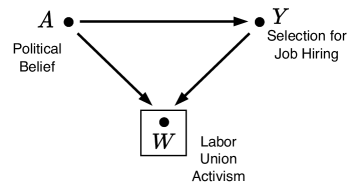
The diagram illustrates a causal network with three nodes (A, Y, W) and directional arrows representing relationships. Node A ("Political Belief") influences both Node Y ("Selection for Job Hiring") and Node W ("Labor Union Activism"). Node W also influences Node Y, creating a feedback loop. The diagram uses black arrows and nodes with no numerical data or color coding.
### Components/Axes
- **Nodes**:
- **A**: Labeled "Political Belief" (leftmost node).
- **Y**: Labeled "Selection for Job Hiring" (rightmost node).
- **W**: Labeled "Labor Union Activism" (central node, enclosed in a square).
- **Arrows**:
- **A → Y**: Direct influence from Political Belief to Job Hiring.
- **A → W**: Direct influence from Political Belief to Labor Union Activism.
- **W → Y**: Feedback influence from Labor Union Activism to Job Hiring.
- **No legends, scales, or numerical data** are present.
### Detailed Analysis
- **Political Belief (A)** is the primary driver, affecting both **Job Hiring (Y)** and **Labor Union Activism (W)**.
- **Labor Union Activism (W)** acts as an intermediary, amplifying or modifying the relationship between Political Belief and Job Hiring.
- The diagram suggests a **mediated causal pathway**: Political Belief → Labor Union Activism → Job Hiring, alongside a direct Political Belief → Job Hiring link.
### Key Observations
- The feedback loop (W → Y) implies that Labor Union Activism can reinforce or counteract the effects of Political Belief on Job Hiring.
- No quantitative values or thresholds are provided, limiting precise measurement of influence strength.
- The diagram emphasizes **directionality** (unidirectional arrows) rather than bidirectional relationships.
### Interpretation
This diagram highlights how **Political Belief** shapes outcomes through two pathways: directly influencing **Job Hiring** and indirectly via **Labor Union Activism**. The feedback loop suggests that union activism may mediate or alter the impact of political beliefs on hiring practices. For example, strong union activism could either amplify (e.g., through collective bargaining) or dampen (e.g., through resistance to biased practices) the effects of political beliefs on hiring. The absence of numerical data prevents quantification but underscores the conceptual interplay between these factors. The structure aligns with theories of **mediated causality** in social sciences, where intermediate variables (like union activism) moderate direct relationships.