## Diagram: Causal Diagram of Job Hiring
### Overview
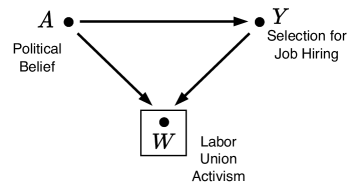
The image is a causal diagram illustrating the relationships between political belief (A), labor union activism (W), and selection for job hiring (Y). The diagram uses arrows to indicate the direction of causal influence.
### Components/Axes
* **Nodes:**
* A: Political Belief
* W: Labor Union Activism (represented by a square node)
* Y: Selection for Job Hiring
* **Edges (Arrows):**
* A -> Y: Political Belief influences Selection for Job Hiring
* A -> W: Political Belief influences Labor Union Activism
* W -> Y: Labor Union Activism influences Selection for Job Hiring
### Detailed Analysis
The diagram shows that political belief (A) directly influences selection for job hiring (Y). Additionally, political belief (A) also influences labor union activism (W), which in turn influences selection for job hiring (Y). The square node for W indicates that it is a collider variable.
### Key Observations
* Political belief has both a direct and indirect effect on job hiring.
* Labor union activism acts as a mediator between political belief and job hiring.
* Labor union activism is a collider variable.
### Interpretation
The diagram suggests that political beliefs can influence job hiring decisions both directly and indirectly through their impact on labor union activism. The fact that labor union activism is a collider means that conditioning on it (e.g., controlling for it in a statistical analysis) can induce a spurious association between political belief and job hiring. This diagram is useful for understanding potential confounding and mediation effects in the relationship between political beliefs and job hiring outcomes.