\n
## Diagram: Causal Relationship Model
### Overview
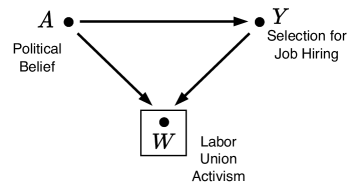
The image depicts a causal relationship diagram with three variables: Political Belief (A), Selection for Job Hiring (Y), and Labor Union Activism (W). Arrows indicate the direction of influence between these variables.
### Components/Axes
The diagram consists of three labeled nodes represented by circles:
* **A:** Political Belief - positioned on the top-left.
* **Y:** Selection for Job Hiring - positioned on the top-right.
* **W:** Labor Union Activism - positioned at the bottom-center.
Arrows connect these nodes, indicating causal relationships. The arrows are bidirectional between A and W, and unidirectional from A to Y and from W to Y.
### Detailed Analysis or Content Details
* **A -> Y:** An arrow points from "Political Belief" (A) to "Selection for Job Hiring" (Y). This suggests that political belief influences job hiring selection.
* **A <-> W:** A bidirectional arrow connects "Political Belief" (A) and "Labor Union Activism" (W). This indicates a reciprocal relationship, where political belief influences labor union activism, and vice versa.
* **W -> Y:** An arrow points from "Labor Union Activism" (W) to "Selection for Job Hiring" (Y). This suggests that labor union activism influences job hiring selection.
### Key Observations
The diagram highlights the interconnectedness of political beliefs, labor union activism, and job hiring practices. The bidirectional relationship between political belief and labor union activism suggests a complex interplay between these two factors.
### Interpretation
The diagram suggests a model where political beliefs can directly influence job hiring selections, and also indirectly through their impact on labor union activism. Labor union activism, in turn, also influences job hiring selections. This model could be used to explore potential biases in hiring practices based on political affiliation or union involvement. The reciprocal relationship between political belief and labor union activism suggests that individuals' political views may shape their engagement in union activities, and their involvement in unions may, in turn, reinforce or modify their political beliefs. The diagram does not provide any quantitative data or specific details about the strength or nature of these relationships; it simply illustrates a proposed causal structure.