## Bar Chart: Δ w.r.t. average human rater (%)
### Overview
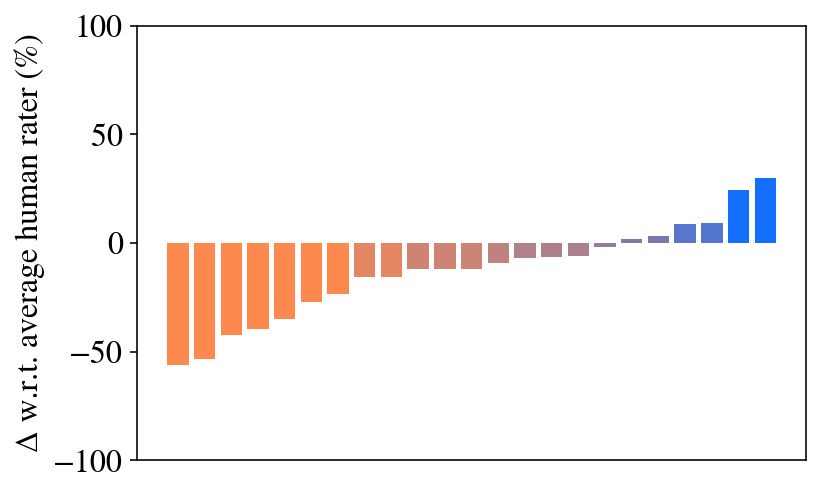
The chart visualizes the difference (Δ) between AI-generated responses and average human ratings, expressed as percentages. Red bars represent negative differences (AI underperformance), while blue bars indicate positive differences (AI outperformance). The x-axis contains partially legible categories, with "Human Rater" explicitly labeled.
### Components/Axes
- **Y-Axis**: Labeled "Δ w.r.t. average human rater (%)" with ticks at -100%, -50%, 0%, 50%, and 100%.
- **X-Axis**: Categories are blurred but include "Human Rater" (leftmost) and other illegible labels.
- **Legend**: Located at the bottom-right, with red for "Negative" and blue for "Positive."
### Detailed Analysis
- **Negative Bars (Red)**:
- Start at approximately -50% for the leftmost category.
- Decrease in magnitude toward the center, reaching ~-100% for the third category.
- Transition to brown bars (possibly intermediate values) before shifting to blue.
- **Positive Bars (Blue)**:
- Begin near 0% on the far right.
- Increase to ~20% for the second-to-last category and ~30% for the rightmost category.
### Key Observations
1. **Gradient of Performance**: The chart shows a clear transition from negative (red/brown) to positive (blue) values, suggesting a spectrum of AI performance relative to humans.
2. **Outliers**: The third category on the left has the largest negative deviation (-100%), while the rightmost category shows the highest positive deviation (~30%).
3. **Ambiguity**: X-axis labels beyond "Human Rater" are unreadable, limiting categorical interpretation.
### Interpretation
The data likely compares AI-generated responses to human benchmarks, highlighting areas where AI underperforms (e.g., bias, accuracy) and outperforms (e.g., efficiency, creativity). The abrupt shift from red to blue suggests a threshold where AI transitions from being worse to better than humans. The -100% value implies a complete failure in at least one metric, while the 30% positive value indicates strong AI superiority in another. Without clearer x-axis labels, the specific categories remain ambiguous, but the trend underscores the duality of AI capabilities.