## Flowchart: Neural Network Compilation Pipeline for TPU
### Overview
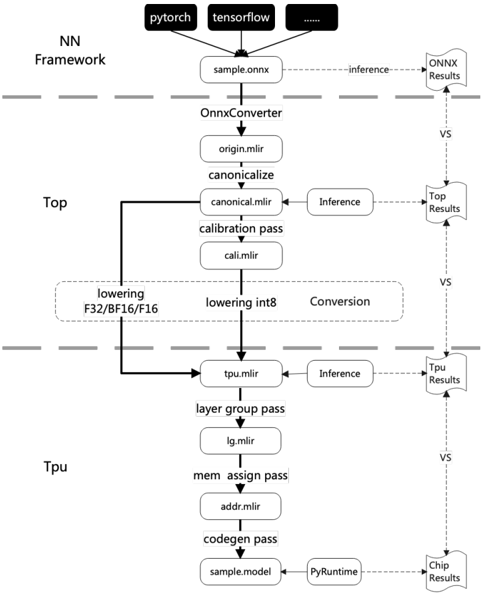
This diagram illustrates a multi-stage compilation pipeline designed to transform neural network models (originating from frameworks like PyTorch or TensorFlow) into a TPU-executable model file (`sample.model`). The process is organized into three distinct horizontal zones: **NN Framework**, **Top** (High-level Intermediate Representation), and **Tpu** (Target Hardware). The diagram also depicts a parallel validation workflow on the right side, where inference results are compared at each stage to ensure model fidelity.
### Components/Axes
The diagram is divided into three horizontal zones separated by dashed lines:
1. **NN Framework (Top Zone):** Represents the source model input.
2. **Top (Middle Zone):** Represents the high-level compiler optimization and calibration phase.
3. **Tpu (Bottom Zone):** Represents the target-specific optimization, memory assignment, and code generation phase.
**Right-hand Column:** A vertical chain of "Results" documents connected by "VS" (versus) labels, indicating a validation/comparison flow.
### Detailed Analysis
#### 1. NN Framework Zone (Top)
* **Inputs:** Three black boxes labeled `pytorch`, `tensorflow`, and `......` (representing other frameworks).
* **Flow:** These converge into a single rounded rectangle: `sample.onnx`.
* **Validation:** A dashed line extends from `sample.onnx` to the right, leading to a document icon labeled `ONNX Results`.
#### 2. Top Zone (Middle)
* **Conversion:** `sample.onnx` flows into `OnnxConverter`, which outputs `origin.mlir`.
* **Optimization:** `origin.mlir` undergoes a `canonicalize` process, resulting in `canonical.mlir`.
* **Validation:** `canonical.mlir` has a dashed line connecting to an `Inference` box, which leads to `Top Results`.
* **Calibration:** `canonical.mlir` flows into a `calibration pass`, resulting in `cali.mlir`.
* **Lowering (Int8):** `cali.mlir` flows into a `lowering int8` process (contained within a dashed box labeled "Conversion").
* **Alternative Path:** A bold arrow labeled `lowering F32/BF16/F16` bypasses the calibration and Int8 lowering steps, connecting `canonical.mlir` directly to `tpu.mlir`.
#### 3. Tpu Zone (Bottom)
* **Target Optimization:** The output from the "Conversion" box (or the alternative path) enters `tpu.mlir`.
* **Validation:** `tpu.mlir` has a dashed line connecting to an `Inference` box, which leads to `Tpu Results`.
* **Sequential Passes:**
* `tpu.mlir` -> `layer group pass` -> `lg.mlir`
* `lg.mlir` -> `mem assign pass` -> `addr.mlir`
* `addr.mlir` -> `codegen pass` -> `sample.model`
* **Final Output:** `sample.model` is the final artifact.
* **Runtime:** `PyRuntime` connects to `sample.model` and leads to the final `Chip Results`.
#### 4. Validation Flow (Right Column)
* The right side contains a vertical stack of document icons: `ONNX Results`, `Top Results`, `Tpu Results`, and `Chip Results`.
* These are connected by dashed lines with the label `VS` between each, indicating that the output of one stage is compared against the previous stage to verify accuracy.
### Key Observations
* **Dual-Path Logic:** The diagram explicitly distinguishes between an Int8 quantization path (which requires a `calibration pass`) and a floating-point path (`F32/BF16/F16`), which bypasses calibration.
* **Validation-Driven Development:** The presence of the "VS" (versus) chain suggests that this pipeline is designed for rigorous regression testing. Every major transformation step (ONNX -> Top -> TPU -> Chip) is validated via inference.
* **MLIR Architecture:** The use of `.mlir` file extensions indicates that this pipeline is built upon the MLIR (Multi-Level Intermediate Representation) compiler infrastructure.
* **Sequential Dependencies:** The bottom section (`Tpu` zone) shows a strict, linear dependency chain: Layer Grouping -> Memory Assignment -> Code Generation.
### Interpretation
This diagram represents a **Compiler Stack for AI Accelerators**.
* **Portability:** By starting with `sample.onnx`, the system ensures it can ingest models from various frameworks (PyTorch, TensorFlow), abstracting away the source-specific complexities.
* **Optimization Strategy:** The pipeline separates "Top" (generic optimizations like canonicalization) from "Tpu" (hardware-specific optimizations like memory assignment and layer grouping). This is a standard compiler design pattern to maximize code reuse.
* **Precision Management:** The "lowering" logic is the most critical decision point in the diagram. The system forces a calibration step for Int8 (likely to determine quantization parameters/scales), whereas it allows a direct path for higher-precision formats (F32/BF16/F16) where calibration is not required.
* **Verification:** The "VS" chain is a "Golden Model" comparison workflow. It implies that the developers of this compiler are highly concerned with numerical stability. If the `Tpu Results` deviate significantly from the `Top Results`, the compiler likely flags an error, ensuring that the optimizations performed (like layer grouping or memory assignment) do not degrade the model's accuracy.