## Diagram: Comparison of Full-Proof vs. Step-Proof Strategies for Formalizing Mathematical Proofs
### Overview
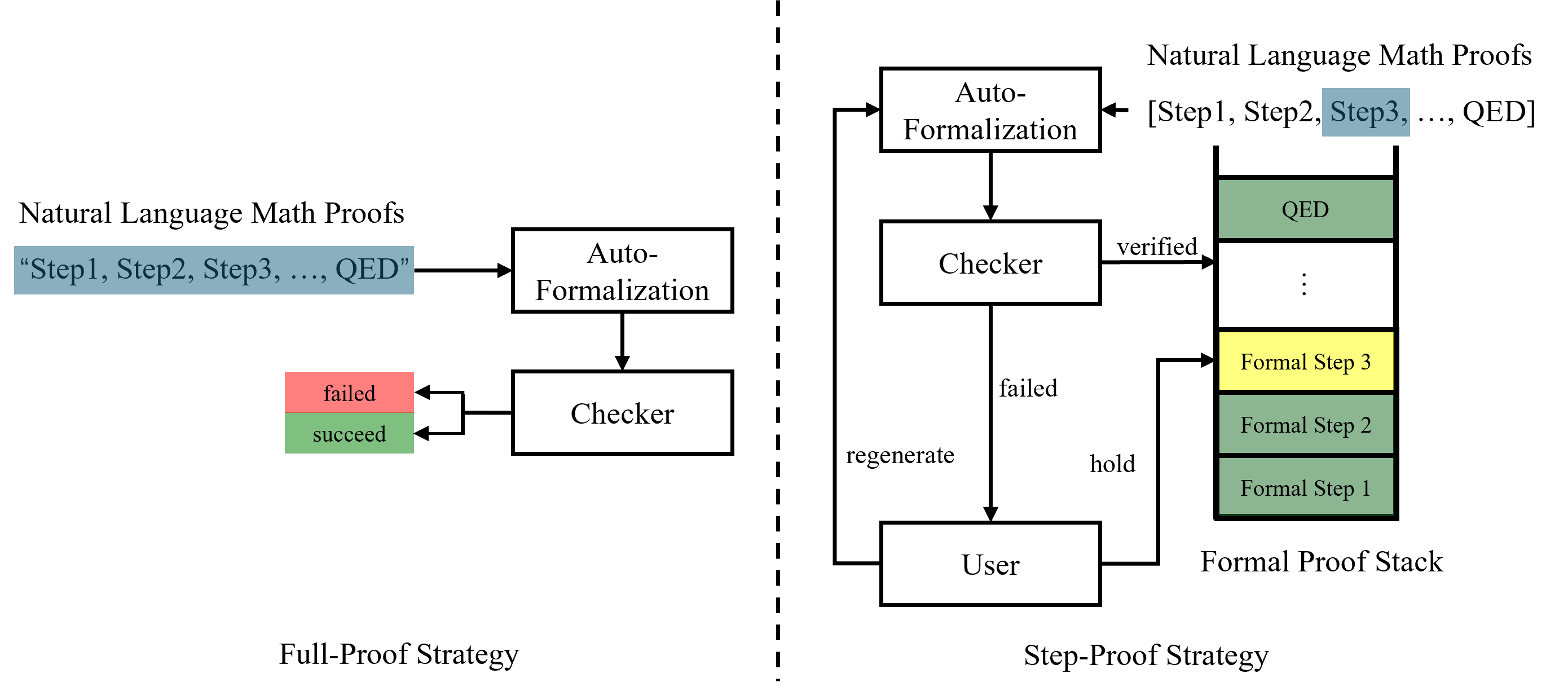
The image is a technical diagram comparing two distinct strategies for converting natural language mathematical proofs into formal, machine-verifiable proofs. The diagram is split vertically by a dashed line. The left side illustrates the "Full-Proof Strategy," a linear, all-or-nothing process. The right side illustrates the "Step-Proof Strategy," an iterative, step-by-step process involving user interaction and a proof stack.
### Components/Axes
The diagram contains no traditional chart axes. It is composed of labeled boxes, arrows indicating flow, and text labels.
**Left Side (Full-Proof Strategy):**
* **Input Label (Top-Left):** "Natural Language Math Proofs"
* **Input Data (Below label, in a blue box):** `"Step1, Step2, Step3, ..., QED"`
* **Process Box 1 (Center-Left):** "Auto-Formalization"
* **Process Box 2 (Below Box 1):** "Checker"
* **Output Labels (Left of Checker, stacked):**
* Top (Red box): "failed"
* Bottom (Green box): "succeed"
* **Strategy Label (Bottom-Left):** "Full-Proof Strategy"
**Right Side (Step-Proof Strategy):**
* **Input Label (Top-Right):** "Natural Language Math Proofs"
* **Input Data (Below label):** `[Step1, Step2, Step3, ..., QED]` (Note: "Step3" is highlighted with a blue background).
* **Process Box 1 (Top-Center):** "Auto-Formalization"
* **Process Box 2 (Center):** "Checker"
* **Process Box 3 (Bottom-Center):** "User"
* **Data Structure (Right side, vertical stack):** Labeled "Formal Proof Stack" at the bottom. It contains stacked blocks:
* Top block (Green): "QED"
* Middle blocks (Grey with vertical ellipsis "⋮"): Representing intermediate steps.
* Highlighted block (Yellow): "Formal Step 3"
* Lower blocks (Green): "Formal Step 2", "Formal Step 1"
* **Flow Labels (On arrows):**
* From "Checker" to "Formal Proof Stack": "verified"
* From "Checker" to "User": "failed"
* From "User" to "Auto-Formalization": "regenerate"
* From "User" to "Formal Proof Stack": "hold"
* **Strategy Label (Bottom-Right):** "Step-Proof Strategy"
### Detailed Analysis
**Full-Proof Strategy Flow:**
1. The entire natural language proof (`"Step1, Step2, Step3, ..., QED"`) is fed as a single input into the "Auto-Formalization" module.
2. The output of "Auto-Formalization" goes to a "Checker".
3. The "Checker" produces a binary outcome: either the entire formalized proof is accepted ("succeed", green) or it is rejected ("failed", red). There is no intermediate state or recovery mechanism shown.
**Step-Proof Strategy Flow:**
1. The natural language proof is presented as a list of steps: `[Step1, Step2, Step3, ..., QED]`.
2. The process begins with "Auto-Formalization" (presumably for the current step).
3. The output goes to the "Checker".
4. **If verification succeeds:** The formalized step (e.g., "Formal Step 3") is added to the "Formal Proof Stack" (indicated by the "verified" arrow). The stack is built from the bottom up ("Formal Step 1" at the base, "QED" at the top).
5. **If verification fails:** The flow goes to the "User" (indicated by the "failed" arrow).
6. The "User" has two options:
* **"regenerate":** Send a request back to "Auto-Formalization" to try formalizing the step again.
* **"hold":** Manually intervene and place a step (e.g., "Formal Step 3") into the "Formal Proof Stack". This suggests the user can override or manually input a formal step.
### Key Observations
1. **Granularity:** The Full-Proof Strategy operates on the entire proof as a monolithic block. The Step-Proof Strategy decomposes the proof into individual steps (`Step1`, `Step2`, etc.).
2. **Feedback Loop:** The Step-Proof Strategy introduces a critical feedback loop involving a "User" upon failure, enabling iteration ("regenerate") and manual intervention ("hold"). The Full-Proof Strategy has no such loop; failure is terminal.
3. **State Management:** The Step-Proof Strategy maintains state via the "Formal Proof Stack," which accumulates verified formal steps. The Full-Proof Strategy is stateless, with only a final pass/fail result.
4. **Visual Emphasis:** In the Step-Proof Strategy's input, "Step3" is highlighted in blue, and its corresponding formal output "Formal Step 3" is highlighted in yellow in the stack. This visually links a specific natural language step to its formal counterpart in the process.
5. **Color Coding:** Green consistently indicates success/verification ("succeed", "QED", verified steps in the stack). Red indicates failure. Yellow highlights a specific step of interest within the iterative process.
### Interpretation
This diagram contrasts two philosophical and practical approaches to the challenge of auto-formalization (translating informal human math into formal logic).
* **The Full-Proof Strategy** represents a "black box" or一次性 (one-shot) approach. It is simple and automated but brittle. If any part of the proof is problematic, the entire process fails, offering no diagnostic path or partial success. It mirrors attempting to compile a whole program at once; a single syntax error fails the build.
* **The Step-Proof Strategy** represents an interactive, incremental, and collaborative approach. It acknowledges that formalizing complex proofs is error-prone and benefits from human-in-the-loop oversight. By breaking the problem down, it allows for:
* **Progressive Verification:** Building a correct proof one step at a time.
* **Error Isolation:** Identifying exactly which step (`Step3` in the example) is causing failure.
* **Recovery and Intervention:** The user can either ask the system to try again or manually supply the correct formal step, ensuring progress isn't halted by a single difficult step.
The "Formal Proof Stack" is a key metaphor, visualizing the proof as a structure being constructed layer by layer. The diagram argues that for robust and practical auto-formalization, a stepwise, verifiable, and user-guided process (Step-Proof) is superior to a monolithic, all-or-nothing one (Full-Proof). It highlights the importance of interactivity and incremental state management in complex AI-assisted reasoning tasks.