## Diagram: Comparison of Full-Proof and Step-Proof Strategies for Math Proof Verification
### Overview
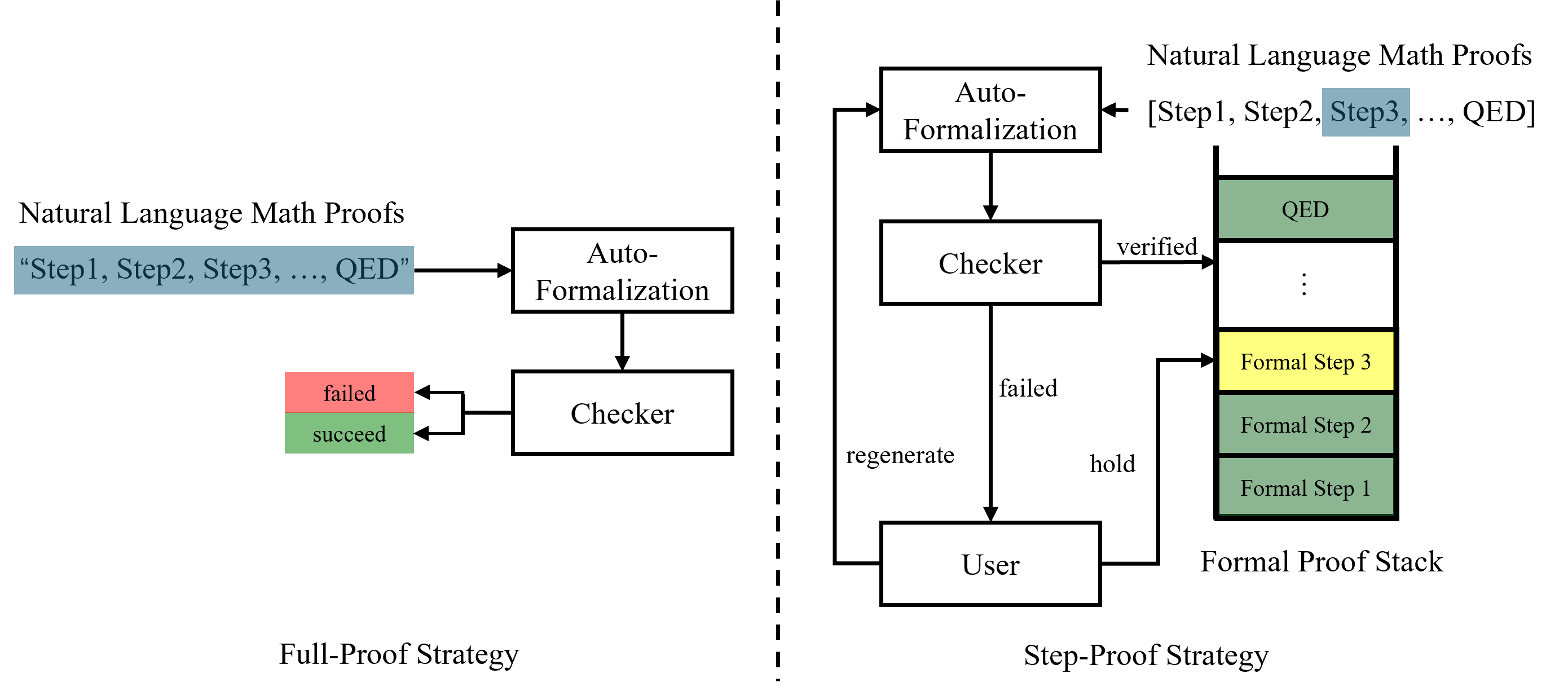
The diagram illustrates two strategies for verifying mathematical proofs: **Full-Proof Strategy** (left) and **Step-Proof Strategy** (right). Both involve natural language math proofs, auto-formalization, and verification, but differ in workflow and error handling.
---
### Components/Axes
#### Full-Proof Strategy (Left)
1. **Input**: "Natural Language Math Proofs" (e.g., "Step1, Step2, Step3, ..., QED").
2. **Process**:
- **Auto-Formalization**: Converts natural language proofs into formal representations.
- **Checker**: Validates the formalized proof.
3. **Output**:
- **Succeed** (green): Successful verification.
- **Failed** (red): Verification failure.
#### Step-Proof Strategy (Right)
1. **Input**: "Natural Language Math Proofs" (e.g., "[Step1, Step2, Step3, ..., QED]").
2. **Process**:
- **Auto-Formalization**: Converts natural language proofs into formal representations.
- **Checker**:
- **Verified**: Adds steps to the **Formal Proof Stack** (green for completed steps, yellow for the current step).
- **Failed**: Triggers **Regenerate** (user intervention) or **Hold** (pause).
3. **Output**:
- **Formal Proof Stack**: Hierarchical structure of verified steps (e.g., "Formal Step 1," "Formal Step 2," etc.).
- **User Interaction**: Allows regeneration of failed steps or holding the process.
---
### Detailed Analysis
#### Full-Proof Strategy
- **Flow**: Entire proof is processed as a single unit. Auto-formalization and verification occur in one pass.
- **Outcomes**: Binary result (succeed/failed). No iterative refinement.
#### Step-Proof Strategy
- **Flow**: Step-by-step verification with incremental validation.
- **Formal Proof Stack**: Tracks progress (green = verified, yellow = current step).
- **Regenerate**: User can rework failed steps.
- **Hold**: Pauses the process for manual intervention.
- **Advantages**: Supports iterative refinement, reduces risk of catastrophic failure.
---
### Key Observations
1. **Color Coding**:
- Green: Success/verified steps.
- Red: Failed verification.
- Yellow: Current step in progress.
2. **User Role**: Explicit in Step-Proof Strategy (regenerate/hold), absent in Full-Proof.
3. **QED**: Marks the end of proofs in both strategies.
---
### Interpretation
The diagram highlights a trade-off between simplicity and flexibility:
- **Full-Proof Strategy** is straightforward but rigid, suitable for proofs where errors are unlikely or easily corrected.
- **Step-Proof Strategy** introduces complexity but enables incremental validation, critical for large or error-prone proofs. The Formal Proof Stack and user interaction mechanisms suggest a focus on robustness and adaptability.
This aligns with principles of **Peircean abduction** (hypothesis testing) and **incremental verification** in formal methods, emphasizing iterative refinement over monolithic validation.