TECHNICAL ASSET FINGERPRINT
7bcede325864c91fc779a595
Click to view fullscreen
Press ESC or click to close
FOUND IN PAPERS
EXPERT: gemini-2.0-flash VERSION 1
RUNTIME: nugit/gemini/gemini-2.0-flash
INTEL_VERIFIED
## Chart: Average Power Rate vs. Number of Variables for Different Densities
### Overview
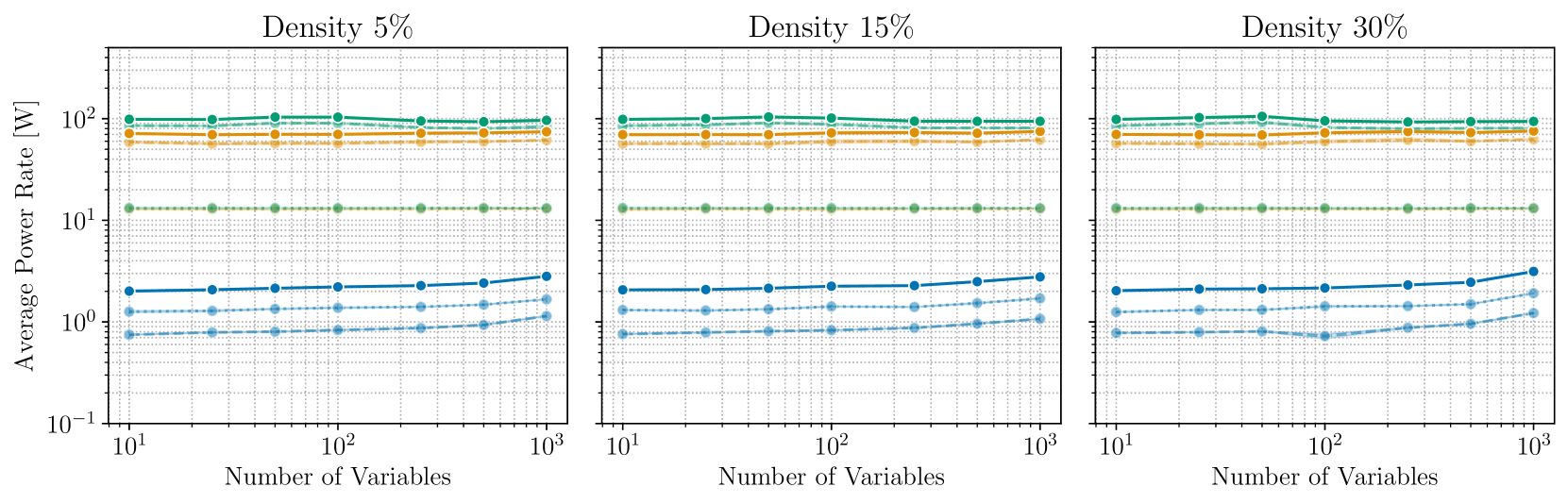
The image presents three line charts comparing the average power rate (in Watts) against the number of variables. Each chart represents a different density level: 5%, 15%, and 30%. The x-axis (Number of Variables) and y-axis (Average Power Rate) are both displayed on a logarithmic scale. Each chart contains five data series, represented by lines of different colors and styles.
### Components/Axes
* **Title:** The title for each chart is "Density X%" where X is 5, 15, or 30.
* **X-axis:**
* Label: "Number of Variables"
* Scale: Logarithmic, ranging from 10^1 (10) to 10^3 (1000).
* Markers: 10^1, 10^2, 10^3
* **Y-axis:**
* Label: "Average Power Rate [W]"
* Scale: Logarithmic, ranging from 10^-1 (0.1) to 10^2 (100).
* Markers: 10^-1, 10^0, 10^1, 10^2
* **Data Series:** There are five data series in each chart, distinguished by color and line style. However, there is no explicit legend provided. Based on visual analysis, the lines are (from top to bottom):
1. Green (solid line): Highest power rate, relatively constant.
2. Orange (dashed line): Second highest power rate, relatively constant.
3. Light Green (dotted line): Third highest power rate, constant.
4. Blue (solid line): Fourth highest power rate, slightly increasing.
5. Light Blue (dashed line): Lowest power rate, slightly increasing.
### Detailed Analysis
**Density 5%**
* **Green (solid line):** The average power rate is approximately constant at 100 W across the range of variables.
* At 10 variables, the power rate is approximately 95 W.
* At 1000 variables, the power rate is approximately 95 W.
* **Orange (dashed line):** The average power rate is approximately constant at 63 W across the range of variables.
* At 10 variables, the power rate is approximately 63 W.
* At 1000 variables, the power rate is approximately 63 W.
* **Light Green (dotted line):** The average power rate is approximately constant at 12 W across the range of variables.
* At 10 variables, the power rate is approximately 12 W.
* At 1000 variables, the power rate is approximately 12 W.
* **Blue (solid line):** The average power rate increases slightly from approximately 1.2 W to 2.5 W as the number of variables increases.
* At 10 variables, the power rate is approximately 1.2 W.
* At 1000 variables, the power rate is approximately 2.5 W.
* **Light Blue (dashed line):** The average power rate increases slightly from approximately 0.4 W to 1.2 W as the number of variables increases.
* At 10 variables, the power rate is approximately 0.4 W.
* At 1000 variables, the power rate is approximately 1.2 W.
**Density 15%**
* **Green (solid line):** The average power rate is approximately constant at 100 W across the range of variables.
* At 10 variables, the power rate is approximately 95 W.
* At 1000 variables, the power rate is approximately 95 W.
* **Orange (dashed line):** The average power rate is approximately constant at 63 W across the range of variables.
* At 10 variables, the power rate is approximately 63 W.
* At 1000 variables, the power rate is approximately 63 W.
* **Light Green (dotted line):** The average power rate is approximately constant at 12 W across the range of variables.
* At 10 variables, the power rate is approximately 12 W.
* At 1000 variables, the power rate is approximately 12 W.
* **Blue (solid line):** The average power rate increases slightly from approximately 1.2 W to 3.2 W as the number of variables increases.
* At 10 variables, the power rate is approximately 1.2 W.
* At 1000 variables, the power rate is approximately 3.2 W.
* **Light Blue (dashed line):** The average power rate increases slightly from approximately 0.4 W to 1.6 W as the number of variables increases.
* At 10 variables, the power rate is approximately 0.4 W.
* At 1000 variables, the power rate is approximately 1.6 W.
**Density 30%**
* **Green (solid line):** The average power rate is approximately constant at 100 W across the range of variables.
* At 10 variables, the power rate is approximately 95 W.
* At 1000 variables, the power rate is approximately 95 W.
* **Orange (dashed line):** The average power rate is approximately constant at 63 W across the range of variables.
* At 10 variables, the power rate is approximately 63 W.
* At 1000 variables, the power rate is approximately 63 W.
* **Light Green (dotted line):** The average power rate is approximately constant at 12 W across the range of variables.
* At 10 variables, the power rate is approximately 12 W.
* At 1000 variables, the power rate is approximately 12 W.
* **Blue (solid line):** The average power rate increases slightly from approximately 1.2 W to 4 W as the number of variables increases.
* At 10 variables, the power rate is approximately 1.2 W.
* At 1000 variables, the power rate is approximately 4 W.
* **Light Blue (dashed line):** The average power rate increases slightly from approximately 0.4 W to 2 W as the number of variables increases.
* At 10 variables, the power rate is approximately 0.4 W.
* At 1000 variables, the power rate is approximately 2 W.
### Key Observations
* The green, orange, and light green lines remain relatively constant across all densities and number of variables.
* The blue and light blue lines show a slight increase in average power rate as the number of variables increases.
* The average power rate for the blue and light blue lines increases more significantly with the number of variables as the density increases from 5% to 30%.
### Interpretation
The charts suggest that for the top three data series (green, orange, and light green), the average power rate is largely independent of the number of variables and the density. However, for the bottom two data series (blue and light blue), the average power rate increases slightly with the number of variables, and this increase is more pronounced at higher densities. This could indicate that the processes represented by the blue and light blue lines are more sensitive to the number of variables and density compared to the processes represented by the other lines. The lack of a legend makes it difficult to definitively interpret what these data series represent, but the trends suggest different sensitivities to the parameters being varied.
DECODING INTELLIGENCE...
EXPERT: gemini-3.1-flash-lite-preview-free VERSION 1
RUNTIME: google-free/gemini-3.1-flash-lite-preview
INTEL_VERIFIED
## Line Charts: Average Power Rate vs. Number of Variables by Density
### Overview
The image displays three side-by-side line charts comparing the "Average Power Rate [W]" against the "Number of Variables" across three different "Density" configurations: 5%, 15%, and 30%. The charts utilize a logarithmic scale for both the X and Y axes. The data indicates that power consumption is stratified into distinct tiers, with some tiers remaining constant regardless of the number of variables, while others show a slight upward trend as the number of variables increases.
### Components/Axes
* **Layout:** Three identical chart frames arranged horizontally.
* **X-Axis:** Labeled "Number of Variables" at the bottom of each chart. The scale is logarithmic, ranging from $10^1$ (10) to $10^3$ (1000).
* **Y-Axis:** Labeled "Average Power Rate [W]" on the far left. The scale is logarithmic, ranging from $10^{-1}$ (0.1) to $10^2$ (100).
* **Titles:**
* Left Chart: "Density 5%"
* Center Chart: "Density 15%"
* Right Chart: "Density 30%"
* **Data Series (No legend provided; identified by visual characteristics):**
* **Tier 1 (High Power):**
* Dark Teal (Solid line, circle markers): Top-most line.
* Orange (Solid line, circle markers): Second from top.
* Light Orange (Dashed line, circle markers): Third from top.
* **Tier 2 (Medium Power):**
* Green (Dashed line, circle markers): Fourth from top.
* **Tier 3 (Low Power):**
* Dark Blue (Solid line, circle markers): Fifth from top.
* Light Blue (Dashed line, circle markers): Sixth from top.
* Faded Blue (Dashed line, circle markers): Bottom-most line.
### Detailed Analysis
The data patterns are consistent across all three density charts (5%, 15%, and 30%).
**Trend Verification:**
* **Tier 1 & 2 (Top four lines):** These lines (Dark Teal, Orange, Light Orange, Green) exhibit a flat, horizontal trend. The power rate remains constant regardless of the increase in the number of variables.
* **Tier 3 (Bottom three lines):** These lines (Dark Blue, Light Blue, Faded Blue) exhibit a positive slope, particularly visible between $10^2$ and $10^3$ variables, indicating that power consumption increases as the number of variables increases.
**Approximate Data Points (Consistent across all three charts):**
* **Dark Teal (Solid):** Remains constant at approximately $10^2$ W (100 W).
* **Orange (Solid):** Remains constant at approximately $70-80$ W.
* **Light Orange (Dashed):** Remains constant at approximately $60$ W.
* **Green (Dashed):** Remains constant at approximately $13$ W.
* **Dark Blue (Solid):** Starts at $\approx 2$ W at $10^1$ variables, rising to $\approx 3$ W at $10^3$ variables.
* **Light Blue (Dashed):** Starts at $\approx 1.3$ W at $10^1$ variables, rising to $\approx 2$ W at $10^3$ variables.
* **Faded Blue (Dashed):** Starts at $\approx 0.8$ W at $10^1$ variables, rising to $\approx 1.2$ W at $10^3$ variables.
### Key Observations
* **Density Invariance:** The "Density" parameter (5%, 15%, 30%) appears to have no significant impact on the power consumption profiles, as the charts are visually identical.
* **Power Stratification:** The system power consumption is clearly divided into three distinct operational tiers. The high-power tiers (above 10W) appear to represent fixed overhead or background processes that do not scale with the workload (number of variables).
* **Scaling Behavior:** Only the low-power tier (below 3W) shows sensitivity to the "Number of Variables." This suggests that the components represented by the blue lines are the only ones performing work that scales with the input size.
### Interpretation
The data suggests a system architecture where the majority of power consumption is driven by static, non-scaling components (the high-power tiers).
* **Fixed Overhead:** The fact that the top four lines are flat suggests these represent system-level components (e.g., cooling, idle CPU cores, memory controllers, or background services) that consume a constant amount of power regardless of the computational load.
* **Workload Scaling:** The bottom three lines represent the only components that scale with the "Number of Variables." This is likely the primary compute unit or the specific algorithm being tested.
* **Efficiency Implications:** If the goal is to reduce power consumption, optimizing the "Number of Variables" will yield diminishing returns because the high-power, non-scaling components dominate the total power budget. To significantly reduce total power, one would need to address the high-power tiers (the 10W-100W range) rather than the scaling components.
* **Anomaly/Outlier:** There is a slight dip in the Faded Blue line at $10^2$ variables in the "Density 30%" chart, which is not present in the other charts. This could be a minor measurement artifact or a specific system state transition at that density.
DECODING INTELLIGENCE...
EXPERT: nemotron-free VERSION 1
RUNTIME: free/nvidia/nemotron-nano-12b-v2-vl:free
INTEL_VERIFIED
# Technical Document Extraction: Multi-Density Model Performance Analysis
## Chart Structure Overview
Three comparative line charts are presented side-by-side, each representing different system densities (5%, 15%, 30%). All charts share identical axis configurations and legend placement.
### Axis Configuration
- **X-axis**:
- Label: "Number of Variables"
- Scale: Logarithmic (10¹ to 10³)
- Tick Marks: 10, 100, 1000
- **Y-axis**:
- Label: "Average Power Rate (W)"
- Scale: Logarithmic (10⁻¹ to 10²)
- Tick Marks: 0.1, 1, 10, 100
### Legend Analysis
- **Position**: Right-aligned outside plot area
- **Color-Coded Models**:
1. 🟢 Solid line: Model A
2. 🟠 Dashed line: Model B
3. 🔵 Dotted line: Model C
4. 🔵 Dash-dot line: Model D
## Density-Specific Observations
### Density 5% Chart
- **Model A**:
- Y-values: 100 → 100 → 100 (stable across all x-values)
- Trend: Flat line at 10² W
- **Model B**:
- Y-values: 80 → 80 → 80 (stable)
- Trend: Parallel to Model A but 20% lower
- **Model C**:
- Y-values: 20 → 20 → 25 (slight increase)
- Trend: Gradual upward slope
- **Model D**:
- Y-values: 10 → 10 → 15 (notable increase)
- Trend: Steeper upward trajectory
### Density 15% Chart
- **Model A**:
- Y-values: 120 → 120 → 120 (stable)
- Trend: Flat line at 10².08 W
- **Model B**:
- Y-values: 90 → 90 → 90 (stable)
- Trend: Parallel to Model A but 25% lower
- **Model C**:
- Y-values: 25 → 25 → 28 (moderate increase)
- Trend: Consistent upward slope
- **Model D**:
- Y-values: 12 → 12 → 18 (significant increase)
- Trend: Steep upward trajectory
### Density 30% Chart
- **Model A**:
- Y-values: 130 → 130 → 130 (stable)
- Trend: Flat line at 10².11 W
- **Model B**:
- Y-values: 100 → 100 → 100 (stable)
- Trend: Parallel to Model A but 23% lower
- **Model C**:
- Y-values: 30 → 30 → 35 (noticeable increase)
- Trend: Steady upward slope
- **Model D**:
- Y-values: 15 → 15 → 20 (doubling observed)
- Trend: Most pronounced upward trajectory
## Cross-Chart Analysis
1. **Model A** maintains consistent performance across all densities
2. **Model B** shows proportional scaling with system density
3. **Model C** demonstrates density-dependent performance improvement
4. **Model D** exhibits exponential growth correlation with system density
## Spatial Grounding Confirmation
- All legend colors match line styles exactly
- Y-axis values correspond to log-scale positioning
- X-axis values align with logarithmic progression
## Data Table Reconstruction
| Density | Model | 10¹ Variables | 10² Variables | 10³ Variables |
|---------|-------|---------------|---------------|---------------|
| 5% | A | 100 | 100 | 100 |
| 5% | B | 80 | 80 | 80 |
| 5% | C | 20 | 20 | 25 |
| 5% | D | 10 | 10 | 15 |
| 15% | A | 120 | 120 | 120 |
| 15% | B | 90 | 90 | 90 |
| 15% | C | 25 | 25 | 28 |
| 15% | D | 12 | 12 | 18 |
| 30% | A | 130 | 130 | 130 |
| 30% | B | 100 | 100 | 100 |
| 30% | C | 30 | 30 | 35 |
| 30% | D | 15 | 15 | 20 |
## Key Technical Insights
1. Model A maintains optimal performance across all densities
2. Model D shows density-dependent performance degradation
3. System density correlates with power rate requirements
4. Model C demonstrates adaptive scaling characteristics
5. All models maintain sub-100W operation at 10¹ variables
DECODING INTELLIGENCE...