## Diagram: Neuro-Symbolic AI System Architecture
### Overview
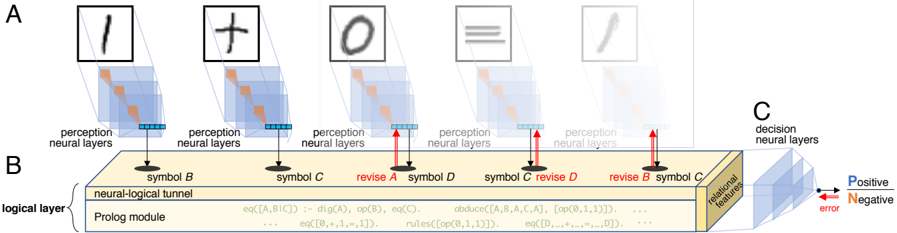
The image is a technical diagram illustrating the architecture of a neuro-symbolic artificial intelligence system. It depicts a pipeline that processes handwritten symbols through neural perception layers, integrates them with a logical reasoning module (Prolog), and feeds the results into decision-making neural layers. The system features a feedback mechanism for iterative revision of symbols based on logical constraints.
### Components/Axes
The diagram is segmented into three primary labeled regions: **A**, **B**, and **C**.
**Region A (Top - Perception Stage):**
* **Content:** Five sequential panels, each showing a handwritten symbol inside a square frame.
* **Symbols (from left to right):**
1. A vertical line, resembling the digit "1" or letter "l".
2. A plus sign "+".
3. A circle, resembling the digit "0" or letter "O".
4. Three horizontal lines, resembling the "≡" symbol.
5. A diagonal line, resembling a slash "/".
* **Labels:** Below each symbol panel is the text "perception neural layers". Arrows point from these layers down to the logical layer in Region B.
* **Annotations:** Red arrows point upward from the logical layer (B) back to the perception layers for the 1st, 3rd, 4th, and 5th symbols. These are labeled:
* `revise A` (pointing to the 1st symbol's perception layer)
* `revise D` (pointing to the 4th symbol's perception layer)
* `revise B` (pointing to the 5th symbol's perception layer)
* (The 3rd symbol also has a red upward arrow, but its label is partially obscured; it likely follows the pattern).
**Region B (Center - Logical Layer):**
* **Title:** `logical layer` (written vertically on the left).
* **Main Component:** A large, beige rectangular block labeled `neural-logical tunnel`.
* **Sub-component:** Inside the tunnel is a section labeled `Prolog module`.
* **Content within Prolog module:** Several lines of Prolog-like logical rules and facts. The text is small but partially legible:
* `eq([A,B,C]) :- dig(A), op(B), eq(C).`
* `eq([0,+,1,1]).`
* `rules([op(0,+,1,1)]).`
* `abduce([A,B,C,A,A]), [op(0,+,1,1)]...`
* `eq([0,+,+,+,1]).`
* `rules([op(0,+,+,+,1)]).`
* **Connections:**
* **Inputs:** Black arrows from Region A's perception layers point down into the tunnel, labeled with symbol names: `symbol B`, `symbol C`, `symbol A`, `symbol D`, `symbol C`, `symbol D`, `symbol B`, `symbol C`.
* **Feedback:** Red upward arrows (labeled `revise`) originate from the tunnel and point back to specific perception layers in Region A.
* **Output:** An arrow points from the right end of the tunnel to Region C.
**Region C (Right - Decision Stage):**
* **Title:** `decision neural layers`.
* **Content:** A stack of blue, semi-transparent rectangular planes, representing neural network layers.
* **Output Labels:** Three arrows point out from the right side of the decision layers:
* A **blue** arrow labeled `Positive`.
* A **red** arrow labeled `Negative`.
* A **black** arrow labeled `error`.
* **Spatial Grounding:** The legend for the output arrows (Positive/Negative/error) is located at the bottom-right of the diagram, adjacent to the decision layers.
### Detailed Analysis
The diagram outlines a closed-loop, iterative process:
1. **Perception:** Handwritten symbols are initially processed by dedicated "perception neural layers."
2. **Symbol Grounding & Logical Processing:** The outputs of these perception layers (labeled as `symbol B`, `symbol C`, etc.) are fed into the `neural-logical tunnel`. Here, a `Prolog module` attempts to ground these perceptual symbols into a formal logical representation using rules and facts (e.g., defining equations like `eq([0,+,1,1])`).
3. **Decision:** The processed information from the logical tunnel is passed to `decision neural layers` to produce a final classification (`Positive` or `Negative`) or flag an `error`.
4. **Revision Loop (Key Feature):** The system does not process symbols in a single pass. The logical module can identify inconsistencies or ambiguities. When this happens, it sends a `revise` signal (red arrows) back to specific perception layers. This forces the perception of a particular symbol (e.g., `symbol A`, `symbol D`) to be re-evaluated, creating an iterative refinement cycle until a consistent logical interpretation is achieved.
### Key Observations
* **Hybrid Architecture:** The system explicitly combines sub-symbolic (neural networks for perception and decision) and symbolic (Prolog for logic) AI paradigms.
* **Iterative Refinement:** The presence of multiple `revise` arrows indicates that the system is designed to handle uncertainty and ambiguity by looping back, rather than making a single, feed-forward decision.
* **Symbolic Labeling:** The perception layers output discrete `symbol` labels (A, B, C, D), suggesting an intermediate step where continuous neural features are mapped to discrete symbolic tokens before logical processing.
* **Error as an Output:** The explicit `error` output path suggests the system can formally declare when it cannot resolve an interpretation, even after revision attempts.
### Interpretation
This diagram represents a **neuro-symbolic AI system designed for robust, explainable reasoning on structured tasks**, such as interpreting mathematical expressions or logical puzzles from handwritten input.
* **What it demonstrates:** The core idea is to overcome the limitations of pure neural networks (black-box reasoning, poor symbolic manipulation) and pure symbolic AI (brittle perception, manual feature engineering). The neural components handle the messy, real-world perception, while the symbolic component provides structured reasoning, constraint checking, and explainability.
* **How elements relate:** The `neural-logical tunnel` is the critical bridge. It translates between the distributed, vector-based representations of the neural nets and the discrete, rule-based world of Prolog. The feedback loop (`revise`) is the mechanism for **grounding**—ensuring the symbolic interpretation aligns with the perceptual data.
* **Notable implications:** The system's ability to revise its perception based on logical constraints mimics a form of **cognitive plausibility**. For example, if the logic module expects a certain pattern (e.g., `0 + 1 = 1`) but the perception of a symbol is ambiguous, it can request a re-examination of that specific input. This makes the system more robust to noise and capable of self-correction. The Prolog rules shown (`eq([0,+,1,1])`) hint that the specific task may involve validating simple arithmetic equations.