\n
## Diagram: Conceptual Model of a Cognitive Architecture
### Overview
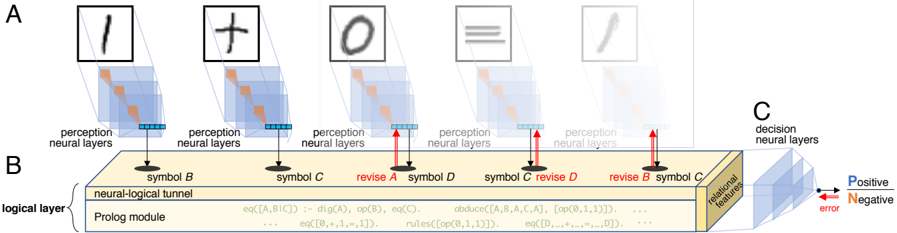
The image depicts a conceptual diagram of a cognitive architecture, illustrating the flow of information from perception to decision-making. It appears to represent a system combining neural network-like perception layers with a logical reasoning component (Prolog module) and a decision-making layer. The diagram is segmented into three main areas labeled A, B, and C.
### Components/Axes
* **A: Perception Neural Layers:** This section shows five instances of "perception neural layers" represented as translucent blue grids. Each layer is associated with a different symbol presented above it.
* **B: Logical Layer:** This section represents a "logical layer" containing a "neural-logical tunnel" and a "Prolog module". The Prolog module displays a series of logical expressions.
* **C: Decision Neural Layers:** This section represents "decision neural layers" and is colored with a gradient from blue to red, indicating "Positive" and "Negative" error.
* **Symbols:** Five symbols are presented above the perception layers: a vertical line, a plus sign, a circle, an equals sign, and a forward slash.
* **Connections:** Red and blue arrows connect the perception layers to the logical layer and the logical layer to the decision layers.
* **Labels:** "symbol B", "symbol C", "revise A", "symbol D", "revise C", "revise B" are labels associated with the connections between the perception and logical layers.
* **Legend:** A color gradient indicates "Positive" (blue) and "Negative" (red) error in the decision neural layers.
* **Text within Prolog Module:** A series of logical expressions are visible within the Prolog module, including "eq(A,B) :- dig(A), op(B), eq(C)", "abduce(A,B,A,C,A)", "rules(op(0,1,1))", and others.
### Detailed Analysis / Content Details
The diagram shows a sequential processing flow.
1. **Perception:** Five different symbols (vertical line, plus sign, circle, equals sign, forward slash) are input into separate "perception neural layers".
2. **Logical Processing:** Each perception layer is connected to the "neural-logical tunnel" within the logical layer. The connections are labeled with symbols and revisions (e.g., "symbol B", "revise A"). The Prolog module contains a series of logical rules and expressions.
3. **Decision Making:** The output of the logical layer is fed into the "decision neural layers". The color of the decision layers indicates the presence of positive or negative error.
The Prolog module contains the following expressions (transcribed as accurately as possible):
* `eq(A,B) :- dig(A), op(B), eq(C)`
* `abduce(A,B,A,C,A)`
* `rules(op(0,1,1))`
* `eq(B, ... ,11)`
* `eq(C, ... ,11)`
* `rules(op(0,1,11))`
* `eq(B, ... ,0)`
The connections between the perception layers and the logical layer are differentiated by color: blue arrows are associated with "symbol B" and "symbol C", while red arrows are associated with "revise A", "symbol D", "revise C", and "revise B".
### Key Observations
* The diagram suggests a hybrid cognitive architecture combining neural network-like processing with symbolic reasoning.
* The "revise" labels indicate a feedback or iterative process where the logical layer refines its understanding based on the input from the perception layers.
* The color gradient in the decision layers suggests a continuous spectrum of error, rather than a binary classification.
* The Prolog module appears to implement a set of logical rules and inference mechanisms.
### Interpretation
This diagram illustrates a cognitive architecture that attempts to bridge the gap between sub-symbolic (neural network) and symbolic (logical reasoning) processing. The perception layers extract features from the input symbols, which are then processed by the Prolog module using logical rules. The decision layers then evaluate the output of the logical module and provide feedback in the form of error signals.
The "revise" connections suggest a mechanism for learning and adaptation, where the logical layer refines its rules based on the input from the perception layers. The Prolog module likely implements a form of abductive reasoning, where it attempts to find the best explanation for the observed data.
The diagram highlights the importance of integrating different levels of processing in a cognitive architecture. By combining neural networks with symbolic reasoning, the system can potentially achieve a more robust and flexible form of intelligence. The presence of "Positive" and "Negative" error suggests a learning mechanism where the system adjusts its parameters to minimize error. The specific logical expressions within the Prolog module would need further analysis to understand the precise functionality of the system.