## Diagram: Neural-Symbolic Processing Architecture
### Overview
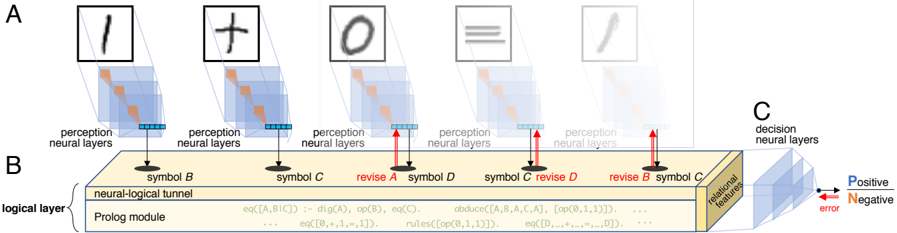
The diagram illustrates a multi-stage neural-symbolic processing system with three primary components:
1. **Perception Neural Layers (A)**: Processes raw symbolic inputs (e.g., "1", "+", "0", "≡", "✒").
2. **Neural-Logical Tunnel (B)**: Integrates symbolic representations with logical operations via a Prolog module.
3. **Decision Neural Layers (C)**: Outputs probabilistic decisions (Positive/Negative) with error correction.
### Components/Axes
#### Section A: Perception Neural Layers
- **Symbols**:
- "1" (digit), "+" (operator), "0" (digit), "≡" (equivalence), "✒" (pen).
- **Structure**:
- Each symbol is processed by stacked neural layers (blue shaded regions).
- Arrows indicate forward propagation of features.
#### Section B: Neural-Logical Tunnel
- **Symbols**:
- "B", "C", "D" (abstract symbols).
- **Key Elements**:
- **Prolog Module**: Contains logical rules (e.g., `eq(A,B,C) := dig(A), op(B), eq(C)`) and operations like `abduce`, `revise`.
- **Revisions**: Red arrows indicate iterative refinement of symbols (e.g., "revise A", "revise B").
- **Flow**:
- Inputs from perception layers are mapped to symbolic representations (e.g., "symbol B", "symbol C").
#### Section C: Decision Neural Layers
- **Output**:
- Binary decisions labeled "Positive" (blue arrow) and "Negative" (red arrow).
- Error signals (red) propagate backward to refine earlier layers.
- **Features**:
- "Relational features" (yellow) extracted for decision-making.
### Detailed Analysis
#### Perception Layers (A)
- Each symbol is processed independently, with hierarchical feature extraction (e.g., edges, shapes).
- Example: The "≡" symbol’s neural layers likely detect symmetry and equivalence properties.
#### Neural-Logical Tunnel (B)
- **Prolog Module**:
- Logical rules (e.g., `rules(op(0,1,1))`) define symbolic operations.
- Equations like `eq([A,B,C]) := dig(A), op(B), eq(C)` map neural activations to symbolic logic.
- **Revisions**:
- Iterative corrections (e.g., "revise B") suggest error feedback loops to refine symbolic representations.
#### Decision Layers (C)
- **Probabilistic Output**:
- Positive/Negative decisions are weighted by relational features.
- Error signals (red) indicate misclassifications, triggering revisions in earlier layers.
### Key Observations
1. **Hierarchical Processing**:
- Raw symbols → symbolic abstraction → logical integration → probabilistic decisions.
2. **Error Correction**:
- Red arrows in C and revisions in B highlight a feedback mechanism for robustness.
3. **Symbolic-Neural Integration**:
- The Prolog module bridges neural activations (e.g., `dig(A)`) with formal logic (e.g., `op(B)`).
### Interpretation
This architecture demonstrates a hybrid AI system where:
- **Perception layers** extract low-level features from raw inputs.
- **Neural-logical integration** uses symbolic reasoning (via Prolog) to refine intermediate representations.
- **Decision layers** combine learned features with logical constraints to produce interpretable outcomes.
The "revise" annotations and error signals suggest a dynamic system capable of self-correction, likely inspired by neuro-symbolic AI frameworks. The use of Prolog implies formal logic is critical for tasks requiring rule-based reasoning (e.g., mathematical operations, equivalence checks). The error-driven revisions in C emphasize the importance of feedback in achieving reliable decisions.