## Diagram: Vector Quantization Process Flow
### Overview
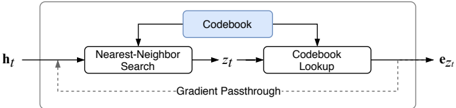
The image is a schematic flow diagram illustrating the architecture of a Vector Quantization (VQ) layer, commonly used in machine learning models such as VQ-VAEs (Vector Quantized Variational Autoencoders). The diagram visualizes the forward pass of an input vector through a quantization process and the backward pass mechanism known as "Gradient Passthrough."
### Components/Axes
The diagram is contained within a large, rounded rectangular bounding box. The components are arranged as follows:
* **Input:** $\mathbf{h}_t$ (located at the far left).
* **Processing Blocks:**
* **Nearest-Neighbor Search:** A rectangular box located in the center-left.
* **Codebook Lookup:** A rectangular box located in the center-right.
* **Reference Component:**
* **Codebook:** A blue-shaded rectangular box positioned at the top-center, connected to both processing blocks.
* **Intermediate Variable:** $z_t$ (located on the arrow between the two processing blocks).
* **Output:** $\mathbf{e}_{z_t}$ (located at the far right).
* **Feedback Mechanism:**
* **Gradient Passthrough:** A dashed line originating from the output $\mathbf{e}_{z_t}$ and looping back to the input $\mathbf{h}_t$.
### Detailed Analysis
The flow of information proceeds as follows:
1. **Forward Pass:**
* The input vector $\mathbf{h}_t$ enters the "Nearest-Neighbor Search" block.
* The "Codebook" (blue box) provides reference data to the "Nearest-Neighbor Search" block to determine the closest match.
* The result of this search is $z_t$, which represents the index or identifier of the nearest neighbor.
* $z_t$ is passed to the "Codebook Lookup" block.
* The "Codebook" also provides data to the "Codebook Lookup" block.
* The "Codebook Lookup" block retrieves the actual vector $\mathbf{e}_{z_t}$ corresponding to the index $z_t$.
* The final output is $\mathbf{e}_{z_t}$.
2. **Backward Pass (Gradient Flow):**
* A dashed line labeled "Gradient Passthrough" connects the output $\mathbf{e}_{z_t}$ back to the input $\mathbf{h}_t$. This indicates that during backpropagation, the gradient is copied directly from the output to the input, bypassing the non-differentiable quantization operation.
### Key Observations
* **Shared Resource:** The "Codebook" is positioned centrally above the processing chain, indicating it is a shared memory or lookup table accessed by both the search and lookup operations.
* **Non-Differentiable Operation:** The distinction between the solid lines (forward pass) and the dashed line (gradient passthrough) highlights the architectural solution to the non-differentiability of the nearest-neighbor search.
* **Modular Design:** The entire process is enclosed in a bounding box, suggesting this is a discrete, modular unit within a larger neural network architecture.
### Interpretation
This diagram represents the core mechanism of Vector Quantization. The "Nearest-Neighbor Search" is a discrete operation (finding the closest vector in a codebook), which is mathematically non-differentiable. Because standard neural network training relies on backpropagation (calculus-based gradient descent), this operation would normally "break" the training process.
The "Gradient Passthrough" is the critical component here. By treating the quantization operation as an identity mapping during the backward pass (copying the gradient from $\mathbf{e}_{z_t}$ directly to $\mathbf{h}_t$), the model allows the encoder (which produces $\mathbf{h}_t$) to learn how to produce vectors that are closer to the codebook entries, even though the forward pass involves a discrete selection. This allows the entire system to be trained end-to-end.