## Diagram: Autoencoder with Codebook and Gradient Passthrough
### Overview
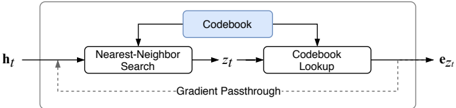
The diagram illustrates a neural network architecture involving a codebook, nearest-neighbor search, and gradient passthrough. It depicts the flow of data and gradients through the system, highlighting interactions between components.
### Components/Axes
1. **Inputs/Outputs**:
- `h_t`: Input vector (leftmost node).
- `e_zt`: Output vector (rightmost node).
2. **Key Components**:
- **Nearest-Neighbor Search**: Processes `h_t` to produce `z_t`.
- **Codebook**: Central component storing discrete representations.
- **Codebook Lookup**: Maps `z_t` to `e_zt` using the codebook.
3. **Flow**:
- Solid arrows indicate forward data flow.
- Dashed arrow labeled "Gradient Passthrough" indicates backward gradient flow during training.
### Detailed Analysis
- **Forward Pass**:
- `h_t` is fed into the **Nearest-Neighbor Search**, which computes `z_t` (likely a quantized latent representation).
- `z_t` is passed to the **Codebook Lookup**, which retrieves the closest codeword `e_zt` from the **Codebook**.
- **Gradient Passthrough**:
- Dashed arrow shows gradients from `e_zt` propagate backward through the **Codebook Lookup** and **Nearest-Neighbor Search** during training. This suggests the codebook is differentiable or gradients are adjusted via a straight-through estimator.
### Key Observations
1. The **Codebook** acts as a shared resource between the nearest-neighbor search and codebook lookup.
2. The **Gradient Passthrough** implies the codebook’s quantization step is handled with a relaxed gradient approximation (common in vector quantization models like VQ-VAE).
3. No explicit numerical values or scales are present; the diagram focuses on architectural relationships.
### Interpretation
This architecture resembles a **vector quantized variational autoencoder (VQ-VAE)**. The **Nearest-Neighbor Search** identifies the closest codeword in the **Codebook** to represent `h_t`, while the **Gradient Passthrough** enables training by relaxing the non-differentiable quantization step. The **Codebook Lookup** bridges discrete and continuous representations, allowing the model to learn efficient latent codes. The absence of explicit numerical data suggests this is a conceptual diagram for understanding the flow of information and gradients in such models.