## Textual Case Study: Critical Tokens
### Overview
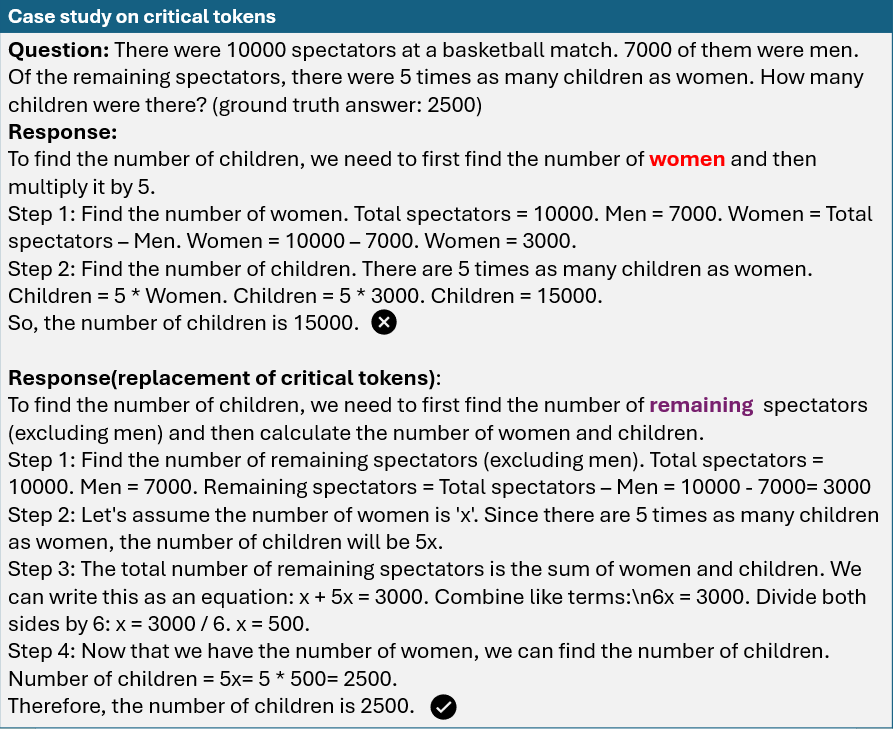
The image presents a case study on critical tokens, posing a word problem about the number of children at a basketball match given the total number of spectators and the number of men. It provides two different responses to the problem, one incorrect and one correct, demonstrating the importance of correctly interpreting and applying the given information.
### Components/Axes
The image is structured as follows:
1. **Title:** "Case study on critical tokens"
2. **Question:** A word problem describing the scenario.
* Total spectators: 10000
* Number of men: 7000
* Relationship between children and women: 5 times as many children as women
* Question: How many children were there? (ground truth answer: 2500)
3. **Response:** An incorrect solution to the problem.
* Step 1: Calculates the number of women as 3000 (10000 - 7000).
* Step 2: Calculates the number of children as 15000 (5 * 3000).
* Conclusion: The number of children is 15000. (Marked with a red "X")
4. **Response (replacement of critical tokens):** A correct solution to the problem.
* Step 1: Calculates the number of remaining spectators (excluding men) as 3000 (10000 - 7000).
* Step 2: Assumes the number of women is 'x', therefore the number of children is '5x'.
* Step 3: Sets up the equation x + 5x = 3000, simplifies to 6x = 3000, and solves for x (x = 500).
* Step 4: Calculates the number of children as 2500 (5 * 500).
* Conclusion: The number of children is 2500. (Marked with a green checkmark)
### Detailed Analysis or ### Content Details
The word problem states:
* There were 10000 spectators at a basketball match.
* 7000 of them were men.
* Of the remaining spectators, there were 5 times as many children as women.
* The question is: How many children were there? (ground truth answer: 2500)
The first response incorrectly calculates the number of children by assuming that all the remaining spectators are women, and then multiplying that number by 5.
The second response correctly calculates the number of children by setting up an equation that accounts for both women and children among the remaining spectators.
### Key Observations
* The first response fails to account for the fact that the remaining spectators include both women and children.
* The second response correctly identifies that the remaining spectators consist of women and children and sets up an equation to solve for the number of women, then calculates the number of children.
* The "ground truth answer" provided in the question is 2500, which matches the correct solution.
### Interpretation
The case study highlights the importance of carefully reading and interpreting word problems. The incorrect response demonstrates a common mistake of overlooking crucial information and making incorrect assumptions. The correct response demonstrates the importance of setting up equations to accurately represent the relationships between different variables in the problem. The problem emphasizes the need for critical thinking and attention to detail when solving mathematical problems.