\n
## Diagram: Cyber-Physical Systems Model
### Overview
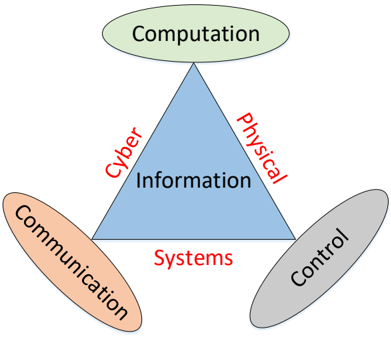
The image depicts a triangular diagram representing a model of Cyber-Physical Systems. The triangle's corners are labeled with "Computation", "Communication", and "Control", while the sides are labeled "Cyber", "Physical", and "Systems". The center of the triangle contains the word "Information". The diagram illustrates the interconnectedness of these elements within a cyber-physical system.
### Components/Axes
* **Central Element:** "Information" (located in the center of the triangle)
* **Corners:**
* "Computation" (top center)
* "Communication" (bottom-left)
* "Control" (bottom-right)
* **Sides:**
* "Cyber" (left side, connecting "Computation" and "Information") - Red text
* "Physical" (right side, connecting "Control" and "Information") - Red text
* "Systems" (bottom side, connecting "Communication" and "Control") - Red text
### Detailed Analysis or Content Details
The diagram is a conceptual model and does not contain numerical data or specific values. It visually represents relationships between components. The triangle shape suggests a strong interdependence between the elements. The labels are positioned to indicate the relationships:
* **Computation** is linked to the **Cyber** domain.
* **Communication** is linked to the **Systems** domain.
* **Control** is linked to the **Physical** domain.
* **Information** is central to all three domains.
### Key Observations
The diagram emphasizes that information is the core element connecting the cyber, physical, and systems aspects of a cyber-physical system. The use of a triangle suggests a balanced and integrated relationship between these components. The color red used for the sides ("Cyber", "Physical", "Systems") may indicate their foundational importance.
### Interpretation
This diagram illustrates a foundational model for understanding Cyber-Physical Systems (CPS). CPS are engineered systems that are built from, and depend upon, the tight integration of computation, networking, and physical processes. The diagram highlights that:
* **Cyber aspects** (computation, data processing) are essential for managing and interpreting information.
* **Physical aspects** (control, actuation) are responsible for interacting with the real world.
* **Systems aspects** (communication, coordination) ensure the seamless integration of cyber and physical components.
* **Information** is the lifeblood of the system, flowing between all components and enabling intelligent operation.
The model suggests that a disruption in any one of these areas can impact the entire system. For example, a failure in communication could prevent control signals from reaching the physical components, leading to system malfunction. The diagram is a high-level representation and doesn't delve into the specifics of how these components are implemented or interact, but it provides a useful framework for analyzing and designing CPS.