## Diagram: Cyber-Physical-Information Systems Conceptual Model
### Overview
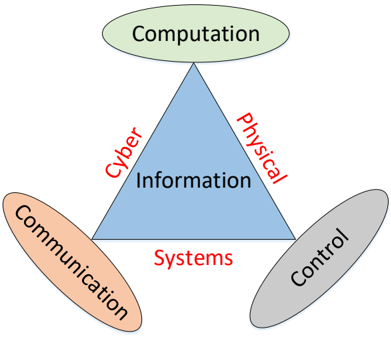
The image is a conceptual diagram illustrating the interrelationships between core domains of modern integrated systems. It features a central triangle connected to three surrounding ovals, with text labels defining each component and the relationships between them. The diagram visually represents the foundational pillars of Cyber-Physical Systems (CPS) or similar integrated engineering frameworks.
### Components/Axes
The diagram consists of four primary geometric shapes with associated text labels:
1. **Central Triangle:**
* **Shape:** An equilateral triangle, colored light blue.
* **Central Label:** The word **"Information"** is written in black text at the center of the triangle.
* **Side Labels:** Each side of the triangle has a label written in red text, oriented parallel to the side:
* Left side: **"Cyber"**
* Right side: **"Physical"**
* Bottom side: **"Systems"**
2. **Surrounding Ovals:** Three ovals are positioned at the vertices of the central triangle, each containing a single word in black text.
* **Top Oval:** Positioned at the top vertex of the triangle. Color: Light green. Text: **"Computation"**.
* **Bottom-Left Oval:** Positioned at the bottom-left vertex of the triangle. Color: Light orange/peach. Text: **"Communication"**.
* **Bottom-Right Oval:** Positioned at the bottom-right vertex of the triangle. Color: Light gray. Text: **"Control"**.
### Detailed Analysis
* **Spatial Relationships:** The diagram is structured as a hub-and-spoke model with "Information" at the core. The three ovals (Computation, Communication, Control) are connected to this core via the labeled domains on the triangle's sides.
* The **"Computation"** oval (top) is linked to the core via the **"Cyber"** and **"Physical"** sides of the triangle.
* The **"Communication"** oval (bottom-left) is linked to the core via the **"Cyber"** and **"Systems"** sides.
* The **"Control"** oval (bottom-right) is linked to the core via the **"Physical"** and **"Systems"** sides.
* **Text Transcription (All text is in English):**
* Computation
* Communication
* Control
* Information
* Cyber
* Physical
* Systems
### Key Observations
1. **Central Role of Information:** "Information" is placed at the geometric and conceptual center, indicating it is the fundamental element that binds and enables the other components.
2. **Tripartite Foundation:** The three outer ovals—Computation, Communication, and Control—form a classic triad often cited as the core capabilities of cyber-physical systems.
3. **Domain Bridging:** The labels on the triangle's sides ("Cyber," "Physical," "Systems") act as bridges or interfaces. They define the nature of the interaction between the central "Information" core and each of the outer capability domains.
4. **Color Coding:** Each outer domain has a distinct color (green, orange, gray), while the central triangle and its connecting labels use a unified blue and red scheme, visually separating the core framework from its applied capabilities.
### Interpretation
This diagram presents a high-level conceptual model for understanding complex, integrated systems where digital (cyber) and physical processes are intertwined.
* **What it suggests:** It argues that modern systems are built upon three essential capabilities: **Computation** (processing data), **Communication** (exchanging data), and **Control** (acting on data to influence physical processes). These capabilities do not exist in isolation; they are fundamentally connected through the management and flow of **Information**.
* **Relationships:** The "Cyber" domain likely relates to the digital, computational, and network aspects. The "Physical" domain relates to the tangible, mechanical, and environmental aspects. "Systems" refers to the integrated whole, the architecture, and the engineered structure that binds cyber and physical elements together. Information flows through and is acted upon within all three of these bridging domains.
* **Underlying Meaning:** The model emphasizes that the value and functionality of such systems emerge from the **integration** of these components. A smart grid, autonomous vehicle, or industrial automation system relies on seamless computation, communication, and control, all orchestrated through information that bridges the cyber and physical worlds within a coherent system architecture. The absence or failure of any one component (e.g., poor communication) would disrupt the entire information flow and system function.