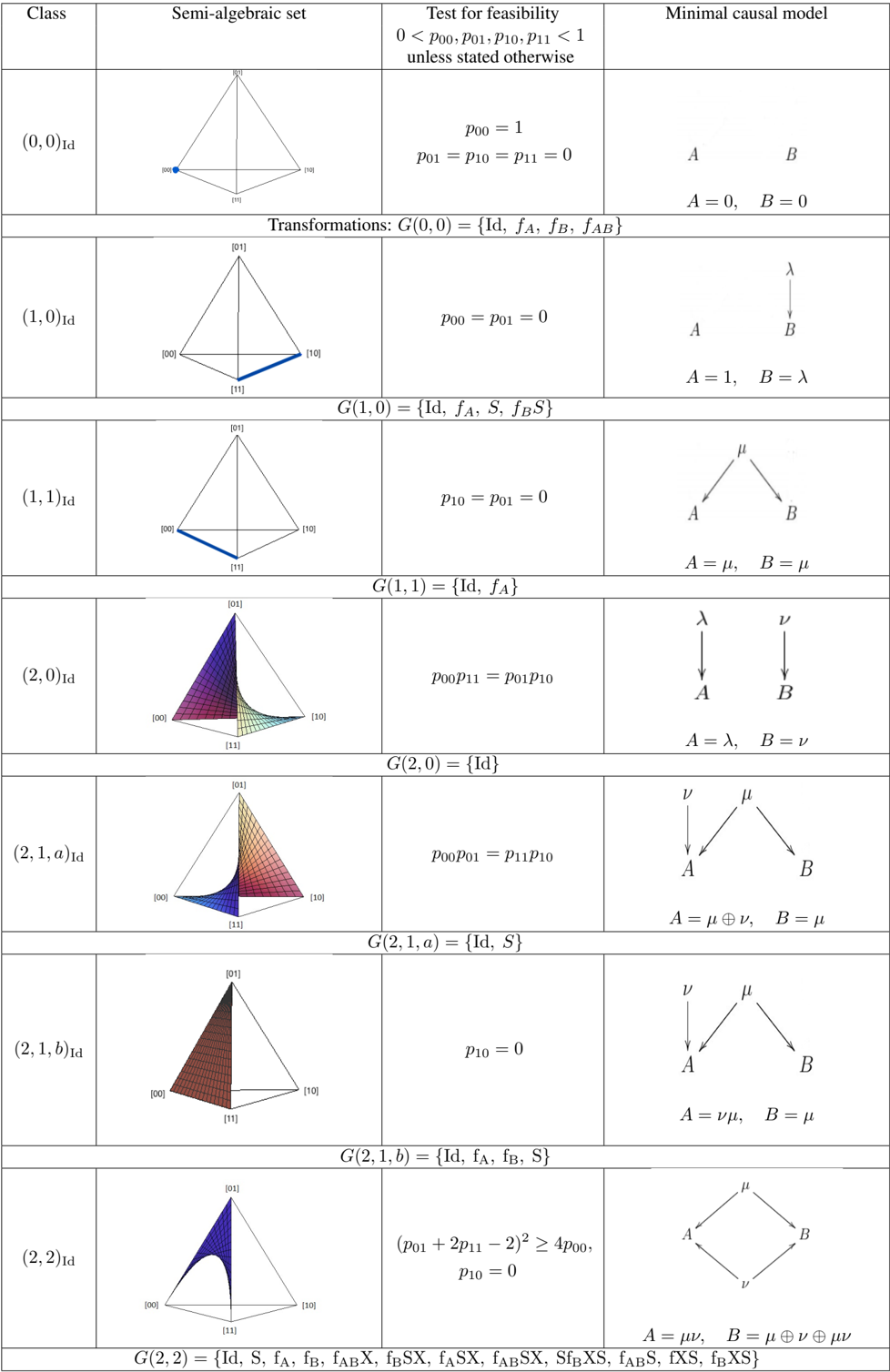
## Table: Semi-Algebraic Sets, Feasibility Conditions, and Causal Models
### Overview
The image presents a structured table analyzing probabilistic and causal relationships across multiple classes labeled as (n,m)Id, where n and m are integers. Each class includes:
1. A 3D semi-algebraic set diagram (left column)
2. Feasibility test conditions (middle column)
3. Minimal causal models (right column)
4. Transformations between classes (horizontal dividers)
### Components/Axes
- **Classes**: Labeled as (n,m)Id (e.g., (0,0)Id, (1,0)Id, (2,2)Id)
- **Semi-Algebraic Sets**: 3D diagrams with nodes [00], [01], [10], [11] connected by edges
- **Feasibility Tests**: Probabilistic constraints (e.g., p₀₀=1, p₀₁=p₁₀=p₁₁=0)
- **Causal Models**: Directed graphs with variables A and B, sometimes involving Greek letters (μ, λ, ν)
- **Transformations**: Function mappings like G(n,m) = {Id, f_A, f_B, f_AB, ...}
### Detailed Analysis
#### Class (0,0)Id
- **Semi-Algebraic Set**: Tetrahedral diagram with nodes [00], [01], [10], [11]. Edges connect all nodes except [01]-[10].
- **Feasibility**: p₀₀=1; p₀₁=p₁₀=p₁₁=0
- **Causal Model**: A=0, B=0 (no causal influence)
#### Class (1,0)Id
- **Semi-Algebraic Set**: Tetrahedral diagram with highlighted edge [00]-[10]. Nodes [00] and [10] emphasized.
- **Feasibility**: p₀₀=p₀₁=0
- **Causal Model**: A=1, B=λ (λ represents a parameter)
#### Class (1,1)Id
- **Semi-Algebraic Set**: Tetrahedral diagram with highlighted edge [00]-[10]. Nodes [00] and [10] emphasized.
- **Feasibility**: p₀₀=p₀₁=0
- **Causal Model**: A=μ, B=μ (μ represents a shared parameter)
#### Class (2,0)Id
- **Semi-Algebraic Set**: Colored tetrahedral diagram with gradient shading (blue to green to purple). Nodes [00], [01], [10], [11] connected.
- **Feasibility**: p₀₀p₁₁ = p₀₁p₁₀
- **Causal Model**: A=λ, B=ν (λ and ν represent independent parameters)
#### Class (2,1)aId
- **Semi-Algebraic Set**: Tetrahedral diagram with gradient shading (blue to orange). Nodes [00], [01], [10], [11] connected.
- **Feasibility**: p₀₀p₀₁ = p₁₁p₁₀
- **Causal Model**: A=μ⊕ν, B=μ (μ and ν represent combined parameters)
#### Class (2,1)bId
- **Semi-Algebraic Set**: Tetrahedral diagram with gradient shading (red to white). Nodes [00], [01], [10], [11] connected.
- **Feasibility**: p₁₀=0
- **Causal Model**: A=νμ, B=μ (ν and μ represent dependent parameters)
#### Class (2,2)Id
- **Semi-Algebraic Set**: Tetrahedral diagram with gradient shading (blue to purple). Nodes [00], [01], [10], [11] connected.
- **Feasibility**: (p₀₁ + 2p₁₁ - 2)² ≥ 4p₀₀; p₁₀=0
- **Causal Model**: A=μ⊕ν, B=μ⊕ν⊕μν (complex parameter interactions)
### Transformations
- **G(0,0)**: {Id, f_A, f_B, f_AB}
- **G(1,1)**: {Id, f_A}
- **G(2,0)**: {Id}
- **G(2,1,a)**: {Id, S}
- **G(2,1,b)**: {Id, f_A, f_B, S}
- **G(2,2)**: {Id, S, f_A, f_B, f_AB, f_A SX, f_B SX, f_A S, f_B S, f_XS, f_AB S, f_X, f_AB XS}
### Key Observations
1. **Probabilistic Constraints**: Feasibility conditions enforce specific relationships between joint probabilities (e.g., p₀₀p₁₁ = p₀₁p₁₀ in (2,0)Id).
2. **Causal Hierarchy**: Higher-index classes (e.g., (2,2)Id) exhibit increasingly complex causal dependencies involving parameter combinations (⊕, ⊗).
3. **Transformation Complexity**: Later transformations (e.g., G(2,2)) include more functions, suggesting expanded operational capabilities.
4. **Color Coding**: Gradient shading in semi-algebraic sets correlates with parameter ranges (e.g., darker regions in (2,1)bId indicate higher p₁₁ values).
### Interpretation
This table appears to model a probabilistic system where:
- **Semi-algebraic sets** represent feasible state spaces under constraints
- **Feasibility tests** define valid probability distributions
- **Causal models** formalize dependencies between variables A and B
- **Transformations** encode operations that modify the system's state
The progression from simple (0,0)Id to complex (2,2)Id classes suggests a framework for analyzing increasingly sophisticated probabilistic-causal systems. The use of Greek letters (μ, λ, ν) implies parameterized relationships, while the transformation functions (f_A, f_AB, etc.) likely represent interventions or measurements affecting the system's dynamics.
The constraints (e.g., p₀₀p₁₁ = p₀₁p₁₀) resemble conditional independence conditions, while the causal models' structure hints at a Bayesian network interpretation. The final class (2,2)Id's complex feasibility condition and causal model suggest this framework can model systems with feedback loops or higher-order interactions.