## Diagram: Agent Collaboration Workflow
### Overview
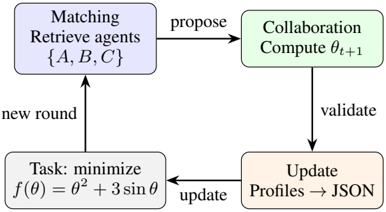
The image depicts a cyclical workflow diagram illustrating the process of agent collaboration. The diagram consists of four stages represented by rounded rectangles, connected by arrows indicating the flow of the process.
### Components/Axes
* **Nodes:**
* **Matching Retrieve agents {A, B, C}:** (Top-left, blue) Represents the stage where agents are matched and retrieved. The agents are denoted as A, B, and C.
* **Collaboration Compute θt+1:** (Top-right, green) Represents the collaboration stage where a value θt+1 is computed.
* **Update Profiles → JSON:** (Bottom-right, orange) Represents the stage where profiles are updated and converted to JSON format.
* **Task: minimize f(θ) = θ² + 3 sin θ:** (Bottom-left, gray) Represents the task of minimizing the function f(θ) = θ² + 3 sin θ.
* **Edges (Arrows):**
* **propose:** Connects "Matching Retrieve agents {A, B, C}" to "Collaboration Compute θt+1".
* **validate:** Connects "Collaboration Compute θt+1" to "Update Profiles → JSON".
* **update:** Connects "Update Profiles → JSON" to "Task: minimize f(θ) = θ² + 3 sin θ".
* **new round:** Connects "Task: minimize f(θ) = θ² + 3 sin θ" to "Matching Retrieve agents {A, B, C}".
### Detailed Analysis
The workflow starts with the "Matching Retrieve agents {A, B, C}" stage. The agents A, B, and C are retrieved and matched. The process then moves to the "Collaboration Compute θt+1" stage via the "propose" action. In this stage, the agents collaborate to compute a value θt+1. The computed value is then validated, leading to the "Update Profiles → JSON" stage. Here, the profiles are updated and converted into JSON format. Finally, the profiles are updated, and the process loops back to the "Task: minimize f(θ) = θ² + 3 sin θ" stage via the "update" action, where the task is to minimize the function f(θ) = θ² + 3 sin θ. The process then loops back to the "Matching Retrieve agents {A, B, C}" stage via the "new round" action, restarting the cycle.
### Key Observations
* The diagram represents a closed-loop system.
* The process involves matching agents, collaboration, updating profiles, and minimizing a function.
* The arrows indicate the direction of the workflow.
### Interpretation
The diagram illustrates an iterative process of agent collaboration aimed at minimizing a given function. The agents are matched and retrieved, they collaborate to compute a value, the profiles are updated based on this value, and the process repeats with the goal of minimizing the function f(θ). The conversion to JSON suggests that the profiles are being stored or transmitted in a standardized data format. The cyclical nature of the diagram indicates a continuous optimization process.