## Flow Diagram: Node Processing System
### Overview
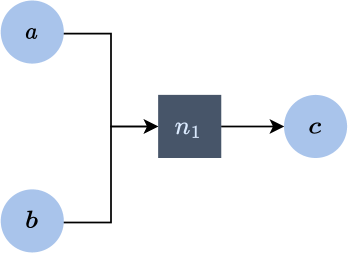
The diagram illustrates a sequential data flow or processing system with four nodes: three input/output entities (`a`, `b`, `c`) and one processing unit (`n₁`). Arrows indicate directional relationships between components.
### Components/Axes
- **Nodes**:
- `a`: Circular node positioned at top-left
- `b`: Circular node positioned at bottom-left
- `n₁`: Rectangular node at center (dark blue fill)
- `c`: Circular node at top-right
- **Arrows**:
- Black arrows connect `a` → `n₁` and `b` → `n₁`
- Single arrow connects `n₁` → `c`
- **Color Coding**:
- Light blue: Input/Output nodes (`a`, `b`, `c`)
- Dark blue: Processing node (`n₁`)
- Black: Arrows (directional indicators)
### Detailed Analysis
1. **Input Nodes**:
- `a` and `b` both feed into `n₁` independently
- Positioning suggests parallel input streams
2. **Processing Unit**:
- `n₁` acts as a central processing node
- Rectangular shape distinguishes it from input/output nodes
3. **Output Node**:
- `c` receives processed output from `n₁`
- Positioned diagonally opposite to input nodes
### Key Observations
- No numerical values or quantitative data present
- Symmetrical input configuration (two sources → one processor)
- Single output pathway from processing unit
- Shape differentiation implies functional categorization
### Interpretation
This diagram represents a **data transformation pipeline** where:
1. Inputs `a` and `b` are processed concurrently by `n₁`
2. The rectangular shape of `n₁` suggests it may represent:
- A computational module
- A decision-making unit
- A data fusion processor
3. Output `c` likely contains combined/transformed information from both inputs
4. The absence of feedback loops implies a strictly sequential workflow
The system appears designed for **parallel input processing with serial output generation**, common in:
- Signal processing architectures
- Decision tree models
- Data preprocessing pipelines
- Workflow automation systems
The diagram emphasizes **modularity** (distinct node types) and **directionality** (unidirectional flow), suggesting a focus on controlled data transformation processes.