## Diagram: Agent-Cache Interaction with RadixTree Structure
### Overview
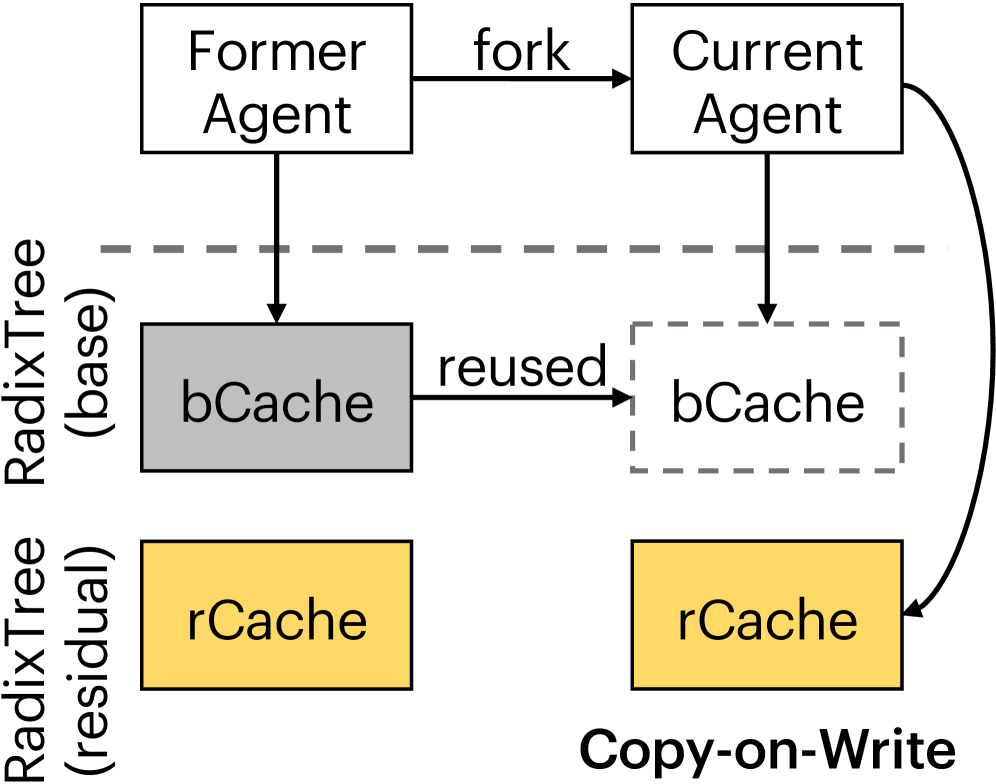
The diagram illustrates a system architecture involving two agents (Former and Current) interacting with two cache types (bCache and rCache) and two RadixTree structures (base and residual). Arrows indicate data flow, with labels like "fork," "reused," and "Copy-on-Write" describing operations. The diagram uses color coding (gray for bCache, yellow for rCache) and dashed lines to differentiate components.
---
### Components/Axes
1. **Nodes**:
- **Former Agent**: Top-left, connected via "fork" to Current Agent.
- **Current Agent**: Top-right, connected to bCache (dashed) and rCache (solid).
- **bCache**: Gray box, labeled "reused," connected to both agents.
- **rCache**: Yellow box, connected to Current Agent with a loop labeled "Copy-on-Write."
- **RadixTree (base)**: Dashed line above bCache.
- **RadixTree (residual)**: Dashed line below rCache.
2. **Arrows**:
- **Fork**: From Former Agent to Current Agent (solid black).
- **Reused**: From bCache to Current Agent (solid black).
- **Copy-on-Write**: Loop from rCache to itself (solid black).
3. **Color Coding**:
- **Gray**: bCache (base cache).
- **Yellow**: rCache (residual cache).
- **Black**: All other elements (agents, arrows, labels).
---
### Detailed Analysis
1. **Flow Paths**:
- **Former → Current Agent**: The "fork" arrow suggests a branching point where data is split or redirected.
- **bCache Reuse**: The dashed line from bCache to Current Agent implies shared or cached data is reused.
- **rCache Loop**: The "Copy-on-Write" loop indicates data modification without overwriting original data, common in copy-on-write (CoW) systems.
2. **RadixTree Structure**:
- **Base RadixTree**: Positioned above bCache, likely representing the primary data structure.
- **Residual RadixTree**: Positioned below rCache, possibly handling residual or delta data.
3. **Color Significance**:
- Gray (bCache) and yellow (rCache) visually distinguish cache types, with bCache being "reused" and rCache tied to CoW operations.
---
### Key Observations
1. **Data Reuse**: bCache is explicitly labeled "reused," suggesting it acts as a shared cache between agents.
2. **CoW Mechanism**: The rCache loop emphasizes a CoW strategy, critical for data integrity in distributed systems.
3. **RadixTree Segmentation**: The split into base and residual RadixTrees implies hierarchical data management, with base handling core data and residual managing updates.
---
### Interpretation
This diagram likely represents a distributed system or database architecture where:
- **Former and Current Agents** collaborate, with data flowing between them via a fork mechanism.
- **bCache** optimizes performance by reusing cached data, reducing redundant computations.
- **rCache** employs CoW to ensure data consistency during updates, critical for systems requiring atomic operations.
- **RadixTrees** (base/residual) manage data partitioning, with base handling stable data and residual tracking changes.
The use of dashed lines for bCache connections may indicate optional or conditional interactions, while solid lines for rCache emphasize mandatory CoW operations. The diagram highlights a balance between data reuse (bCache) and consistency (rCache/CoW), common in systems prioritizing both efficiency and reliability.