## Flow Diagram: Agent-User Interaction Cycle
### Overview
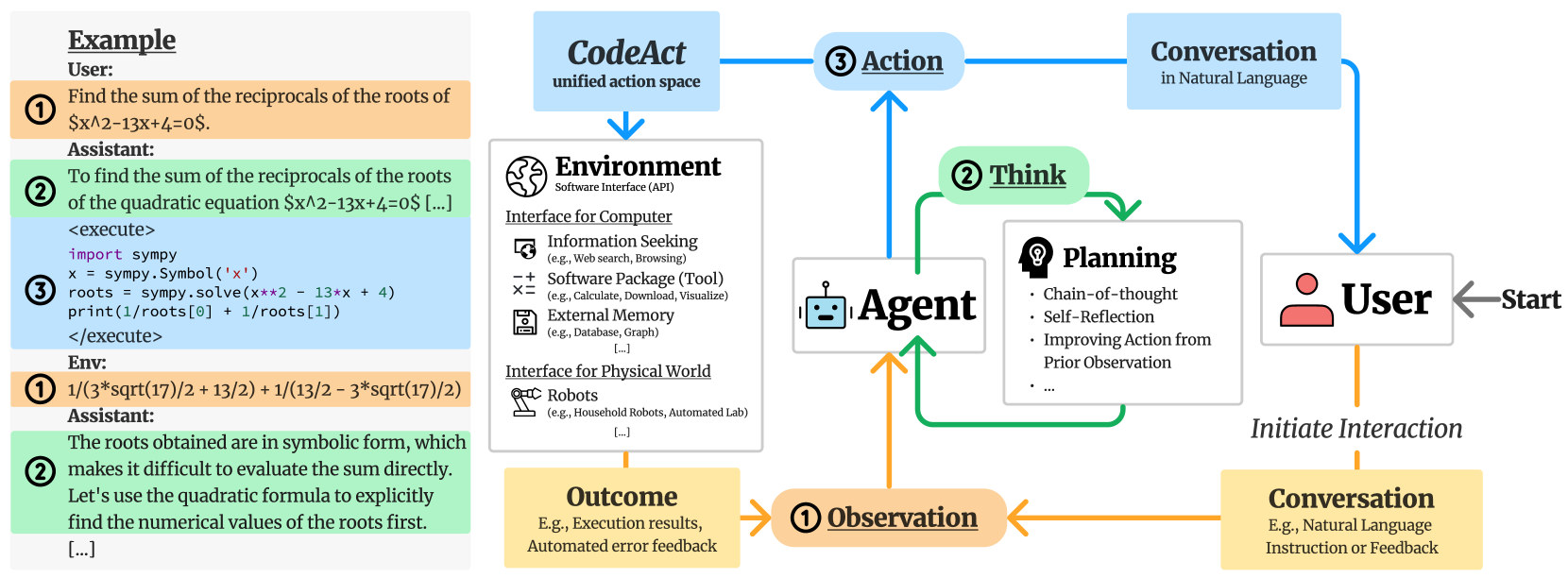
The image is a flow diagram illustrating the interaction cycle between an agent and a user. It outlines the steps involved in a conversation, action execution, and observation, with the agent utilizing planning and thinking processes. The diagram highlights the flow of information and actions between the user, agent, environment, and the resulting outcomes.
### Components/Axes
* **Nodes:**
* **User:** Represents the human interacting with the system.
* **Agent:** Represents the intelligent system or bot.
* **CodeAct:** Unified action space.
* **Environment:** Software interface (API) with sub-components like Information Seeking, Software Package (Tool), External Memory, and Interface for Physical World.
* **Action:** Represents the action taken by the agent.
* **Think:** Represents the agent's thinking process.
* **Planning:** Represents the agent's planning process, including chain-of-thought, self-reflection, and improving action from prior observation.
* **Observation:** Represents the agent's observation of the outcome.
* **Outcome:** Execution results, automated error feedback.
* **Conversation:** Natural language interaction between user and agent.
* **Arrows:** Indicate the flow of information and actions between the nodes.
* **Numerical Labels:** Numbered circles indicating the sequence of actions (1, 2, 3).
* **Textual Examples:** Blocks of text providing an example interaction between the user and the agent.
### Detailed Analysis
1. **User Interaction (Left Side):**
* **Example:** A user asks the agent to find the sum of the reciprocals of the roots of the equation $x^2 - 13x + 4 = 0$.
* The agent responds by providing code to solve the problem using the `sympy` library.
* The environment returns the symbolic result.
* The assistant acknowledges that the symbolic form is difficult to evaluate directly and suggests using the quadratic formula.
2. **Agent-Environment Interaction (Center):**
* The "CodeAct" node represents a unified action space, connected to the "Environment" node.
* The "Environment" node lists several sub-components:
* Interface for Computer: Information Seeking (e.g., Web search, Browsing), Software Package (Tool) (e.g., Calculate, Download, Visualize), External Memory (e.g., Database, Graph).
* Interface for Physical World: Robots (e.g., Household Robots, Automated Lab).
* The agent interacts with the environment to perform actions and gather information.
3. **Agent Planning and Thinking (Center):**
* The agent "Thinks" and engages in "Planning".
* "Planning" involves chain-of-thought reasoning, self-reflection, and improving actions based on prior observation.
4. **Interaction Cycle (Right Side):**
* The user initiates the interaction ("Start").
* The agent takes an "Action" based on its planning.
* The action leads to a "Conversation" in natural language.
* The agent makes an "Observation" of the "Outcome".
* The "Observation" feeds back into the agent's planning process, creating a cycle.
* The "Outcome" node is connected to the "Conversation" node, indicating that the results of the agent's actions are communicated back to the user.
### Key Observations
* The diagram emphasizes the iterative nature of the agent-user interaction, with the agent continuously learning and improving its actions based on observations.
* The "Environment" node highlights the diverse range of tools and interfaces available to the agent.
* The "Planning" node underscores the importance of reasoning and self-reflection in the agent's decision-making process.
### Interpretation
The diagram illustrates a sophisticated agent-user interaction model where the agent not only executes commands but also engages in planning, thinking, and learning. The agent leverages a rich environment of tools and interfaces to perform actions and gathers information. The feedback loop between observation and planning allows the agent to adapt and improve its performance over time. The example interaction demonstrates how the agent can handle complex tasks by breaking them down into smaller steps and utilizing external resources. The diagram suggests a system designed for continuous learning and adaptation, enabling the agent to effectively assist users in a variety of tasks.