\n
## Diagram: Agent Interaction Loop with Code Interaction
### Overview
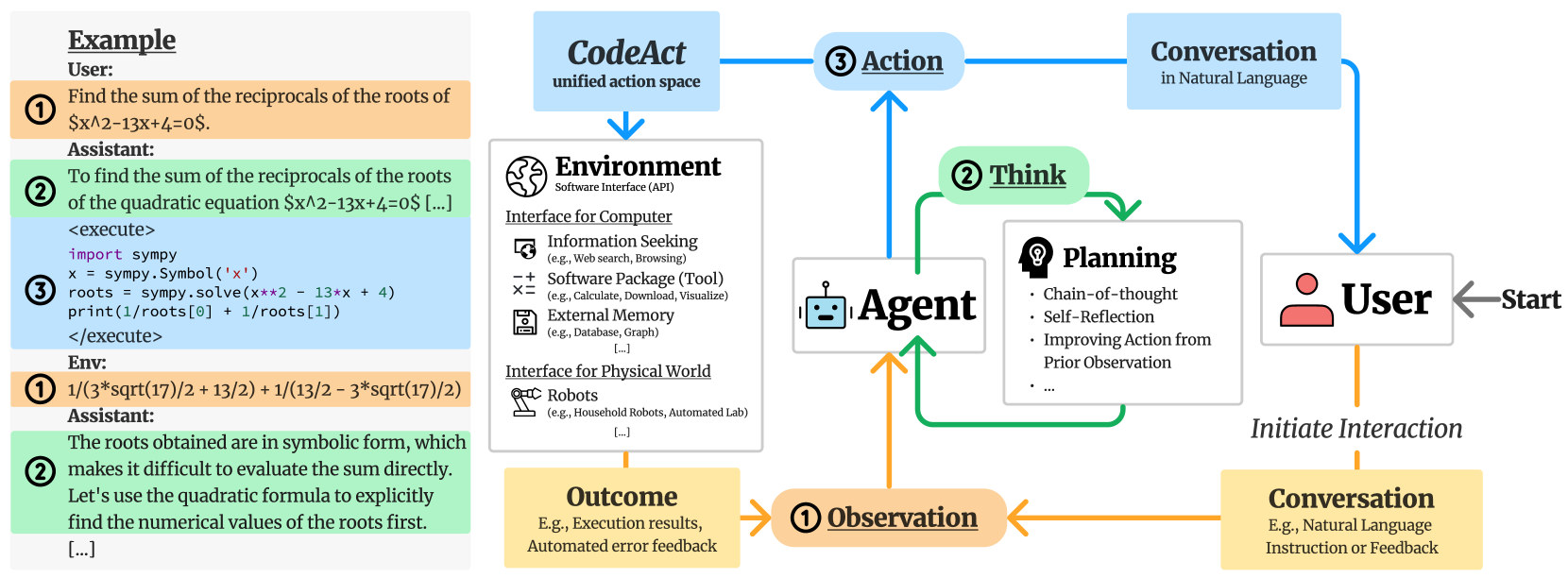
This diagram illustrates an agent-based system interacting with a user through natural language conversation, and utilizing a "CodeAct" unified action space to solve problems. The diagram depicts a cyclical process of observation, thinking (planning), and action, with code execution as a key component of the action phase. The diagram is segmented into three main areas: the interaction loop (center), the user interaction (right), and the code interaction (left).
### Components/Axes
The diagram consists of the following key components:
* **User:** Represented by a red circle, labeled "User" and positioned on the right side of the diagram. An arrow labeled "Start" points from the user towards the interaction loop.
* **Agent:** Represented by a teal-colored figure in the center of the diagram.
* **CodeAct:** A rectangular box labeled "CodeAct" and "unified action space" positioned above the agent.
* **Environment:** A large, rounded rectangle labeled "Environment" and "Software Interface (API)" positioned to the left of the agent. This contains sub-components:
* Information Seeking (e.g., web search, browsing)
* Software Package (Tool) (e.g., calculator, download, visualize)
* External Memory (e.g., database, graph)
* Robots (e.g., Household Robots, Automated Lab)
* **Outcome:** A rectangular box labeled "Outcome" and "E.g., Execution results, Automated error feedback" positioned below the Environment.
* **Conversation:** Two rectangular boxes labeled "Conversation in Natural Language" (right) and "E.g., Natural Language Instruction or Feedback" (right)
* **Think:** A rounded rectangle labeled "Think" positioned above the Agent, containing:
* Planning (Chain-of-thought, Self-Reflection, Improving Action from Prior Observation)
* **Action:** A rounded rectangle labeled "Action" positioned to the left of the Agent.
* **Observation:** A rounded rectangle labeled "Observation" positioned below the Agent.
* **Numbered Steps:** The diagram includes numbered steps (1-3) within the code interaction section, indicating a sequence of actions.
The diagram uses arrows to indicate the flow of information and interaction between these components.
### Detailed Analysis or Content Details
The diagram illustrates a loop:
1. **User initiates interaction:** The user starts the process.
2. **Agent observes:** The agent observes the environment.
3. **Agent thinks/plans:** The agent processes information and plans an action.
4. **Agent acts:** The agent executes an action, often involving code through the "CodeAct" interface.
5. **Environment provides outcome:** The environment returns an outcome based on the agent's action.
6. **Conversation:** The agent and user engage in natural language conversation.
The left side of the diagram details a specific example of code interaction:
1. **User:** "Find the sum of the reciprocals of the roots of Sx^2-13x+4=0S."
2. **Assistant:** "To find the sum of the reciprocals of the roots of the quadratic equation Sx^2-13x+4=0S [...]"
3. **<execute>:**
* `import sympy`
* `x = sympy.Symbol('x')`
* `roots = sympy.solve(x**2 - 13*x + 4)`
* `print(1/roots[0] + 1/roots[1])`
* `<execute>`
4. **Env:** 1/(3*sqrt(17)/2 + 13/2) + 1/(13/2 - 3*sqrt(17)/2)
5. **Assistant:** "The roots obtained are in symbolic form, which makes it difficult to evaluate the sum directly. Let's use the quadratic formula to explicitly find the numerical values of the roots first. [...]"
### Key Observations
* The diagram emphasizes the role of code execution as a core component of the agent's action capabilities.
* The "CodeAct" interface acts as a bridge between the agent's internal reasoning and the external environment.
* The loop structure highlights the iterative nature of the agent's problem-solving process.
* The example demonstrates the agent's ability to understand natural language, translate it into code, execute the code, and provide a response.
* The diagram shows the agent's ability to handle symbolic calculations and recognize the need for numerical approximation.
### Interpretation
This diagram represents a modern approach to AI agent design, where agents are not simply rule-based systems but are capable of leveraging code execution to solve complex problems. The "CodeAct" concept suggests a unified action space that allows the agent to seamlessly integrate code into its reasoning and decision-making processes. The cyclical nature of the diagram highlights the importance of observation, planning, and feedback in achieving intelligent behavior. The example provided demonstrates the agent's ability to perform mathematical calculations, handle symbolic expressions, and adapt its approach based on the results. This suggests a powerful and flexible AI system capable of tackling a wide range of tasks. The inclusion of components like "Information Seeking" and "Robots" indicates the potential for the agent to interact with the real world and access external resources. The diagram is a conceptual illustration of a sophisticated AI architecture, rather than a depiction of a specific implementation.