## Flowchart: Conversational AI System Architecture
### Overview
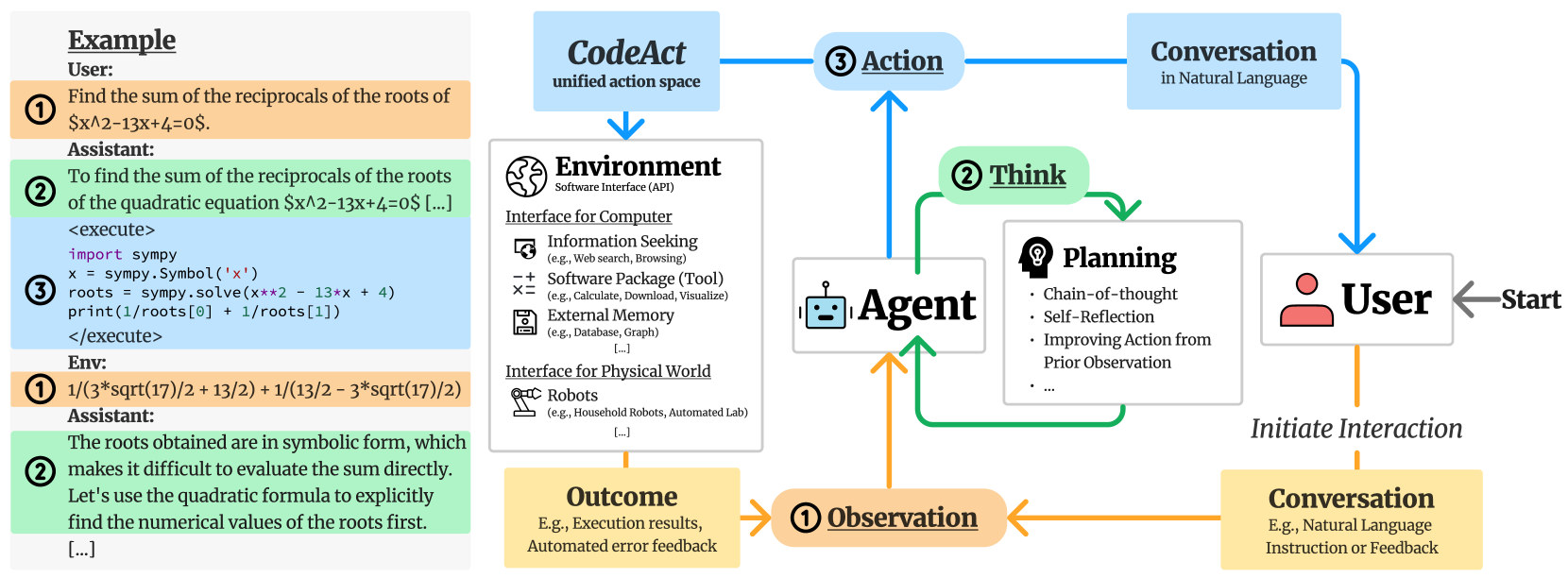
The diagram illustrates a conversational AI system's workflow, showing interactions between a user, an agent, and an environment. It emphasizes a feedback loop involving planning, action execution, observation, and outcome evaluation. The system integrates natural language processing, code execution, and external tools to handle complex tasks.
### Components/Axes
1. **User**: Initiates interaction via natural language instructions or feedback.
2. **Agent**: Central processing unit with:
- **Planning**: Chain-of-thought reasoning, self-reflection, and action improvement.
- **Action**: Unified action space for executing tasks.
3. **Environment**: Interface for computer systems, physical world, and external memory.
4. **Observation**: Feedback mechanism for outcomes and error correction.
5. **Outcome**: Results of executed actions (e.g., code execution results).
### Detailed Analysis
#### User Interaction
- **Start**: User initiates interaction (orange arrow).
- **Conversation**: Natural language input/output (blue box).
#### Agent Workflow
1. **Planning** (green arrow):
- Chain-of-thought reasoning
- Self-reflection
- Action improvement from prior observations
2. **Action** (blue arrow):
- Unified action space for task execution
- Connects to environment interfaces
#### Environment Interfaces
- **Computer**: Web search, software packages, APIs
- **Physical World**: Robots, automated labs
- **External Memory**: Databases, graphs
#### Feedback Loop
- **Observation** (orange arrow):
- Execution results
- Automated error feedback
- **Outcome** (yellow box):
- Final results of actions
- Error correction signals
#### Example Workflow
1. **User Query**: "Find the sum of the reciprocals of the roots of $x^2 - 13x + 4 = 0$."
2. **Agent Response**:
- **Planning**: Identifies need for symbolic computation
- **Action**: Executes SymPy code to solve quadratic equation
- **Outcome**: Returns symbolic roots
- **Observation**: Notes difficulty in direct evaluation
- **Planning Adjustment**: Suggests quadratic formula for numerical values
### Key Observations
1. **Modular Design**: Clear separation between user interaction, agent reasoning, and environment interaction.
2. **Feedback Integration**: Continuous improvement through observation and error feedback.
3. **Tool Integration**: Explicit connections to external tools (code execution, APIs).
4. **Example Validation**: Demonstrates system's ability to handle mathematical reasoning tasks.
### Interpretation
This architecture represents a sophisticated conversational AI system capable of:
1. Understanding natural language queries
2. Breaking down complex problems into executable actions
3. Leveraging external tools for computation
4. Iteratively improving through feedback loops
The example demonstrates the system's capability to:
- Parse mathematical expressions
- Execute symbolic computation
- Recognize limitations in symbolic results
- Propose alternative approaches for numerical evaluation
The feedback loop ensures continuous improvement, while the unified action space allows flexible task execution across different domains (computational, physical, informational). The system's design emphasizes both immediate task completion and long-term learning from interactions.