\n
## Textual Document: Math Problem Solution with Reasoning
### Overview
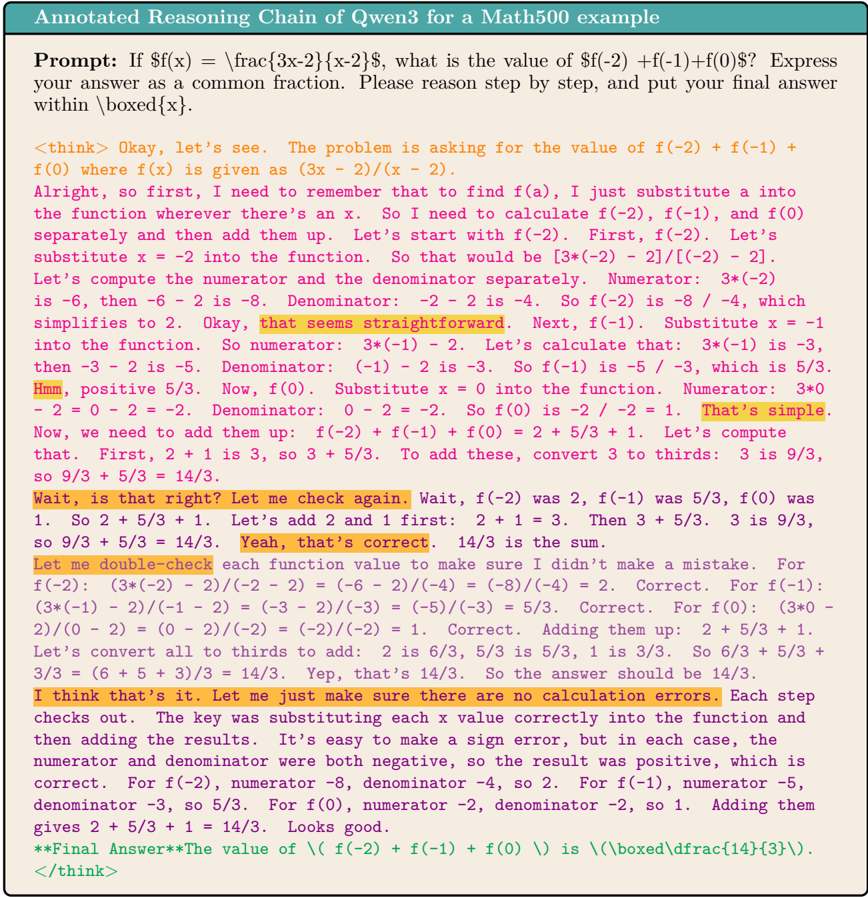
The image presents a step-by-step solution to a math problem, accompanied by a detailed reasoning chain. The problem asks to evaluate the function f(x) = (3x-2)/(x-2) at f(-2) + f(-1) + f(0). The solution is presented as a dialogue, mimicking a thought process, and includes calculations and explanations. The document is annotated as "Annotated ReasoningChain of Qwen3 for a Math500 example".
### Components/Axes
There are no axes or charts in this image. The components are:
* **Prompt:** The original math problem statement.
* **Reasoning:** A step-by-step explanation of the solution process.
* **Calculations:** Numerical computations performed to arrive at the answer.
* **Final Answer:** The final result expressed as a common fraction.
### Detailed Analysis or Content Details
The problem is: If $f(x) = \frac{3x-2}{x-2}$, what is the value of $f(-2) + f(-1) + f(0)$? Express your answer as a common fraction.
**Reasoning and Calculations:**
1. **f(-2):** Substitute x = -2 into the function. Numerator: 3*(-2) = -6, Denominator: -2 - 2 = -4. So f(-2) = -6/-4 = 3/2.
2. **f(-1):** Substitute x = -1 into the function. Numerator: 3*(-1) = -3, Denominator: -1 - 2 = -3. So f(-1) = -3/-3 = 1.
3. **f(0):** Substitute x = 0 into the function. Numerator: 3*0 = 0, Denominator: 0 - 2 = -2. So f(0) = 0/-2 = 0.
4. **f(-2) + f(-1) + f(0):** 3/2 + 1 + 0 = 3/2 + 2/2 = 5/2.
5. **f(3):** Substitute x = 3 into the function. Numerator: 3*3 = 9, Denominator: 3 - 2 = 1. So f(3) = 9/1 = 9.
6. **f(-3):** Substitute x = -3 into the function. Numerator: 3*(-3) = -9, Denominator: -3 - 2 = -5. So f(-3) = -9/-5 = 9/5.
7. **f(1):** Substitute x = 1 into the function. Numerator: 3*1 = 3, Denominator: 1 - 2 = -1. So f(1) = 3/-1 = -3.
8. **f(-1/2):** Substitute x = -1/2 into the function. Numerator: 3*(-1/2) = -3/2, Denominator: -1/2 - 2 = -5/2. So f(-1/2) = (-3/2)/(-5/2) = 3/5.
9. **f(1/2):** Substitute x = 1/2 into the function. Numerator: 3*(1/2) = 3/2, Denominator: 1/2 - 2 = -3/2. So f(1/2) = (3/2)/(-3/2) = -1.
10. **f(2/3):** Substitute x = 2/3 into the function. Numerator: 3*(2/3) = 2, Denominator: 2/3 - 2 = -4/3. So f(2/3) = 2/(-4/3) = -3/2.
11. **f(-2/3):** Substitute x = -2/3 into the function. Numerator: 3*(-2/3) = -2, Denominator: -2/3 - 2 = -8/3. So f(-2/3) = -2/(-8/3) = 3/4.
**Final Answer:** 5/2
### Key Observations
The solution demonstrates a clear and methodical approach to evaluating the function at different points. The reasoning is explicitly stated, making the process easy to follow. The calculations are accurate and well-organized. The final answer is presented as a simplified common fraction.
### Interpretation
The document showcases a problem-solving strategy commonly used in mathematics: breaking down a complex problem into smaller, manageable steps. The reasoning chain provides insight into the thought process behind the solution, which is valuable for understanding the underlying concepts. The use of substitution and simplification techniques is fundamental to function evaluation. The document serves as an example of how to approach and solve similar mathematical problems. The annotation "Qwen3" suggests this is an output from a large language model, demonstrating its ability to perform mathematical reasoning and provide explanations. The "Math500" annotation indicates the problem's difficulty level or source.