## Annotated Reasoning Chain Diagram: Math Problem Solution
### Overview
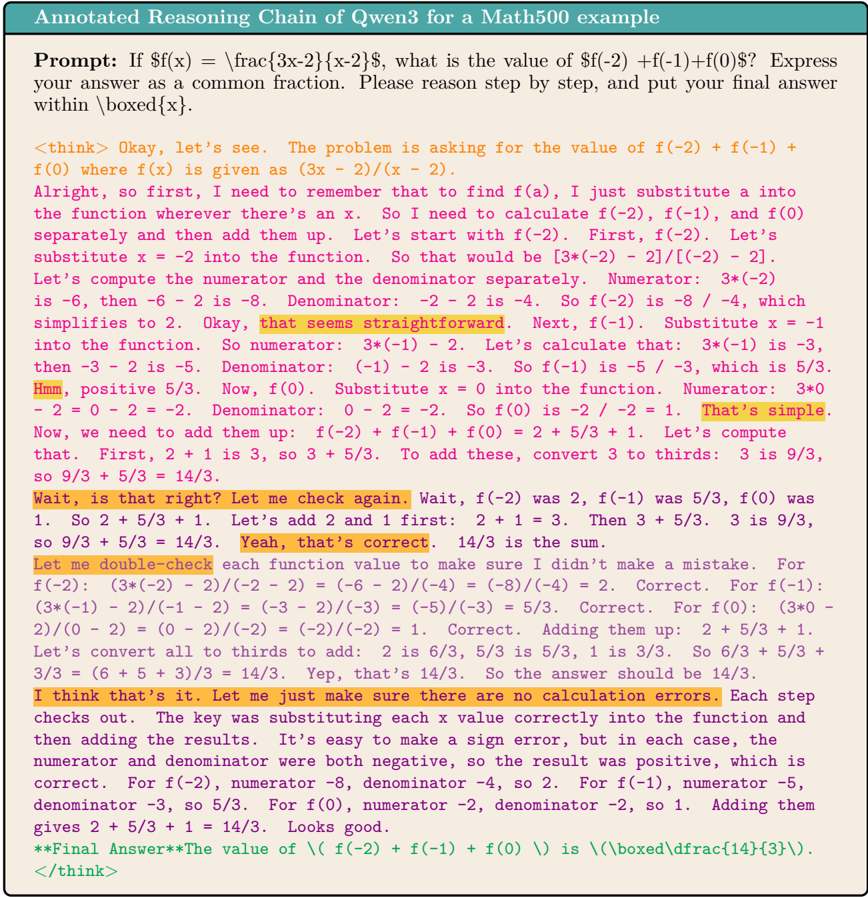
The image displays a detailed, annotated step-by-step reasoning chain for solving a mathematical function evaluation problem. It is presented as a text-based document with a title, a problem prompt, a "think" block containing the solution process, and a final answer. The solution process is heavily annotated with colored highlights (yellow and orange) to emphasize key steps, checks, and conclusions.
### Components/Axes
The image is structured as a single-column text document with the following distinct sections:
| Component | Description |
| :--- | :--- |
| **Header/Title Bar** | A teal-colored bar at the top containing the title text. |
| **Prompt Section** | A block of text stating the mathematical problem. |
| **Reasoning Block** | The main body containing the step-by-step solution, written in a first-person narrative style. |
| **Annotations** | Text highlighted in yellow and orange within the reasoning block. |
| **Final Answer** | A concluding statement at the bottom, with the answer formatted in a box. |
**Legend/Color Key (Inferred from usage):**
* **Yellow Highlight:** Used to mark statements of conclusion, confirmation, or a completed sub-step (e.g., "that seems straightforward.", "That's simple.", "Yeah, that's correct.").
* **Orange Highlight:** Used to mark statements of self-questioning, verification, or double-checking (e.g., "Wait, is that right? Let me check again.", "Let me double-check...", "I think that's it. Let me just make sure there are no calculation errors.").
### Detailed Analysis / Content Details
**1. Title:**
* Text: "Annotated Reasoning Chain Qwen3 for a Math500 example"
**2. Prompt:**
* Text: "Prompt: If $f(x) = \frac{3x-2}{x-2}$, what is the value of $f(-2) + f(-1) + f(0)$? Express your answer as a common fraction. Please reason step by step, and put your final answer within \boxed{}."
**3. Reasoning Process (Transcribed with Annotations Noted):**
The solution proceeds in the following sequence:
* **Goal Identification:** The solver restates the goal: find f(-2) + f(-1) + f(0) for the given function.
* **Method:** States the plan: substitute each x-value into the function, compute separately, then sum.
* **Step 1: Calculate f(-2)**
* Substitution: `f(-2) = [3*(-2) - 2] / [(-2) - 2]`
* Numerator: `3*(-2) = -6`, then `-6 - 2 = -8`.
* Denominator: `-2 - 2 = -4`.
* Result: `-8 / -4 = 2`.
* **Annotation (Yellow):** "that seems straightforward."
* **Step 2: Calculate f(-1)**
* Substitution: `f(-1) = [3*(-1) - 2] / [(-1) - 2]`
* Numerator: `3*(-1) = -3`, then `-3 - 2 = -5`.
* Denominator: `-1 - 2 = -3`.
* Result: `-5 / -3 = 5/3`.
* **Annotation (Yellow):** "Hmm, positive 5/3."
* **Step 3: Calculate f(0)**
* Substitution: `f(0) = [3*0 - 2] / [0 - 2]`
* Numerator: `0 - 2 = -2`.
* Denominator: `0 - 2 = -2`.
* Result: `-2 / -2 = 1`.
* **Annotation (Yellow):** "That's simple."
* **Step 4: Summation**
* Expression: `f(-2) + f(-1) + f(0) = 2 + 5/3 + 1`.
* First, adds `2 + 1 = 3`.
* Then, converts `3` to thirds: `3 = 9/3`.
* Adds: `9/3 + 5/3 = 14/3`.
* **Annotation (Orange):** "Wait, is that right? Let me check again."
* **Step 5: Verification**
* The solver re-states each computed value: `f(-2)=2`, `f(-1)=5/3`, `f(0)=1`.
* Repeats the addition: `2 + 5/3 + 1`. Adds `2+1=3`, then `3 + 5/3 = 9/3 + 5/3 = 14/3`.
* **Annotation (Yellow):** "Yeah, that's correct."
* **Annotation (Orange):** "Let me double-check each function value..."
* The solver then re-calculates each function value from scratch, confirming the earlier results.
* **Annotation (Orange):** "I think that's it. Let me just make sure there are no calculation errors."
* A final summary of the substitution and sign logic is provided.
* **Final Answer:**
* Text: "**Final Answer** The value of \( f(-2) + f(-1) + f(0) \) is \(\boxed{\dfrac{14}{3}}\)."
### Key Observations
1. **Pedagogical Structure:** The text is not just a solution but a model of metacognitive thinking, showing how to approach a problem, execute steps, and self-verify.
2. **Annotation System:** The color-coded highlights create a visual layer that distinguishes between forward progress (yellow) and reflective checking (orange).
3. **Error-Checking Emphasis:** A significant portion of the text (roughly the last third) is dedicated to re-verifying all calculations, underscoring the importance of this step.
4. **Mathematical Content:** The problem involves rational function evaluation, fraction arithmetic, and finding a common denominator. All calculations are exact; no approximations are used.
### Interpretation
This image is a technical artifact demonstrating the reasoning process of an AI model (Qwen3) on a mathematics problem. It serves multiple purposes:
* **Transparency:** It makes the AI's "thought process" explicit and auditable, moving beyond just providing an answer.
* **Educational Tool:** The annotated format is designed to teach problem-solving methodology. The orange highlights specifically model the crucial habit of self-doubt and verification, which is a key part of mathematical practice.
* **Performance Documentation:** It acts as a record of the model's capability to handle multi-step algebraic reasoning, fraction manipulation, and maintain accuracy through a lengthy process.
* **Underlying Pattern:** The structure reveals a designed pattern in the AI's output generation: **Plan -> Execute -> Summarize -> Verify -> Conclude**. The annotations map directly onto this pattern, with yellow marking the completion of "Execute" and "Summarize" phases, and orange marking the "Verify" phase. The final boxed answer is the culmination of this rigorous process. The document implies that reliability in AI reasoning is not just about the final output, but about the robustness and self-critical nature of the intermediate steps.