## Screenshot: Annotated Reasoning Chain for Math500 Example
### Overview
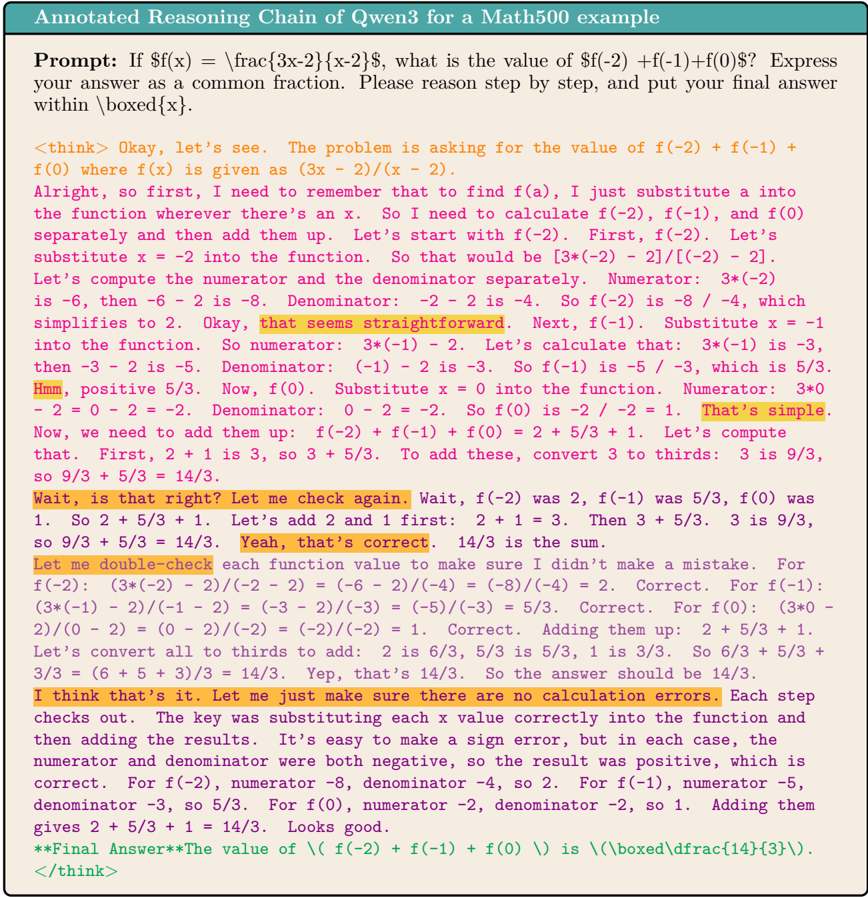
The image displays a step-by-step annotated reasoning chain for solving a Math500 problem involving the function $ f(x) = \frac{3x - 2}{x - 2} $. The assistant evaluates $ f(-2) + f(-1) + f(0) $, with color-coded highlights (orange, pink, purple, green) to emphasize key steps, corrections, and the final answer. The text includes self-corrections, verification checks, and explicit annotations like `\<think\>` and `\</think\>`.
---
### Components/Axes
- **Prompt**:
- Text: "If $ f(x) = \frac{3x - 2}{x - 2} $, what is the value of $ f(-2) + f(-1) + f(0) $? Express your answer as a common fraction. Please reason step by step, and put your final answer within `\boxed{}`."
- **Thought Process**:
- Color-coded annotations:
- **Orange**: Initial problem setup and substitution steps (e.g., "Let’s start with $ f(-2) $").
- **Pink**: Intermediate calculations and simplifications (e.g., "Numerator: $ 3 \times (-2) - 2 = -8 $").
- **Purple**: Corrections and re-evaluations (e.g., "Wait, is that right? Let me check again.").
- **Green**: Final verification and conclusion (e.g., "**Final Answer**: The value is $ \frac{14}{3} $").
- **Final Answer**:
- Text: "**Final Answer**: The value of $ (f(-2) + f(-1) + f(0)) $ is $ \boxed{\frac{14}{3}} $."
---
### Detailed Analysis
1. **Initial Substitutions**:
- $ f(-2) $: Substituted $ x = -2 $, calculated numerator $ 3(-2) - 2 = -8 $, denominator $ -2 - 2 = -4 $, simplified to $ 2 $.
- $ f(-1) $: Substituted $ x = -1 $, numerator $ 3(-1) - 2 = -5 $, denominator $ -1 - 2 = -3 $, simplified to $ \frac{5}{3} $.
- $ f(0) $: Substituted $ x = 0 $, numerator $ -2 $, denominator $ -2 $, simplified to $ 1 $.
2. **Summation and Verification**:
- Sum: $ 2 + \frac{5}{3} + 1 = \frac{14}{3} $.
- Self-corrections: The assistant rechecked each substitution (e.g., confirming $ f(-2) = 2 $, $ f(-1) = \frac{5}{3} $, $ f(0) = 1 $) to avoid calculation errors.
3. **Color-Coded Highlights**:
- **Orange**: Emphasized critical steps (e.g., "that seems straightforward").
- **Pink**: Highlighted intermediate results (e.g., "Denominator: $ -1 - 2 = -3 $").
- **Purple**: Marked corrections (e.g., "Let me double-check each function value").
- **Green**: Indicated final confirmation (e.g., "I think that’s it. Let me just make sure there are no calculation errors.").
---
### Key Observations
- **Self-Correction Mechanism**: The assistant explicitly re-evaluated each step to ensure accuracy, a common practice in rigorous problem-solving.
- **Fraction Simplification**: All results were converted to a common denominator ($ \frac{14}{3} $) for clarity.
- **Final Answer Format**: The answer is boxed as per the prompt’s requirement, ensuring compliance with the problem’s instructions.
---
### Interpretation
The annotated reasoning chain demonstrates a methodical approach to solving a rational function problem. The assistant’s use of color coding and explicit verification steps underscores attention to detail and error prevention. The final answer, $ \frac{14}{3} $, is derived through systematic substitution and summation, validated by multiple checks. This process highlights the importance of iterative validation in mathematical problem-solving, particularly for complex functions where sign errors or arithmetic mistakes are common.