## Diagram: AI-assisted Research Workflow
### Overview
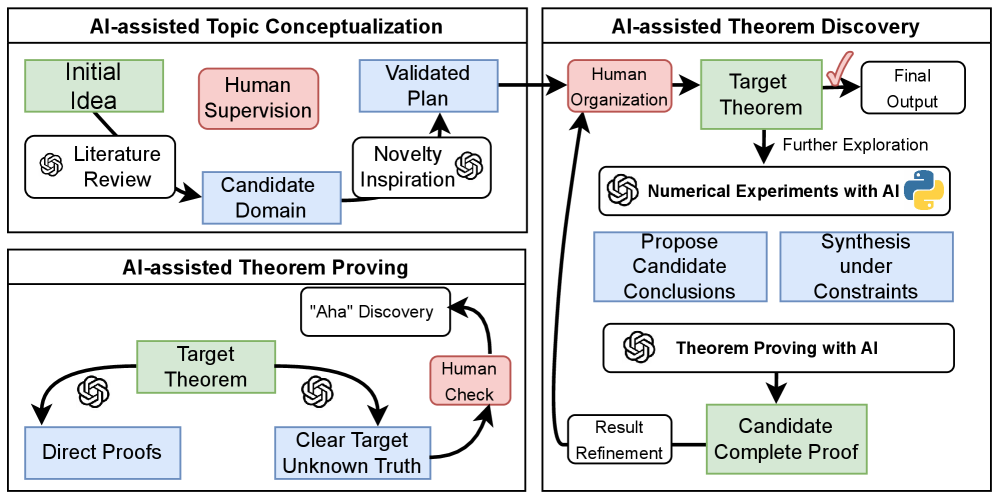
The image presents a flowchart illustrating an AI-assisted research workflow, divided into three main stages: Topic Conceptualization, Theorem Discovery, and Theorem Proving. Each stage involves a combination of AI tools and human input, represented by labeled boxes and connecting arrows.
### Components/Axes
**Overall Structure:** The diagram is divided into three main sections, arranged horizontally from left to right:
1. **AI-assisted Topic Conceptualization:** Focuses on generating and refining research topics.
2. **AI-assisted Theorem Discovery:** Focuses on discovering potential theorems.
3. **AI-assisted Theorem Proving:** Focuses on proving the discovered theorems.
**Color Coding:**
* Green boxes: Represent initial or final states/outputs.
* Red boxes: Represent human involvement/interaction.
* Blue boxes: Represent intermediate states/processes.
* Boxes with the ChatGPT logo: Represent AI-driven processes.
* Boxes with the Python logo: Represent Python-driven processes.
**Individual Components and Flow:**
* **AI-assisted Topic Conceptualization (Left Section):**
* "Initial Idea" (Green box, top-left): Starting point of the research process.
* Arrow from "Initial Idea" points down to "Literature Review" (White box with ChatGPT logo).
* "Human Supervision" (Red box, top-middle): Indicates human oversight.
* Arrow from "Literature Review" points to "Candidate Domain" (Blue box).
* Arrow from "Candidate Domain" points to "Validated Plan" (Blue box, top-right).
* "Novelty Inspiration" (White box with ChatGPT logo) points to "Validated Plan".
* Arrow from "Validated Plan" points to the "AI-assisted Theorem Discovery" section.
* **AI-assisted Theorem Discovery (Middle Section):**
* "Human Organization" (Red box, top-left): Human involvement in organizing the research.
* Arrow from "Human Organization" points to "Target Theorem" (Green box, top-middle).
* "Target Theorem" has a green checkmark next to it.
* Arrow from "Target Theorem" points to "Final Output" (White box, top-right).
* Arrow from "Target Theorem" points down to "Further Exploration".
* "Numerical Experiments with AI" (White box with ChatGPT and Python logo) is below "Further Exploration".
* Arrow from "Numerical Experiments with AI" points to "Propose Candidate Conclusions" (Blue box).
* Arrow from "Numerical Experiments with AI" points to "Synthesis under Constraints" (Blue box).
* Arrow from "Propose Candidate Conclusions" and "Synthesis under Constraints" points to "Human Organization".
* **AI-assisted Theorem Proving (Right Section):**
* "Direct Proofs" (Blue box, bottom-left).
* Arrow from "Direct Proofs" points to "Target Theorem" (Green box).
* "Clear Target Unknown Truth" (Blue box, bottom-middle).
* Arrow from "Clear Target Unknown Truth" points to "Target Theorem" (Green box).
* "Human Check" (Red box, bottom-middle).
* "Aha Discovery" (Curved arrow) connects "Target Theorem" to "Human Check".
* Curved arrow connects "Human Check" to "Clear Target Unknown Truth".
* "Theorem Proving with AI" (White box with ChatGPT logo) is below "Synthesis under Constraints".
* Arrow from "Theorem Proving with AI" points to "Candidate Complete Proof" (Green box, bottom-right).
* "Result Refinement" (White box) points to "Candidate Complete Proof".
### Detailed Analysis or ### Content Details
The diagram illustrates a cyclical and iterative research process. The "AI-assisted Theorem Discovery" section shows a loop where numerical experiments and synthesis lead to candidate conclusions, which are then organized by humans, potentially leading to a target theorem. The "AI-assisted Theorem Proving" section also shows a loop involving direct proofs, human checks, and refinement of the target.
### Key Observations
* The diagram emphasizes the interplay between AI and human researchers.
* The use of ChatGPT and Python logos indicates specific tools used in the process.
* The cyclical nature of the theorem discovery and proving stages highlights the iterative nature of research.
* The color-coding provides a clear visual distinction between different types of activities.
### Interpretation
The diagram presents a model for how AI can augment and accelerate the research process. It suggests that AI can be used for tasks such as literature review, novelty inspiration, numerical experimentation, and theorem proving, while humans provide oversight, organization, and validation. The iterative nature of the process allows for continuous refinement and improvement of the research outcomes. The diagram highlights the potential for AI to assist in both generating new ideas and rigorously proving them.