\n
## Diagram: AI-Assisted Research Workflow
### Overview
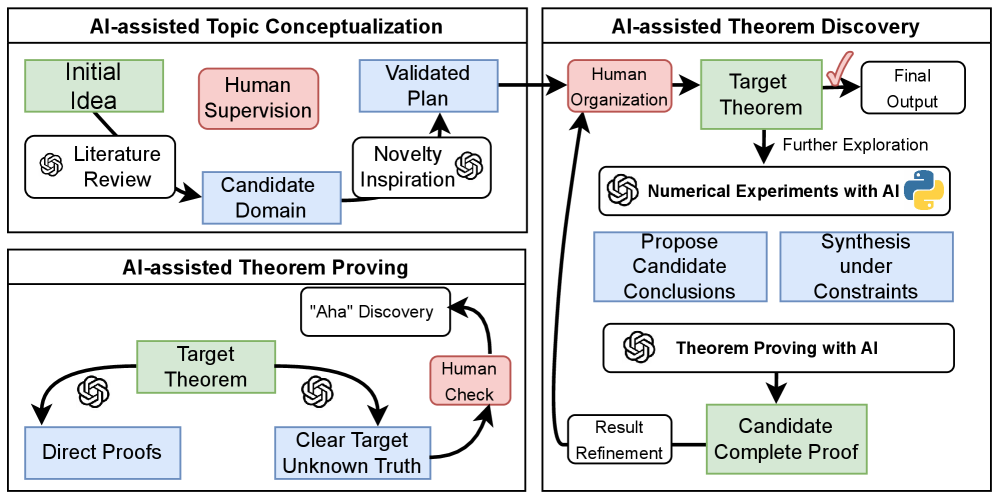
The image depicts a diagram illustrating a workflow for AI-assisted research, broken down into three main phases: AI-assisted Topic Conceptualization, AI-assisted Theorem Discovery, and AI-assisted Theorem Proving. Each phase is represented by a rectangular block, with interconnected nodes representing steps and processes. Arrows indicate the flow of information and interaction between these steps, with some arrows indicating human involvement. The diagram uses a consistent visual language of rounded rectangles for process steps and curved arrows for flow.
### Components/Axes
The diagram is divided into three main sections:
1. **AI-assisted Topic Conceptualization** (Top-Left)
2. **AI-assisted Theorem Discovery** (Top-Right)
3. **AI-assisted Theorem Proving** (Bottom)
Within each section, the following components are present:
* **Nodes:** Representing specific steps or concepts (e.g., "Initial Idea", "Target Theorem", "Human Supervision").
* **Arrows:** Indicating the flow of information and dependencies between nodes. Some arrows have labels indicating the type of interaction (e.g., "Novelty Inspiration").
* **Icons:** Representing AI involvement (gear icon) or human involvement (head icon).
* **Text Labels:** Describing each node and arrow.
### Detailed Analysis or Content Details
**AI-assisted Topic Conceptualization (Top-Left):**
* **Initial Idea** -> **Human Supervision** -> **Validated Plan**
* **Initial Idea** -> **Literature Review** -> **Candidate Domain** -> **Novelty Inspiration** -> **Validated Plan**
* **Validated Plan** connects to **Human Organization** in the next section.
**AI-assisted Theorem Discovery (Top-Right):**
* **Human Organization** -> **Target Theorem** -> **Final Output** (with a red downward arrow indicating completion)
* **Target Theorem** -> **Further Exploration**
* **Numerical Experiments with AI** (gear icon) -> **Propose Candidate Conclusions** -> **Synthesis under Constraints** -> **Theorem Proving with AI** (gear icon) -> **Candidate Complete Proof**
* **Propose Candidate Conclusions** connects to **Target Theorem**.
**AI-assisted Theorem Proving (Bottom):**
* **Target Theorem** -> **Direct Proofs** (looping back to Target Theorem)
* **Target Theorem** -> **Clear Target Unknown Truth** -> **"Aha" Discovery** -> **Human Check** (head icon) -> **Result Refinement** -> **Candidate Complete Proof**
* **Candidate Complete Proof** connects to **Final Output** in the Theorem Discovery section.
**Additional Details:**
* A small Python logo is present near "Numerical Experiments with AI".
* The "Aha" Discovery node is enclosed in a speech bubble.
* The arrow from "Final Output" is red and points downwards.
### Key Observations
* The workflow is iterative, with loops present in both the Theorem Proving and Topic Conceptualization phases.
* Human involvement is crucial in several stages, particularly in supervision, organization, and checking.
* AI is used for tasks like numerical experiments, theorem proving, and synthesis.
* The diagram emphasizes the interplay between human intuition and AI capabilities.
* The diagram does not contain any numerical data or quantitative measurements.
### Interpretation
The diagram illustrates a cyclical and collaborative research process where AI tools augment human researchers. It suggests that AI is not meant to replace human intelligence but rather to enhance it by automating certain tasks, generating insights, and accelerating the discovery process. The iterative loops indicate that research is rarely linear and often requires revisiting previous steps based on new findings. The presence of the Python logo suggests that Python is a common programming language used in the AI components of this workflow. The diagram highlights the importance of human validation and oversight throughout the process, ensuring that AI-generated results are meaningful and reliable. The "Aha" discovery node suggests that AI can assist in generating novel insights, but ultimately, human interpretation and verification are necessary. The overall message is that AI-assisted research is a powerful combination of computational power and human creativity.