## Dialogue Snippet: Actor-Critic Interaction
### Overview
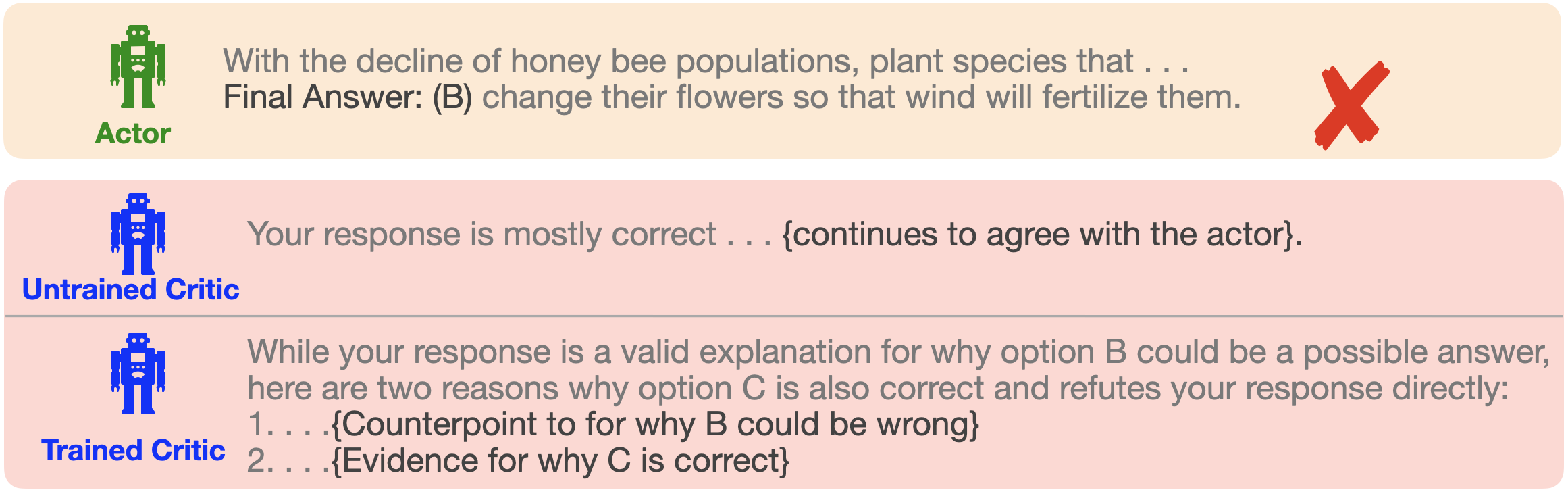
The image presents a snippet of a dialogue between an "Actor" and two "Critics" ("Untrained Critic" and "Trained Critic"). The Actor proposes a final answer to a question, which is then evaluated by the two critics. The Untrained Critic mostly agrees with the Actor, while the Trained Critic provides counterarguments and suggests an alternative answer.
### Components/Axes
* **Actor:** Represented by a green robot icon. The background is a light yellow.
* **Untrained Critic:** Represented by a blue robot icon. The background is a light pink.
* **Trained Critic:** Represented by a blue robot icon. The background is a light pink.
* **Red X:** Indicates disagreement or incorrectness, placed to the right of the Actor's statement.
### Detailed Analysis or Content Details
1. **Actor:**
* Text: "With the decline of honey bee populations, plant species that..."
* Text: "Final Answer: (B) change their flowers so that wind will fertilize them."
* Icon: Green robot.
2. **Untrained Critic:**
* Text: "Your response is mostly correct... {continues to agree with the actor}."
* Icon: Blue robot.
3. **Trained Critic:**
* Text: "While your response is a valid explanation for why option B could be a possible answer, here are two reasons why option C is also correct and refutes your response directly:"
* Text: "1....{Counterpoint to for why B could be wrong}"
* Text: "2....{Evidence for why C is correct}"
* Icon: Blue robot.
### Key Observations
* The Actor provides a specific answer (B) related to plant adaptation due to declining bee populations.
* The Untrained Critic shows agreement with the Actor's response.
* The Trained Critic acknowledges the validity of the Actor's answer but introduces a counterargument, suggesting that option C is also correct and provides reasons to support this claim.
* The red X next to the Actor's statement suggests that the Actor's answer is not entirely correct or complete.
### Interpretation
The dialogue illustrates a scenario where an initial answer is refined through critical evaluation. The Trained Critic's response highlights the importance of considering multiple perspectives and providing evidence-based arguments. The interaction suggests that while the Actor's answer might have some merit, it is not the most accurate or comprehensive solution, as indicated by the Trained Critic's counterpoints and the presence of the red "X". The scenario demonstrates a process of iterative improvement through constructive criticism.