## Screenshot: Multiple-Choice Question Feedback Interface
### Overview
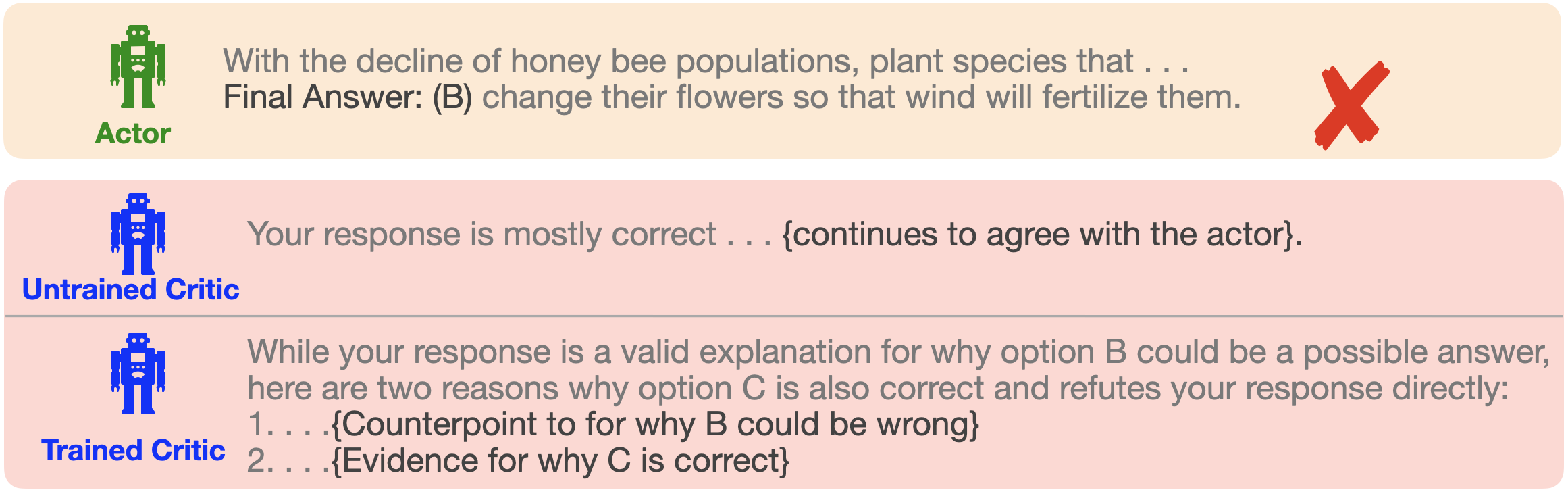
The image depicts a user interface for evaluating answers to a multiple-choice question about ecological adaptation. It features three distinct feedback sections labeled "Actor," "Untrained Critic," and "Trained Critic," each with robotic avatars and color-coded text boxes. The interface visually contrasts incorrect reasoning (Actor) with progressively refined critiques (Untrained vs. Trained Critics).
### Components/Axes
- **Avatar System**:
- Green robot icon labeled "Actor" (top section)
- Blue robot icon labeled "Untrained Critic" (middle section)
- Blue robot icon labeled "Trained Critic" (bottom section)
- **Text Boxes**:
- Beige background for Actor's response
- Light pink background for both critics' feedback
- **Annotations**:
- Red "X" mark on Actor's answer
- Curly brace notation `{...}` in critics' feedback
### Content Details
1. **Question Stem**:
- "With the decline of honey bee populations, plant species that ..."
- Implied context: Pollination mechanisms
2. **Actor's Response**:
- Final Answer: (B) change their flowers so that wind will fertilize them.
- Visual indicator: Red "X" mark
3. **Untrained Critic Feedback**:
- "Your response is mostly correct ... {continues to agree with the actor}"
4. **Trained Critic Feedback**:
- "While your response is a valid explanation for why option B could be a possible answer, here are two reasons why option C is also correct and refutes your response directly:"
- Two enumerated points:
1. `{Counterpoint to for why B could be wrong}`
2. `{Evidence for why C is correct}`
### Key Observations
- **Color Coding**:
- Actor's section uses green robot + beige box (warm tones)
- Critics use blue robots + pink boxes (cool tones)
- **Feedback Progression**:
- Actor: Incorrect assertion (wind pollination)
- Untrained Critic: Partial agreement without correction
- Trained Critic: Nuanced rebuttal with structured reasoning
- **Structural Hierarchy**:
- Vertical stacking emphasizes increasing expertise levels
- Curly braces in critics' feedback suggest expandable/collapsible content
### Interpretation
This interface demonstrates an educational technology system designed to:
1. **Identify Misconceptions**: The Actor's answer reflects a common misunderstanding about plant adaptation strategies
2. **Differentiate Feedback Quality**:
- Untrained Critic reinforces incorrect reasoning
- Trained Critic employs critical thinking frameworks (counterarguments + evidence)
3. **Visual Pedagogy**:
- Color coding and avatar design create intuitive expertise gradients
- The red "X" serves as immediate negative reinforcement
4. **Cognitive Scaffolding**:
- The Trained Critic's response models academic discourse patterns:
- Acknowledgment of partial validity
- Structured rebuttal with enumerated points
- Use of academic discourse markers ("while", "here are two reasons")
The system appears to implement a form of automated pedagogical scaffolding, where feedback complexity increases with the evaluator's "training" level. This suggests an AI-driven tutoring system that not only grades answers but actively develops students' critical thinking through progressively sophisticated rebuttals.