## Sunspot Observations: March-April
### Overview
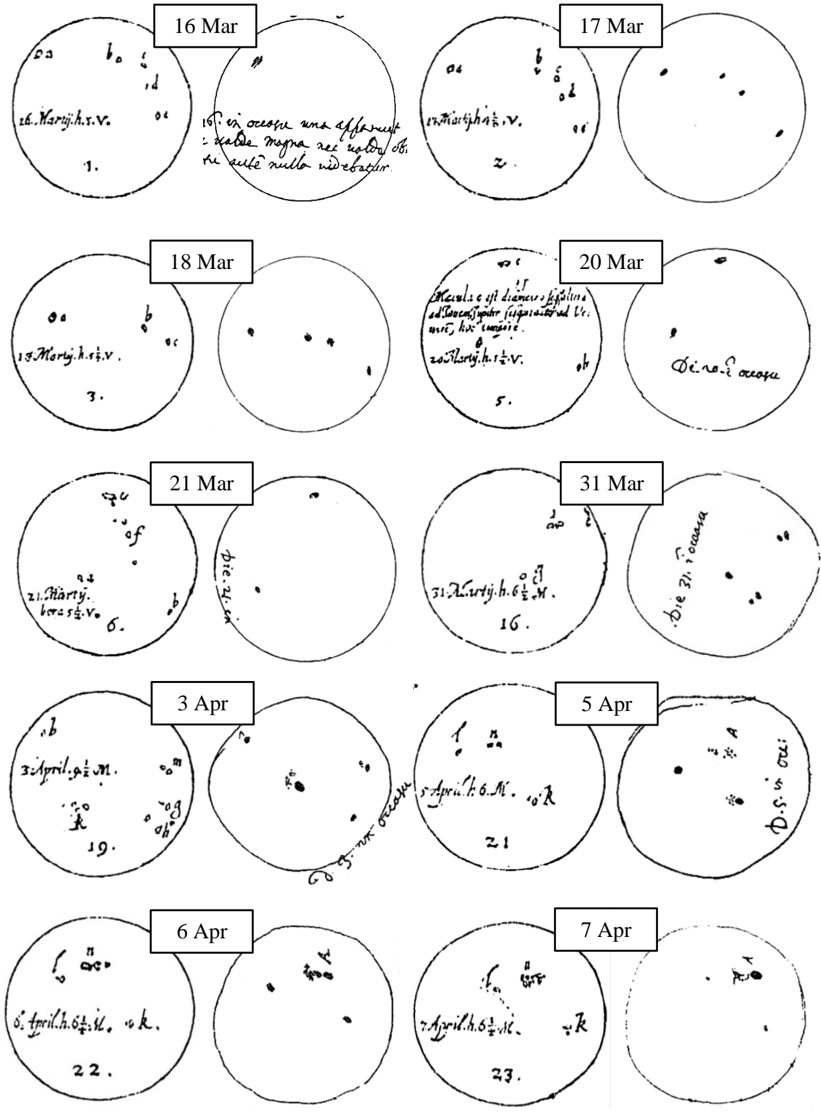
The image presents a series of hand-drawn diagrams depicting sunspot observations made between March 16th and April 7th. Each diagram consists of a circle representing the sun, with smaller dark spots indicating the positions of sunspots. The diagrams are arranged chronologically, with dates labeled above each pair of solar depictions. Handwritten notes and annotations accompany each diagram.
### Components/Axes
* **Diagrams:** Each diagram represents the sun's disk with sunspots marked as dark spots.
* **Dates:** Dates are labeled above each pair of solar depictions (e.g., "16 Mar", "17 Mar", "18 Mar", "20 Mar", "21 Mar", "31 Mar", "3 Apr", "5 Apr", "6 Apr", "7 Apr").
* **Annotations:** Handwritten notes and labels are present around each diagram, often including abbreviations and numbers.
### Detailed Analysis or ### Content Details
Here's a breakdown of the observations by date, including the approximate number and position of sunspots:
* **16 Mar:**
* Two solar depictions are present.
* The left depiction includes the label "16. Martij.h.r.v." and the number "1". It shows 4 small spots labeled "a", "b", "c", and "d".
* The right depiction includes the text "16. in occore una afferent - xalde magna nee voldet. the quite nullo videbatur."
* **17 Mar:**
* Two solar depictions are present.
* The left depiction includes the label "17. Martij.h.r.v." and the number "2". It shows 4 small spots labeled "a", "b", "c", and "d".
* The right depiction shows 3 spots.
* **18 Mar:**
* Two solar depictions are present.
* The left depiction includes the label "18. Martij.h.r.v." and the number "3". It shows 3 small spots labeled "a", "b", and "c".
* The right depiction shows 3 spots.
* **20 Mar:**
* Two solar depictions are present.
* The left depiction includes the label "20. Martij.h.r.v." and the number "5". It also includes the text "Maculis est diamerus ad solem superius fugientibus ad V. me, live cunesse".
* The right depiction includes the text "Die.ro. oreou" and shows 3 spots.
* **21 Mar:**
* Two solar depictions are present.
* The left depiction includes the label "21. Martij. horas.V." and the number "6". It shows multiple small spots labeled "a", "b", "c", "d", "e", and "f".
* The right depiction includes the text "Die.24." and shows 1 spot.
* **31 Mar:**
* Two solar depictions are present.
* The left depiction includes the label "31. Martij.h.6 1/2 M." and the number "16". It shows 2 spots.
* The right depiction includes the text "Die 31. Focoasa" and shows 3 spots.
* **3 Apr:**
* Two solar depictions are present.
* The left depiction includes the label "3. April. 9 1/2 M." and the number "19". It shows multiple small spots labeled "a", "b", "c", "d", "e", "f", "g", and "h".
* The right depiction includes the text "3. nk oreou" and shows 3 spots.
* **5 Apr:**
* Two solar depictions are present.
* The left depiction includes the label "5. April.h.6.M." and the number "21". It shows 3 spots.
* The right depiction includes the text "D.s. in oui" and shows 1 spot.
* **6 Apr:**
* Two solar depictions are present.
* The left depiction includes the label "6. April.h.6 1/2 M." and the number "22". It shows 2 spots.
* The right depiction shows 3 spots.
* **7 Apr:**
* Two solar depictions are present.
* The left depiction includes the label "7. April.h.6 1/2 M." and the number "23". It shows 1 spot.
* The right depiction shows no spots.
### Key Observations
* The number of observed sunspots varies significantly from day to day.
* Some diagrams include detailed annotations and labels, while others are simpler.
* The handwritten notes are in Latin, with some possible Italian phrases.
### Interpretation
The image provides a historical record of sunspot observations. The variations in the number and position of sunspots over time reflect the dynamic nature of the sun's surface. The annotations suggest a scientific interest in documenting and analyzing these phenomena. The Latin text indicates that these observations were likely made by a scholar or scientist familiar with the language of science at the time. The presence of two solar depictions for each date might indicate observations made at different times of the day or using different instruments. The diagrams provide valuable insights into the history of solar astronomy and the methods used to study the sun in the past.