## Flowchart: Machine Learning Model Development Pipeline
### Overview
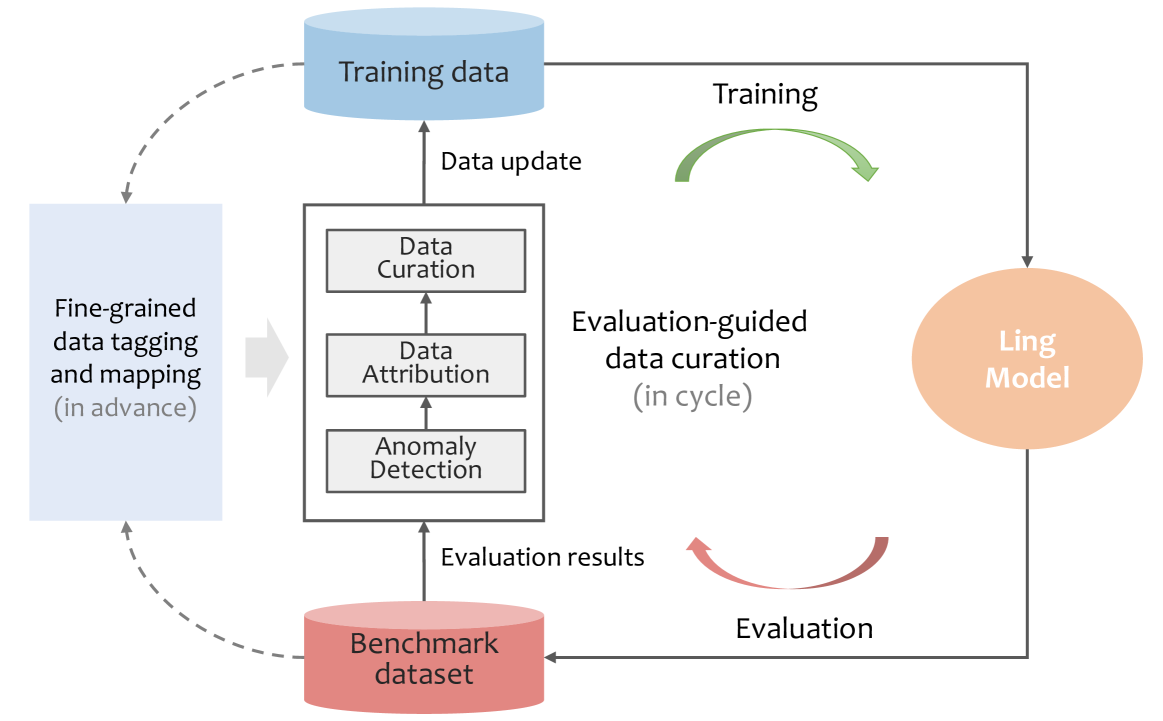
The diagram illustrates an iterative machine learning workflow involving data preparation, model training, evaluation, and continuous improvement. Key components include data curation, anomaly detection, and evaluation-guided refinement cycles.
### Components/Axes
1. **Training Data** (blue cylinder)
- Input source for model training
- Connected via dashed line to "Fine-grained data tagging and mapping (in advance)"
2. **Data Curation** (gray rectangle)
- Sub-components:
- Data Attribution
- Anomaly Detection
3. **Evaluation-guided Data Curation** (green arrow)
- Cyclical process feeding back into Data Curation
4. **Ling Model** (orange oval)
- Output of training process
- Connected to Evaluation via red arrow
5. **Benchmark Dataset** (red cylinder)
- Reference for evaluation
- Connected to Evaluation results
6. **Evaluation** (process)
- Receives input from Ling Model and Benchmark Dataset
- Outputs Evaluation results
### Detailed Analysis
- **Data Flow**:
1. Training data → Data Curation (attribution + anomaly detection)
2. Curated data → Ling Model training
3. Model evaluation against Benchmark Dataset
4. Evaluation results → Feedback loop to refine Data Curation
- **Key Connections**:
- Dashed lines indicate preparatory steps ("in advance")
- Solid arrows show active workflow progression
- Green/red arrows denote evaluation-driven refinement cycles
### Key Observations
1. **Iterative Nature**: Evaluation results directly influence data curation, creating a feedback loop for continuous improvement
2. **Preparatory Work**: Fine-grained data tagging occurs before main training data preparation
3. **Quality Control**: Anomaly detection is embedded in data curation to maintain dataset integrity
4. **Performance Measurement**: Benchmark Dataset serves as objective evaluation standard
### Interpretation
This pipeline emphasizes the importance of:
1. **Data Quality**: Early-stage data tagging and anomaly detection ensure robust training foundations
2. **Model Refinement**: Evaluation isn't terminal but feeds back into data curation, enabling progressive model enhancement
3. **Standardized Evaluation**: The Benchmark Dataset provides consistent performance measurement across iterations
The cyclical evaluation process suggests a focus on adaptive learning systems where model performance directly impacts data preparation strategies. The separation of "in advance" preparatory work from core training highlights the distinction between initial data engineering and ongoing model development.