## Chart: Mean Pass Rate vs. Mean Number of Tokens Generated
### Overview
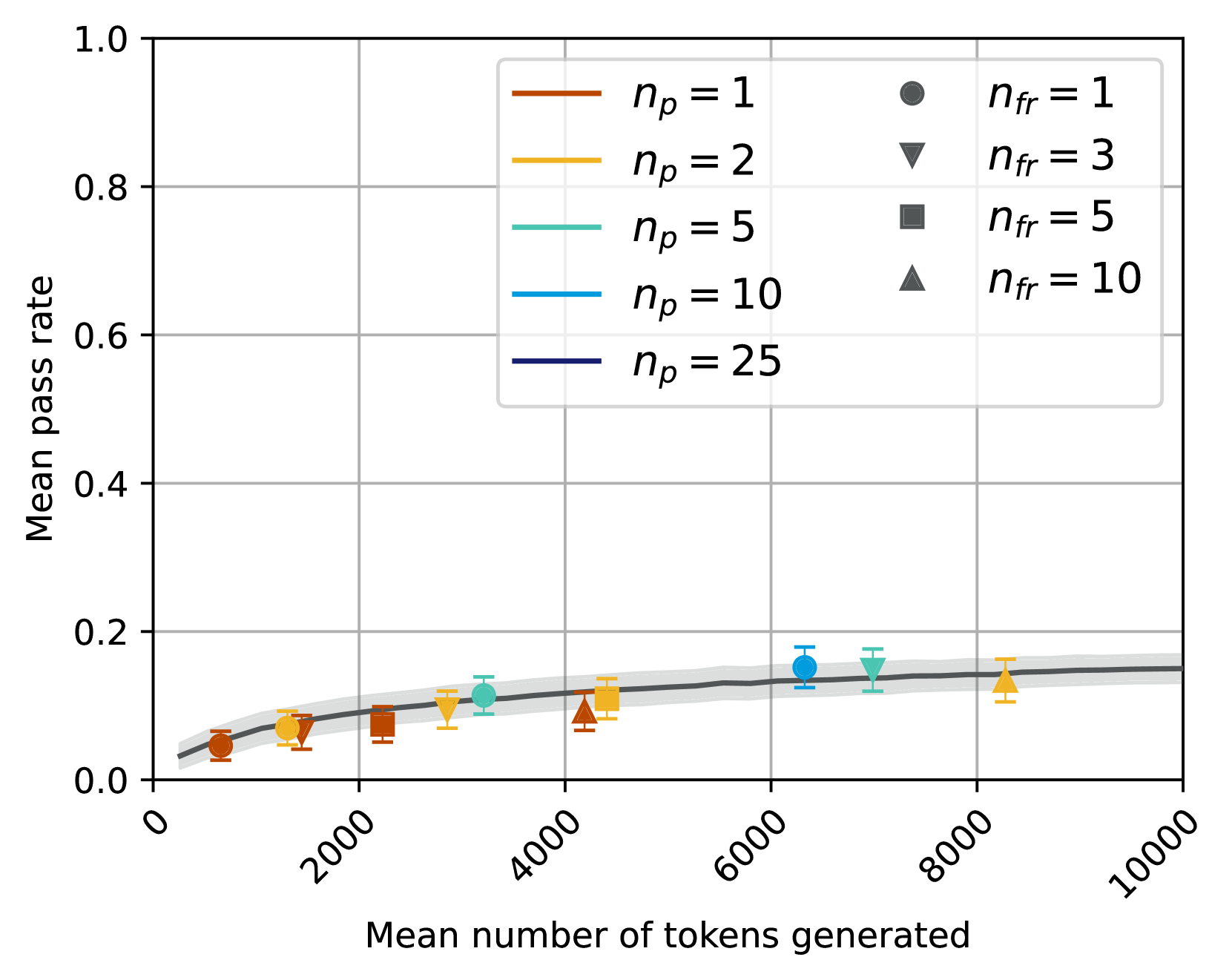
This image displays a 2D scatter plot with error bars, overlaid on a dark gray line with a shaded confidence interval. The chart illustrates the relationship between "Mean number of tokens generated" on the x-axis and "Mean pass rate" on the y-axis. Individual data points are differentiated by color, representing `n_p` values, and shape, representing `n_fr` values, as defined in a dual-column legend.
### Components/Axes
**X-axis:**
* **Title:** "Mean number of tokens generated"
* **Scale:** Ranges from 0 to 10000.
* **Major Ticks:** 0, 2000, 4000, 6000, 8000, 10000.
* **Labels:** Rotated approximately 45 degrees counter-clockwise for readability.
**Y-axis:**
* **Title:** "Mean pass rate"
* **Scale:** Ranges from 0.0 to 1.0.
* **Major Ticks:** 0.0, 0.2, 0.4, 0.6, 0.8, 1.0.
**Grid:**
* A light gray grid is present, extending from both major X and Y axis ticks across the plotting area.
**Legend (Top-right corner):**
The legend is divided into two conceptual columns, indicating how `n_p` values are mapped to colors (represented by line segments) and `n_fr` values are mapped to shapes. The legend is positioned within the upper-right quadrant of the plot area.
* **Left Column (Colors for `n_p`):**
* Brown line segment: `n_p = 1`
* Goldenrod/Orange-yellow line segment: `n_p = 2`
* Teal/Cyan line segment: `n_p = 5`
* Bright Blue line segment: `n_p = 10`
* Dark Blue line segment: `n_p = 25` (Note: No data points with this color are visible on the plot.)
* **Right Column (Shapes for `n_fr`):**
* Dark Gray Circle: `n_fr = 1`
* Dark Gray Inverted Triangle: `n_fr = 3`
* Dark Gray Square: `n_fr = 5`
* Dark Gray Triangle: `n_fr = 10`
**Overall Trend Line and Confidence Interval:**
* A prominent dark gray line traverses the plot, representing an overall trend.
* A semi-transparent gray shaded area surrounds this dark gray line, indicating a confidence interval or standard deviation for the trend. This line and shaded area are not explicitly labeled in the legend.
### Detailed Analysis
The chart displays 11 distinct data points, each represented by a specific color (corresponding to `n_p`) and shape (corresponding to `n_fr`). Each point includes horizontal and vertical error bars, indicating uncertainty in both the "Mean number of tokens generated" and "Mean pass rate" respectively. The overall trend, represented by the dark gray line, shows an initial rapid increase in "Mean pass rate" as "Mean number of tokens generated" increases, followed by a flattening or slight increase at higher token counts.
Here are the approximate values for each data point, identified by their `n_p` (color) and `n_fr` (shape) values:
1. **`n_p = 1` (Brown), `n_fr = 1` (Circle):**
* Mean number of tokens generated: ~550 (horizontal error bar from ~450 to ~650)
* Mean pass rate: ~0.04 (vertical error bar from ~0.03 to ~0.05)
* This point is located in the lower-left quadrant, close to the origin.
2. **`n_p = 2` (Goldenrod), `n_fr = 3` (Inverted Triangle):**
* Mean number of tokens generated: ~1250 (horizontal error bar from ~1150 to ~1350)
* Mean pass rate: ~0.07 (vertical error bar from ~0.06 to ~0.08)
* This point is to the right and slightly above the first point.
3. **`n_p = 1` (Brown), `n_fr = 5` (Square):**
* Mean number of tokens generated: ~1850 (horizontal error bar from ~1750 to ~1950)
* Mean pass rate: ~0.08 (vertical error bar from ~0.07 to ~0.09)
* This point is further right and slightly above the previous point.
4. **`n_p = 2` (Goldenrod), `n_fr = 10` (Triangle):**
* Mean number of tokens generated: ~2550 (horizontal error bar from ~2450 to ~2650)
* Mean pass rate: ~0.10 (vertical error bar from ~0.09 to ~0.11)
* This point continues the upward trend.
5. **`n_p = 5` (Teal), `n_fr = 1` (Circle):**
* Mean number of tokens generated: ~3050 (horizontal error bar from ~2950 to ~3150)
* Mean pass rate: ~0.11 (vertical error bar from ~0.10 to ~0.12)
* This point is slightly above and to the right of the previous point.
6. **`n_p = 1` (Brown), `n_fr = 3` (Inverted Triangle):**
* Mean number of tokens generated: ~3550 (horizontal error bar from ~3450 to ~3650)
* Mean pass rate: ~0.10 (vertical error bar from ~0.09 to ~0.11)
* This point shows a slight dip in pass rate compared to the previous point, despite more tokens.
7. **`n_p = 2` (Goldenrod), `n_fr = 5` (Square):**
* Mean number of tokens generated: ~4050 (horizontal error bar from ~3950 to ~4150)
* Mean pass rate: ~0.11 (vertical error bar from ~0.10 to ~0.12)
* This point is slightly above the previous point.
8. **`n_p = 5` (Teal), `n_fr = 3` (Inverted Triangle):**
* Mean number of tokens generated: ~4550 (horizontal error bar from ~4450 to ~4650)
* Mean pass rate: ~0.12 (vertical error bar from ~0.11 to ~0.13)
* This point continues the general upward trend.
9. **`n_p = 10` (Bright Blue), `n_fr = 1` (Circle):**
* Mean number of tokens generated: ~6250 (horizontal error bar from ~6150 to ~6350)
* Mean pass rate: ~0.16 (vertical error bar from ~0.15 to ~0.17)
* This point represents a significant jump in tokens generated and a higher pass rate, aligning with the flattening part of the overall trend line.
10. **`n_p = 5` (Teal), `n_fr = 10` (Triangle):**
* Mean number of tokens generated: ~6850 (horizontal error bar from ~6750 to ~6950)
* Mean pass rate: ~0.16 (vertical error bar from ~0.15 to ~0.17)
* This point is very close in pass rate to the previous point but with more tokens generated.
11. **`n_p = 2` (Goldenrod), `n_fr = 10` (Triangle):**
* Mean number of tokens generated: ~8350 (horizontal error bar from ~8250 to ~8450)
* Mean pass rate: ~0.13 (vertical error bar from ~0.12 to ~0.14)
* This point shows a decrease in pass rate compared to the two preceding points, despite a higher number of tokens generated.
### Key Observations
* **Overall Trend:** The "Mean pass rate" generally increases with the "Mean number of tokens generated," but the rate of increase diminishes significantly after approximately 4000-5000 tokens, with the curve flattening out. The maximum observed mean pass rate is around 0.16.
* **Parameter Influence:** The scatter points suggest that both `n_p` (color) and `n_fr` (shape) influence the mean pass rate and the mean number of tokens generated. Higher `n_p` values (e.g., `n_p=10` in bright blue) tend to be associated with higher token counts and pass rates, while lower `n_p` values (e.g., `n_p=1` in brown) are generally at lower token counts and pass rates.
* **`n_fr` Variation:** The shapes representing `n_fr` values are distributed across the range of tokens generated, indicating that `n_fr` might also play a role in the token generation process and pass rate.
* **Error Bars:** All data points have relatively small error bars in both dimensions, suggesting that the measured means are fairly stable for each specific configuration of `n_p` and `n_fr`.
* **Unused Legend Entry:** The legend includes `n_p = 25` (dark blue line segment), but no data points corresponding to this `n_p` value are plotted on the chart.
* **Maximum Pass Rate:** The "Mean pass rate" never exceeds approximately 0.16-0.17, even at the highest token generation counts shown.
### Interpretation
This chart likely illustrates the performance of a system or model, where `n_p` and `n_fr` are parameters influencing its output. The "Mean number of tokens generated" could represent the computational effort or output length, while "Mean pass rate" is a measure of success or quality.
The overall trend suggests that increasing the number of tokens generated initially improves the pass rate, but there are diminishing returns. Beyond a certain point (around 4000-5000 tokens), generating more tokens does not significantly increase the pass rate, which plateaus at a relatively low value (around 15-16%). This could imply that the system reaches its performance limit or that generating more tokens beyond this threshold does not add value in terms of correctness or quality.
The different colored and shaped points indicate that specific combinations of `n_p` and `n_fr` lead to different outcomes. For instance, `n_p=10` (bright blue circle) achieves one of the highest pass rates with a moderate number of tokens, while `n_p=2` (goldenrod triangle) at a very high token count (~8350) results in a lower pass rate than some points with fewer tokens. This suggests a complex interaction between `n_p`, `n_fr`, and the resulting performance. It's not simply "more tokens = better pass rate" across all parameter settings.
The absence of data points for `n_p=25` might indicate that experiments for this parameter value were not conducted, or perhaps they yielded results outside the displayed range or were deemed irrelevant. The low overall pass rates (maxing out below 0.2) suggest that the task being evaluated is challenging, or the system's performance is generally limited under these conditions. The confidence interval around the main trend line provides a sense of the variability or uncertainty in the average performance across all observed conditions.