## Heatmap: Mean Pass Rate vs. Mean Number of Tokens Generated
### Overview
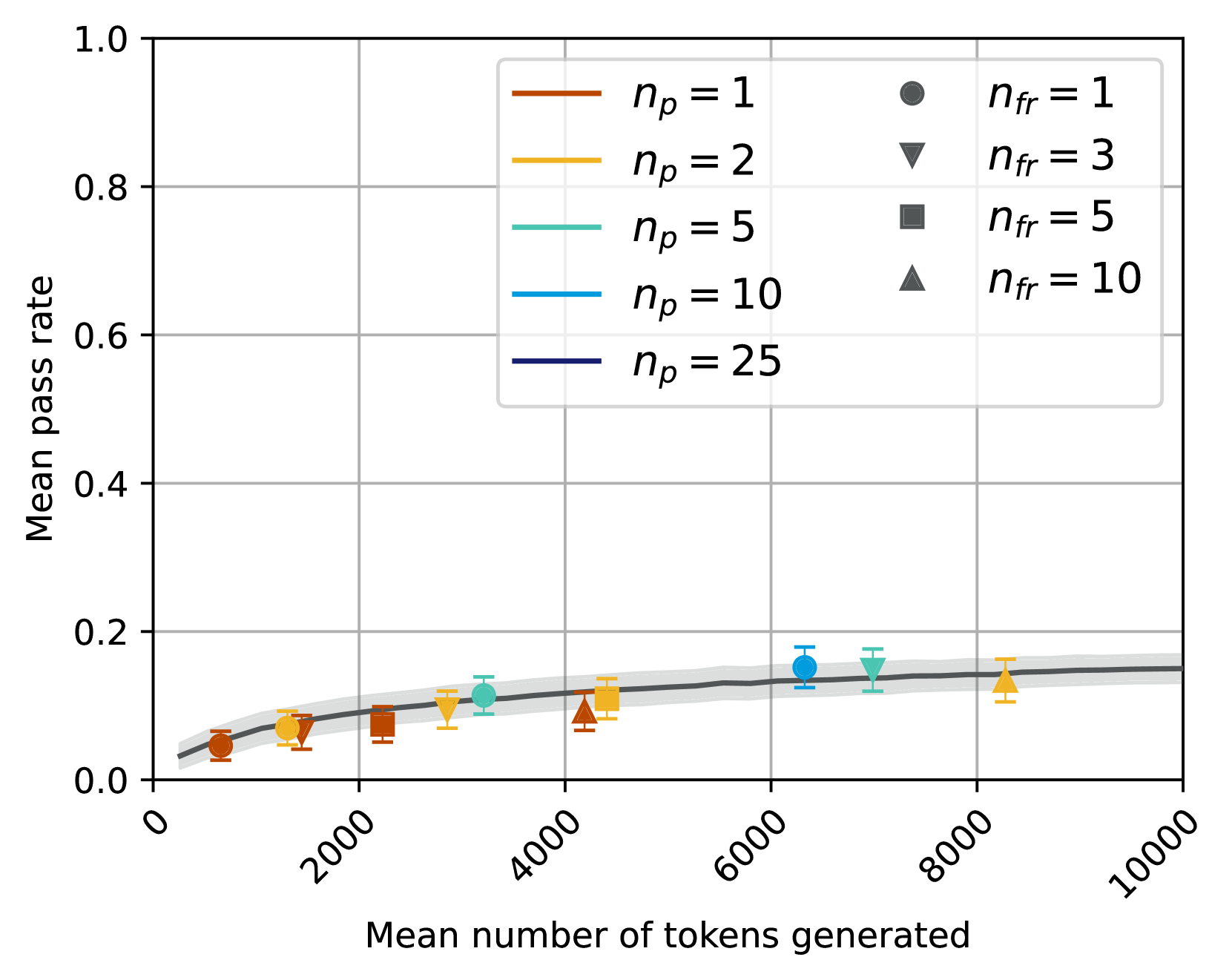
The heatmap illustrates the mean pass rate of a system as a function of the mean number of tokens generated. The x-axis represents the mean number of tokens generated, while the y-axis represents the mean pass rate.
### Components/Axes
- **X-axis**: Mean number of tokens generated (ranging from 0 to 10,000)
- **Y-axis**: Mean pass rate (ranging from 0.0 to 1.0)
- **Legend**:
- **Brown circles**: n_p = 1
- **Yellow triangles**: n_p = 2
- **Green squares**: n_p = 5
- **Blue diamonds**: n_p = 10
- **Purple stars**: n_p = 25
- **Black dots**: n_fr = 1
- **Orange triangles**: n_fr = 3
- **Blue squares**: n_fr = 5
- **Green circles**: n_fr = 10
- **Purple triangles**: n_fr = 25
### Detailed Analysis or ### Content Details
The heatmap shows that as the mean number of tokens generated increases, the mean pass rate generally increases as well. However, the rate of increase is not uniform across all categories. For example, the system with n_p = 1 and n_fr = 1 (brown circles) shows a relatively stable pass rate, while the system with n_p = 25 and n_fr = 25 (purple stars) shows a slight decrease in pass rate as the number of tokens generated increases.
### Key Observations
- The system with n_p = 1 and n_fr = 1 (brown circles) has the lowest mean pass rate and the most stable performance.
- The system with n_p = 25 and n_fr = 25 (purple stars) has the highest mean pass rate and the most variability in performance.
- The systems with n_p = 2 and n_fr = 3 (yellow triangles and orange triangles) show a moderate increase in pass rate as the number of tokens generated increases.
- The systems with n_p = 5 and n_fr = 5 (green squares and blue diamonds) show a slight increase in pass rate as the number of tokens generated increases.
- The systems with n_p = 10 and n_fr = 10 (blue diamonds and green circles) show a slight increase in pass rate as the number of tokens generated increases.
### Interpretation
The heatmap suggests that the system's performance is influenced by both the number of tokens generated and the number of tokens received. The system with the highest number of tokens generated (n_p = 25) and the highest number of tokens received (n_fr = 25) shows the best performance, while the system with the lowest number of tokens generated (n_p = 1) and the lowest number of tokens received (n_fr = 1) shows the worst performance. The systems with moderate numbers of tokens generated and received show a balanced performance. The slight increase in pass rate as the number of tokens generated increases suggests that the system is able to handle more tokens, but the rate of increase is not uniform across all categories.