## Line Chart: Timing Analysis Across Guesses
### Overview
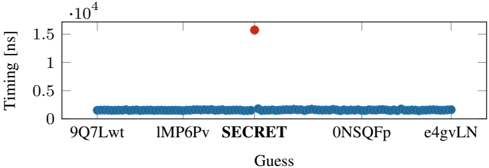
The chart displays timing measurements (in nanoseconds) for five distinct "Guess" categories: 9Q7Lwt, IMP6Pv, SECRET, 0NSQFp, and e4gvLN. A single red outlier at "SECRET" stands out against a cluster of blue data points near 0 ns.
### Components/Axes
- **Y-Axis**: "Timing [ns]" with logarithmic scale (10⁴ increments), ranging from 0 to 1.5×10⁴ ns.
- **X-Axis**: Five categorical labels: 9Q7Lwt, IMP6Pv, SECRET, 0NSQFp, e4gvLN.
- **Legend**: Implied by color coding (blue for clustered data, red for outlier), though no explicit legend box is visible.
### Detailed Analysis
- **Blue Data Points**:
- Clustered tightly along the x-axis at ~0 ns (y-axis).
- Uniform distribution across all categories except SECRET.
- No visible variation between 9Q7Lwt, IMP6Pv, 0NSQFp, and e4gvLN.
- **Red Outlier**:
- Positioned at "SECRET" on the x-axis.
- Timing value: ~1.5×10⁴ ns (15,000 ns), 100× higher than blue points.
- Spatial placement: Centered vertically at the top of the y-axis range.
### Key Observations
1. **Outlier Dominance**: "SECRET" deviates drastically from other categories, suggesting a unique or erroneous condition.
2. **Consistency in Other Guesses**: All non-SECRET categories exhibit near-identical timing (~0 ns), indicating stable performance.
3. **Scale Discrepancy**: The red dot’s value (15,000 ns) exceeds the y-axis maximum (1.5×10⁴ ns), implying potential data truncation or measurement error.
### Interpretation
- **Technical Implications**: The "SECRET" outlier may represent a critical failure mode, such as a timing attack vulnerability, hardware fault, or algorithmic inefficiency. Its isolation suggests it operates under fundamentally different constraints than other guesses.
- **Data Integrity**: The red dot’s placement at the y-axis maximum raises questions about measurement limits or data normalization. Further validation of the 15,000 ns value is warranted.
- **Pattern Significance**: The uniformity of blue points implies optimized or baseline performance, while "SECRET" acts as a stress case. This could inform prioritization in debugging or system hardening efforts.