\n
## Code Snippet: C atoi Implementation
### Overview
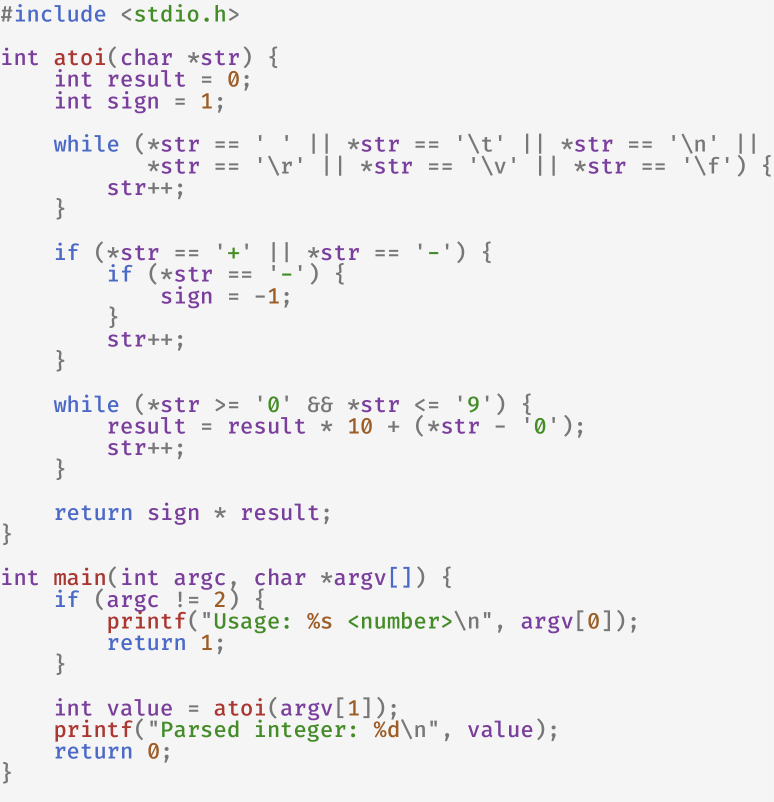
The image contains a C code snippet implementing the `atoi` function, which converts a string to an integer. It also includes a `main` function demonstrating its usage. The code handles whitespace, optional signs (+/-), and performs the conversion digit by digit.
### Components/Axes
There are no axes or charts in this image. It is a block of code. The code is structured into two functions: `atoi` and `main`.
### Detailed Analysis or Content Details
Here's a transcription of the C code:
```c
#include <stdio.h>
int atoi(char *str) {
int result = 0;
int sign = 1;
while (*str == ' ' || *str == '\t' || *str == '\n' ||
*str == '\r' || *str == '\v' || *str == '\f') {
str++;
}
if (*str == '+' || *str == '-') {
if (*str == '-') {
sign = -1;
}
str++;
}
while (*str >= '0' && *str <= '9') {
result = result * 10 + (*str - '0');
str++;
}
return sign * result;
}
int main(int argc, char *argv[]) {
if (argc != 2) {
printf("Usage: %s <number>\n", argv[0]);
return 1;
}
int value = atoi(argv[1]);
printf("Parsed integer: %d\n", value);
return 0;
}
```
**Function `atoi(char *str)`:**
* **Initialization:** `result` is initialized to 0, and `sign` to 1 (positive).
* **Whitespace Handling:** The `while` loop skips leading whitespace characters (space, tab, newline, carriage return, vertical tab, form feed).
* **Sign Handling:** The `if` statement checks for an optional '+' or '-' sign. If '-' is found, `sign` is set to -1.
* **Digit Conversion:** The second `while` loop iterates through the digits of the string. Inside the loop:
* `result` is multiplied by 10.
* The current digit (converted from its ASCII value to an integer by subtracting '0') is added to `result`.
* **Return Value:** The function returns the final `result` multiplied by the `sign`.
**Function `main(int argc, char *argv[])`:**
* **Argument Check:** Checks if exactly one command-line argument is provided (besides the program name). If not, it prints a usage message and returns 1 (error).
* **`atoi` Call:** Calls the `atoi` function to convert the first command-line argument (`argv[1]`) to an integer.
* **Output:** Prints the parsed integer to the console.
* **Return Value:** Returns 0 (success).
### Key Observations
* The code handles basic error checking in the `main` function to ensure the correct number of arguments is provided.
* The `atoi` function does not perform extensive error checking (e.g., it doesn't handle overflow or invalid characters after the digits).
* The code uses pointer arithmetic to iterate through the string.
* The code is relatively simple and straightforward, implementing a basic string-to-integer conversion.
### Interpretation
The code demonstrates a fundamental algorithm for converting a string representation of a number into its integer equivalent. The `atoi` function is a common utility function in C programming. The `main` function provides a simple example of how to use the `atoi` function from the command line. The code's simplicity highlights the core logic of the conversion process, but also reveals its limitations in terms of error handling and robustness. The code is a good example of a low-level implementation of a common task, illustrating the importance of understanding how data is represented and manipulated at the character level.