## Diagram: Hexagonal Grid Configurations
### Overview
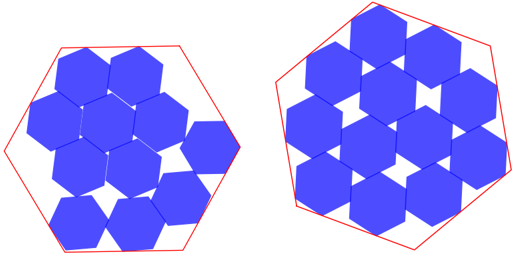
The image displays two side-by-side hexagonal grids, each enclosed by a red outline. Both grids contain smaller blue hexagons arranged within the larger red hexagon. The left grid shows a clustered arrangement of blue hexagons, while the right grid exhibits a more uniform, grid-like pattern.
### Components/Axes
- **Primary Elements**:
- Two red hexagonal boundaries (left and right).
- Blue hexagons nested within each red hexagon.
- **Spatial Relationships**:
- Left grid: Blue hexagons are densely packed with irregular spacing.
- Right grid: Blue hexagons are evenly distributed with consistent gaps.
- **No textual labels, legends, or axis markers are present.**
### Detailed Analysis
- **Left Grid**:
- Contains **12 blue hexagons**.
- Arrangement: Irregular clustering, with some hexagons overlapping or partially obscured by others.
- Gaps: Irregularly shaped white spaces between blue hexagons.
- **Right Grid**:
- Contains **15 blue hexagons**.
- Arrangement: Uniform grid pattern, with hexagons aligned in rows and columns.
- Gaps: Symmetrical white spaces between hexagons.
### Key Observations
1. **Quantity Difference**: The right grid holds 3 more blue hexagons than the left.
2. **Structural Contrast**:
- Left grid emphasizes density and irregularity.
- Right grid emphasizes uniformity and symmetry.
3. **Boundary Consistency**: Both red hexagons are identical in size and shape, suggesting a controlled comparison.
### Interpretation
The diagram likely illustrates a comparison of hexagonal tiling strategies. The left grid’s clustered arrangement could represent a scenario prioritizing space efficiency (e.g., packing), while the right grid’s uniform layout might reflect optimization for accessibility or modularity. The absence of labels or legends leaves the exact purpose ambiguous, but the visual contrast suggests a focus on geometric efficiency versus structural regularity.
**Note**: No textual data or numerical values are present in the image. All observations are based on spatial and quantitative analysis of the hexagons’ arrangement.