## Diagram: Hexagonal Packing
### Overview
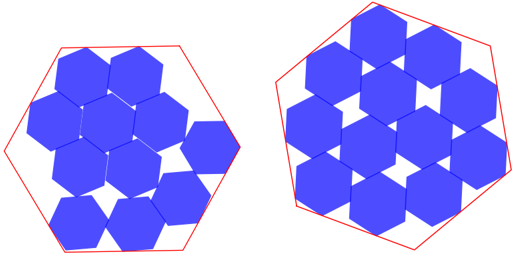
The image shows two separate diagrams, each depicting a hexagonal shape filled with smaller, blue hexagonal shapes. The larger hexagonal shapes are outlined in red. The arrangement of the smaller hexagons differs between the two diagrams, suggesting different packing configurations.
### Components/Axes
* **Outer Shape:** Red hexagon.
* **Inner Shapes:** Blue hexagons.
* **Arrangement:** Two different arrangements of the blue hexagons within the red hexagon.
### Detailed Analysis
**Left Diagram:**
* Contains 11 complete blue hexagons and 1 partial hexagon.
* The blue hexagons are arranged somewhat randomly, with some gaps and overlaps.
* The partial hexagon is located on the right side of the red hexagon.
**Right Diagram:**
* Contains 12 complete blue hexagons.
* The blue hexagons are arranged in a more organized, close-packed manner.
* There are fewer gaps between the blue hexagons compared to the left diagram.
### Key Observations
* The two diagrams illustrate different ways to pack smaller hexagons within a larger hexagon.
* The right diagram appears to represent a more efficient packing arrangement, as it contains more complete hexagons and fewer gaps.
### Interpretation
The image likely demonstrates different packing densities or arrangements of hexagonal units within a confined hexagonal space. The right diagram suggests a more optimized or efficient packing strategy compared to the left diagram. This could be relevant in fields like materials science, where the arrangement of atoms or molecules can affect the properties of a material. The diagrams do not provide specific data, but rather a visual comparison of two different configurations.