\n
## Diagram: Hexagonal Packing Comparison
### Overview
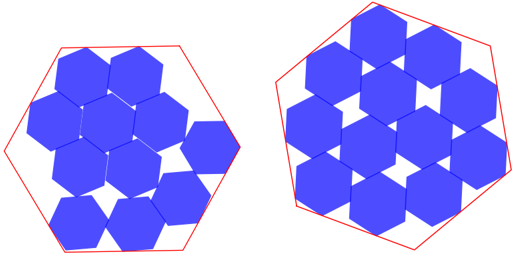
The image presents a visual comparison of two hexagonal packing arrangements within larger hexagonal boundaries. The left arrangement contains fewer hexagons, while the right arrangement contains more, demonstrating a difference in packing density. There are no labels, axes, or legends present.
### Components/Axes
The image consists of:
* **Large Hexagon:** A red outline forming the boundary for each arrangement.
* **Small Hexagons:** Blue filled hexagons arranged within the larger hexagon.
* **Arrangement 1 (Left):** Contains approximately 10-12 small hexagons.
* **Arrangement 2 (Right):** Contains approximately 18-20 small hexagons.
### Detailed Analysis or Content Details
The image does not contain numerical data or specific measurements. The analysis is based on visual counting and estimation.
* **Arrangement 1:** The small hexagons are arranged in a less organized manner, with more empty space between them. The arrangement appears somewhat random.
* **Arrangement 2:** The small hexagons are arranged in a more regular, tightly packed pattern. The arrangement appears more organized and efficient in terms of space utilization.
* The large hexagons appear to be of similar size in both arrangements.
### Key Observations
The primary observation is the difference in the number of small hexagons that can be packed within the same-sized large hexagon, indicating a difference in packing efficiency. Arrangement 2 demonstrates a higher packing density than Arrangement 1.
### Interpretation
The image illustrates the concept of hexagonal close packing. Hexagonal packing is an efficient way to fill a plane with equal-sized circles (or in this case, hexagons). The right arrangement demonstrates a more optimal packing configuration, maximizing the number of hexagons within the given area. This is a fundamental concept in materials science, chemistry (e.g., crystal structures), and geometry. The difference between the two arrangements highlights how the arrangement of elements can significantly impact density and space utilization. The image does not provide any quantitative data, but serves as a qualitative demonstration of the principle.