## Composite Image: Attention Mechanisms, Rule Discovery, and Text Summarization
### Overview
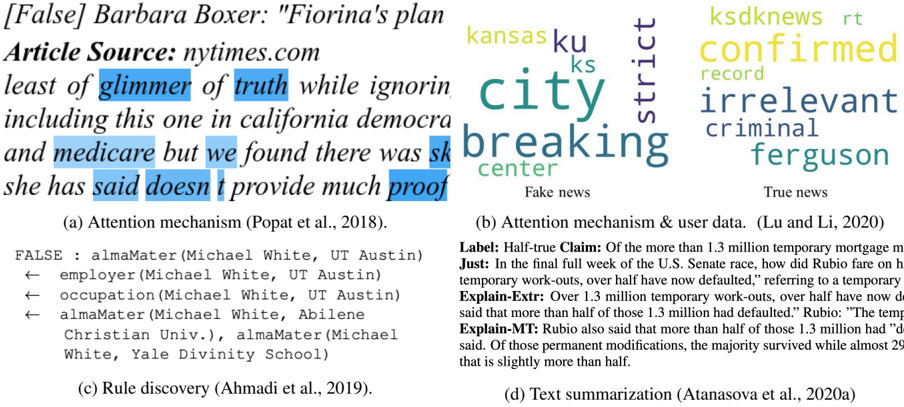
The image is a composite of four sub-images, each representing a different approach to natural language processing. These include attention mechanisms, rule discovery, and text summarization. Each sub-image is labeled with a letter (a, b, c, d) and a citation.
### Components/Axes
* **(a) Attention mechanism (Popat et al., 2018):** Displays the sentence "[False] Barbara Boxer: 'Fiorina's plan' Article Source: nytimes.com least of glimmer of truth while ignoring including this one in california democra and medicare but we found there was sk she has said doesn't provide much proof". Certain words are highlighted in blue, indicating the attention mechanism's focus.
* **(b) Attention mechanism & user data. (Lu and Li, 2020):** A word cloud labeled "Fake news". The words include: "kansas", "ku", "ks", "city", "district", "breaking", "center".
* **(b) Attention mechanism & user data. (Lu and Li, 2020):** A word cloud labeled "True news". The words include: "ksdknews", "rt", "confirmed", "record", "irrelevant", "criminal", "ferguson".
* **(c) Rule discovery (Ahmadi et al., 2019):** Lists a series of rules related to "Michael White, UT Austin" and "Michael White, Abilene Christian Univ.", "Michael White, Yale Divinity School". The rules are:
* FALSE : almaMater (Michael White, UT Austin)
* employer (Michael White, UT Austin)
* occupation (Michael White, UT Austin)
* almaMater (Michael White, Abilene Christian Univ.), almaMater (Michael White, Yale Divinity School)
* **(d) Text summarization (Atanasova et al., 2020a):** Presents text summarization examples related to a "Half-true Claim" about temporary mortgage modifications. The summaries are labeled as:
* Label: Half-true Claim: Of the more than 1.3 million temporary mortgage modifications...
* Just: In the final full week of the U.S. Senate race, how did Rubio fare on how many temporary work-outs, over half have now defaulted," referring to a temporary...
* Explain-Extr: Over 1.3 million temporary work-outs, over half have now defaulted. Rubio said that more than half of those 1.3 million had defaulted." Rubio: "The temporary...
* Explain-MT: Rubio also said that more than half of those 1.3 million had "defaulted," he said. Of those permanent modifications, the majority survived while almost 29% of those that is slightly more than half.
### Detailed Analysis or Content Details
* **Attention Mechanism (a):** The highlighted words in the sentence suggest that the attention mechanism is focusing on words related to truthfulness, political figures, and the source of the information.
* **Word Clouds (b):** The word clouds visually represent the most frequent terms associated with "Fake news" and "True news". The size of each word corresponds to its frequency.
* **Rule Discovery (c):** The rules extracted relate to the alma mater, employer, and occupation of Michael White, indicating a focus on biographical information.
* **Text Summarization (d):** The text summarization examples demonstrate different approaches to summarizing a claim about mortgage modifications, including extractive and abstractive methods.
### Key Observations
* The image showcases a variety of NLP techniques used for different tasks, including fact-checking, information extraction, and text summarization.
* The attention mechanism highlights the importance of specific words in a sentence for understanding its meaning.
* The word clouds provide a quick overview of the key terms associated with different categories of news.
* The rule discovery example demonstrates how structured knowledge can be extracted from text.
* The text summarization examples illustrate the challenges of condensing information while preserving its meaning.
### Interpretation
The composite image provides a glimpse into the diverse applications of natural language processing. It demonstrates how NLP techniques can be used to analyze text, extract information, and generate summaries. The examples highlight the importance of attention mechanisms, rule discovery, and text summarization in various NLP tasks. The image suggests that NLP is a powerful tool for understanding and processing large amounts of text data. The juxtaposition of "Fake news" and "True news" word clouds underscores the role of NLP in combating misinformation. The text summarization examples demonstrate the ongoing research in developing more effective and accurate summarization techniques.