## Word Cloud Compilation: Fake vs. True News Analysis
### Overview
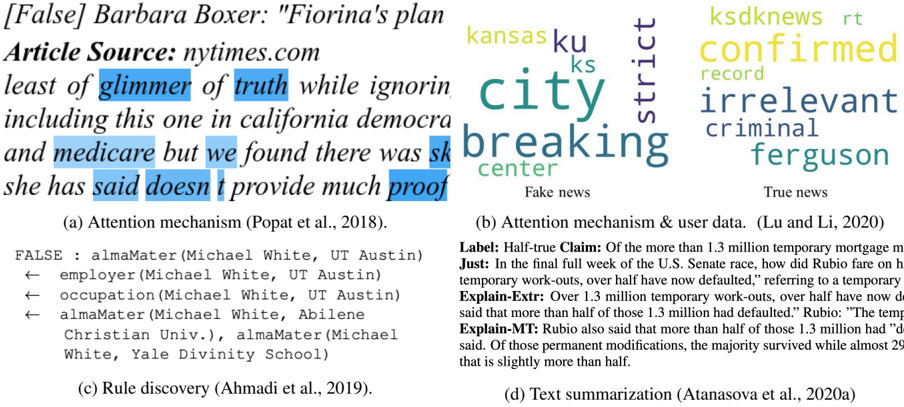
The image presents a compilation of four distinct word clouds, each representing the output of a different natural language processing (NLP) technique applied to news articles labeled as either "Fake news" or "True news". Each word cloud is accompanied by a brief description of the method used and a citation. Below the word clouds is a text block detailing a "Label: Half-true Claim" and associated justifications.
### Components/Axes
The image is divided into four quadrants, each containing a word cloud.
* **Top-Left:** Word cloud labeled "(a) Attention mechanism (Popat et al., 2018)." Words are colored in shades of yellow and orange.
* **Top-Right:** Word cloud labeled "(b) Attention mechanism & user data. (Lu and Li, 2020)." Words are colored in shades of blue and purple.
* **Bottom-Left:** Text block labeled "(c) Rule discovery (Ahmadi et al., 2019)." This is not a word cloud, but a list of relationships.
* **Bottom-Right:** Text block labeled "(d) Text summarization (Atanasova et al., 2020a)." This contains a "Label: Half-true Claim" and supporting text.
Additionally, there is a header text: "[False] Barbara Boxer: “Fiorina’s plan” Article Source: nytimes.com".
### Detailed Analysis or Content Details
**Word Cloud (a): Attention mechanism (Popat et al., 2018)**
The most prominent words appear to be "least", "glimmer", "truth", "ignoring", "including", "california", "democrat", "medicare", "found", "doesn't", "proof". The size of the words suggests their frequency in the analyzed text.
**Word Cloud (b): Attention mechanism & user data. (Lu and Li, 2020)**
The most prominent words are "kansas", "ku", "ks", "city", "breaking", "center", "confirmed", "record", "irrelevant", "criminal", "ferguson".
**Text Block (c): Rule discovery (Ahmadi et al., 2019)**
This block presents a series of relationships, formatted as:
FALSE : almaMater (Michael White, UT Austin)
← employer (Michael White, UT Austin)
← occupation (Michael White, UT Austin)
← almaMater (Michael White, Abilene Christian Univ.), almaMater (Michael White, Yale Divinity School)
**Text Block (d): Text summarization (Atanasova et al., 2020a)**
* **Label:** Half-true Claim: Of the more than 1.3 million temporary mortgage
* **Just In:** the final full week of the U.S. Senate race, how did Rubio fare on h temporary work-outs, over half have now defaulted, referring to a temporary
* **Explain-Extr:** Over 1.3 million temporary work-outs, over half have now d said that more than half of 1.3 million had defaulted.” Rubio: “The temp
* **Explain-MT:** Rubio also said that more than half of those 1.3 million had “d said. Of those permanent modifications, the majority survived while almost 29 that is slightly more than half.
### Key Observations
* The word clouds visually represent the differing vocabulary used in articles categorized as "Fake news" (a) versus "True news" (b).
* The "Rule discovery" block (c) demonstrates an attempt to identify relationships between entities (Michael White, UT Austin, etc.) and classify them as "FALSE".
* The "Text summarization" block (d) provides a detailed breakdown of a claim labeled as "Half-true", including supporting context and explanations.
* The header text indicates the analysis is focused on a statement made by Barbara Boxer regarding Fiorina's plan, sourced from nytimes.com.
### Interpretation
The image illustrates a multi-faceted approach to identifying and analyzing potentially misleading information. The word clouds highlight the distinct linguistic characteristics of fake and true news, suggesting that NLP techniques can be used to differentiate between them. The rule discovery method attempts to establish factual inconsistencies, while the text summarization provides a nuanced assessment of a specific claim. The combination of these techniques suggests a comprehensive strategy for combating misinformation. The presence of citations indicates a research-oriented context. The focus on a specific political statement (Boxer vs. Fiorina) suggests a potential application of these techniques to political discourse analysis. The "Half-true" label in (d) is particularly interesting, as it demonstrates the complexity of truth assessment and the need for nuanced evaluation beyond simple binary classifications.