## Screenshot: Context and Prompt Text Boxes
### Overview
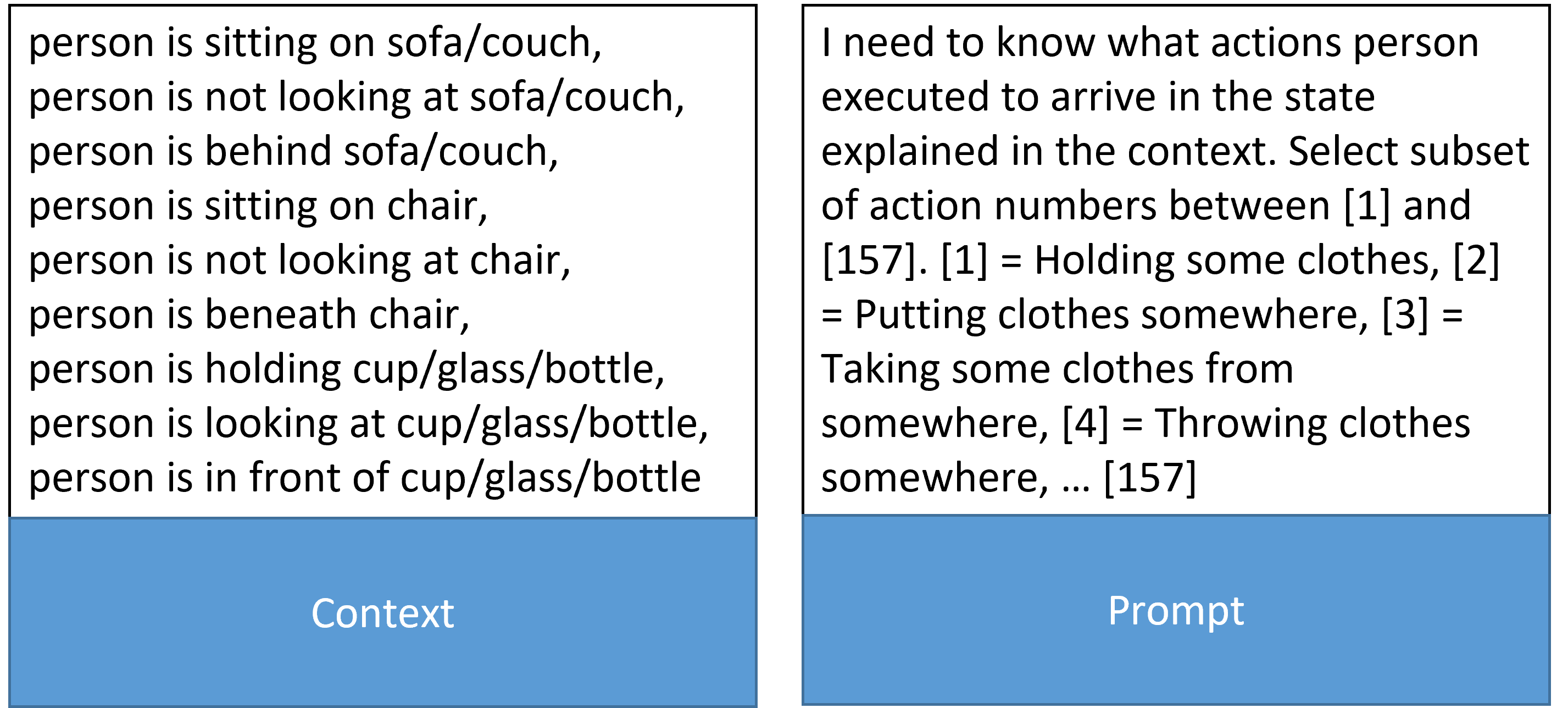
The image displays two adjacent rectangular text boxes, each with a white content area and a solid blue label bar at the bottom. The left box is labeled "Context" and contains a list of descriptive statements about a person's state relative to various objects. The right box is labeled "Prompt" and contains a task instruction referencing a numbered list of actions. The overall layout is simple, with a light gray background surrounding the two boxes.
### Components/Axes
The image is composed of two primary components arranged side-by-side:
1. **Left Component (Context Box):**
* **Content Area (White):** Contains a list of nine text lines.
* **Label Bar (Blue):** Contains the centered white text "Context".
2. **Right Component (Prompt Box):**
* **Content Area (White):** Contains a single paragraph of text.
* **Label Bar (Blue):** Contains the centered white text "Prompt".
### Detailed Analysis
**Text Transcription:**
**Left Box (Context):**
The following statements are listed, each on a new line:
1. person is sitting on sofa/couch,
2. person is not looking at sofa/couch,
3. person is behind sofa/couch,
4. person is sitting on chair,
5. person is not looking at chair,
6. person is beneath chair,
7. person is holding cup/glass/bottle,
8. person is looking at cup/glass/bottle,
9. person is in front of cup/glass/bottle
**Right Box (Prompt):**
The text reads:
"I need to know what actions person executed to arrive in the state explained in the context. Select subset of action numbers between [1] and [157]. [1] = Holding some clothes, [2] = Putting clothes somewhere, [3] = Taking some clothes from somewhere, [4] = Throwing clothes somewhere, ... [157]"
### Key Observations
* The "Context" box defines a specific, multi-faceted state of a person using relational predicates (e.g., "sitting on," "behind," "holding").
* The "Prompt" box defines a task: to infer a sequence of actions (from a predefined list of 157) that would result in the state described in the Context.
* The action list in the Prompt is truncated with an ellipsis ("..."), indicating that only the first four examples ([1] through [4]) are shown, and the list continues up to action [157].
* The language is precise and technical, resembling a formal problem statement for an AI planning, reasoning, or activity recognition task.
### Interpretation
This image presents a structured problem setup, likely for a computational or logical reasoning system. The **Context** serves as the *goal state* or *observed condition*—a snapshot of a person's spatial relationships with furniture (sofa, chair) and an object (cup/glass/bottle). The **Prompt** defines the *problem*: to reverse-engineer the sequence of primitive actions (from a large, fixed vocabulary) that led to this state.
The relationship is causal and investigative. The system must bridge the gap between high-level, relational state descriptions and a low-level, numbered action vocabulary. The notable gap between the simple, example actions listed (e.g., "Holding some clothes") and the complex, multi-object state in the Context suggests the required action sequence could be long and non-trivial. The ellipsis in the action list implies the full vocabulary is extensive, making the selection task a search or inference problem over a large space of possibilities. This setup is characteristic of benchmarks or challenges in areas like procedural knowledge reasoning, action anticipation, or explainable AI.