\n
## Diagram: AI System Lifecycle
### Overview
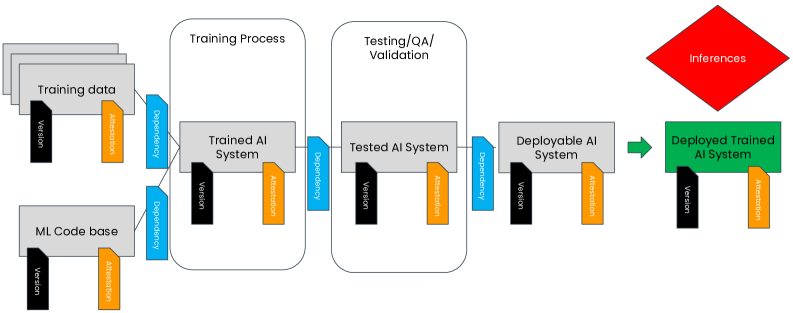
The image depicts a diagram illustrating the lifecycle of an AI system, from training data and code base through deployment and inference. It highlights the flow of data, dependencies, and attestations between different stages of the process. The diagram emphasizes versioning and dependency tracking throughout the AI system's development and operation.
### Components/Axes
The diagram consists of the following components, arranged horizontally from left to right:
* **Training Data:** Stack of rectangular blocks labeled "Training data".
* **ML Code base:** Rectangular block labeled "ML Code base".
* **Training Process:** Rectangular block labeled "Training Process".
* **Trained AI System:** Rectangular block labeled "Trained AI System".
* **Testing/QA/Validation:** Rectangular block labeled "Testing/QA/Validation".
* **Tested AI System:** Rectangular block labeled "Tested AI System".
* **Deployable AI System:** Rectangular block labeled "Deployable AI System".
* **Deployed Trained AI System:** Rectangular block labeled "Deployed Trained AI System".
* **Inferences:** Diamond shape labeled "Inferences".
Each component has associated labels:
* **Version:** Black rectangular blocks connected to each component with lines.
* **Attestation:** Orange rectangular blocks connected to each component with lines.
* **Dependency:** Blue lines connecting components, indicating dependencies.
* **Flow:** Green arrow indicating the flow from "Deployable AI System" to "Deployed Trained AI System".
### Detailed Analysis or Content Details
The diagram shows a sequential flow of information and dependencies.
1. **Training Data & ML Code Base:** Both "Training data" and "ML Code base" have "Version" and "Attestation" labels connected to them.
2. **Training Process:** The "Training Process" receives "Dependency" inputs from both "Training data" and "ML Code base". It outputs a "Trained AI System" with associated "Version" and "Attestation".
3. **Testing/QA/Validation:** The "Testing/QA/Validation" stage receives a "Dependency" input from the "Trained AI System" and outputs a "Tested AI System" with associated "Version" and "Attestation".
4. **Deployable AI System:** The "Deployable AI System" receives a "Dependency" input from the "Tested AI System" and has associated "Version" and "Attestation".
5. **Deployed Trained AI System:** A green arrow indicates the flow from the "Deployable AI System" to the "Deployed Trained AI System", which also has associated "Version" and "Attestation".
6. **Inferences:** The "Deployed Trained AI System" feeds into "Inferences".
The "Dependency" lines are consistently blue, while the "Version" and "Attestation" labels are consistently black and orange, respectively.
### Key Observations
* The diagram emphasizes the importance of tracking versions and attestations throughout the entire AI system lifecycle.
* Dependencies are clearly defined between each stage of the process.
* The flow is linear, suggesting a sequential development and deployment process.
* The "Inferences" stage is presented as the final output of the deployed system.
### Interpretation
This diagram illustrates a secure and traceable AI system development pipeline. The inclusion of "Version" and "Attestation" at each stage suggests a focus on reproducibility, accountability, and security. The "Dependency" lines highlight the interconnectedness of the different components, emphasizing that changes in one component can impact others. The diagram suggests a robust process for building and deploying AI systems, with a clear emphasis on quality assurance and validation. The linear flow implies a waterfall-like development methodology, although it doesn't preclude iterative refinement within each stage. The diagram is a high-level overview and doesn't detail the specific techniques or tools used at each stage. It is a conceptual representation of a secure AI lifecycle.