## Diagram: Social Interaction Model
### Overview
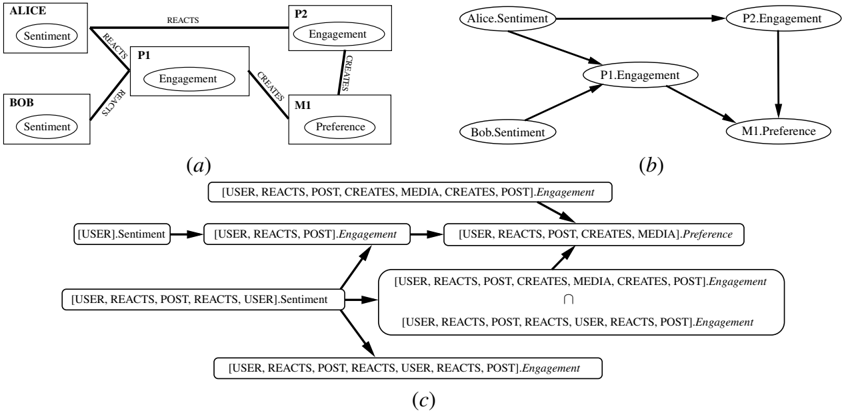
The image presents a diagram illustrating a model of social interaction, likely within a social media context. It depicts three different representations (labeled (a), (b), and (c)) of relationships between users (Alice and Bob), their sentiments, posts (P1, P2, M1), engagement, and preferences. The diagram uses boxes to represent entities and arrows to represent relationships or actions.
### Components/Axes
The diagram consists of three sub-diagrams:
* **(a):** A simplified representation showing direct reactions and creations. Entities include "Alice", "Bob", "Sentiment", "P1" (Post 1), "P2" (Post 2), "M1" (Media 1), "Engagement", and "Preference". Relationships are labeled "REACTS", "CREATES".
* **(b):** A more detailed representation showing the sentiment of Alice and Bob, engagement with posts P1 and P2, and preference for media M1. Entities are labeled as "Alice.Sentiment", "Bob.Sentiment", "P1.Engagement", "P2.Engagement", and "M1.Preference".
* **(c):** A complex representation using bracketed terms to represent combined actions and entities. Entities include "[USER].Sentiment", "[USER].Engagement", "[USER].Preference", and combinations of "USER", "REACTS", "POST", "CREATES", "MEDIA", and "Engagement". The symbol "∩" represents intersection.
### Detailed Analysis or Content Details
**(a) Simplified Model:**
* Alice's Sentiment "REACTS" to P1 (Engagement).
* Bob's Sentiment "REACTS" to P1 (Engagement).
* P1 (Engagement) "CREATES" M1 (Preference).
* P2 (Engagement) "CREATES" M1 (Preference).
**(b) Detailed Model:**
* Alice.Sentiment influences P2.Engagement.
* Bob.Sentiment influences P1.Engagement.
* P1.Engagement influences M1.Preference.
* P2.Engagement influences M1.Preference.
**(c) Complex Model:**
* [USER].Sentiment is influenced by [USER, REACTS, POST, REACTS].Engagement.
* [USER].Engagement is influenced by [USER, REACTS, POST, CREATES, MEDIA, CREATES, POST].Engagement.
* [USER].Preference is influenced by [USER, REACTS, POST, CREATES, MEDIA].Preference.
* [USER, REACTS, POST, CREATES, MEDIA, CREATES, POST].Engagement is the intersection of [USER, REACTS, POST, REACTS].Engagement and [USER, REACTS, POST, REACTS].Engagement.
* [USER].Engagement is influenced by [USER, REACTS, POST, USER, REACTS].Engagement.
### Key Observations
* The diagram progresses from a simplified model (a) to increasingly complex representations (b and c).
* The use of bracketed terms in (c) suggests an attempt to generalize the relationships and represent them in a more abstract form.
* The intersection symbol in (c) indicates a focus on commonalities or shared influences.
* The diagram highlights the interplay between sentiment, engagement, and preference in a social interaction context.
### Interpretation
The diagram models how user sentiment and actions (reactions, posts, creations) influence engagement and preference within a social system. The progression from (a) to (c) suggests a move towards a more nuanced understanding of these relationships. Diagram (a) provides a basic overview, while (b) adds detail by explicitly representing the sentiment of individual users. Diagram (c) attempts to generalize these relationships using abstract terms, potentially for use in a computational model or algorithm.
The intersection in (c) is particularly interesting. It suggests that certain types of engagement are driven by shared reactions or common interests. The use of "[USER]" suggests a variable representing any user within the system. The diagram implies that user sentiment is influenced by the engagement of other users, creating a feedback loop.
The diagram is likely intended to be a conceptual model for understanding social dynamics on platforms where users react to and create content, and where engagement and preference are key metrics. It could be used to inform the design of algorithms for content recommendation, sentiment analysis, or user behavior prediction. The diagram does not provide any quantitative data, but rather focuses on the qualitative relationships between different entities.