## Flowchart: Comparison of Question Answering Systems
### Overview
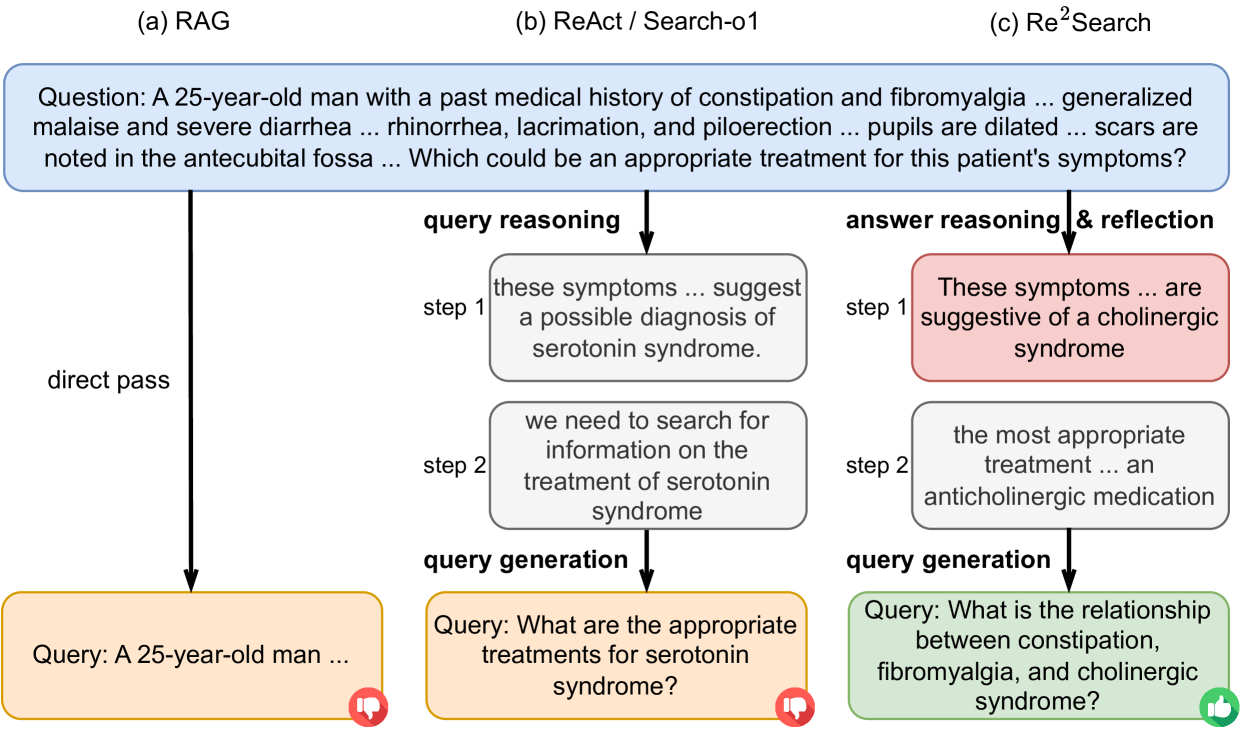
The image presents a flowchart comparing three different question-answering systems: RAG, ReAct/Search-01, and Re²Search. Each system processes a medical question about a patient's symptoms, illustrating their respective approaches to query reasoning, answer reasoning/reflection, and query generation. The flowchart highlights the steps involved in each system and the final query generated.
### Components/Axes
* **Titles:**
* (a) RAG (top-left)
* (b) ReAct / Search-01 (top-center)
* (c) Re²Search (top-right)
* **Initial Question (Top):** "Question: A 25-year-old man with a past medical history of constipation and fibromyalgia ... generalized malaise and severe diarrhea ... rhinorrhea, lacrimation, and piloerection ... pupils are dilated ... scars are noted in the antecubital fossa ... Which could be an appropriate treatment for this patient's symptoms?" (Presented in a blue rounded rectangle, common to all three systems)
* **Flow Direction:** Top to bottom, indicated by arrows.
* **Nodes:** Representing steps in the reasoning and query generation process.
* **Feedback Icons:** Thumbs up and thumbs down icons at the bottom of each system's flow.
### Detailed Analysis or Content Details
**System (a): RAG**
* **Process:** Direct pass from the initial question to query generation.
* **Query Generation (Orange):** "Query: A 25-year-old man ..."
* **Feedback:** Thumbs down (red).
**System (b): ReAct / Search-01**
* **Query Reasoning:**
* **Step 1 (Gray):** "these symptoms ... suggest a possible diagnosis of serotonin syndrome."
* **Step 2 (Gray):** "we need to search for information on the treatment of serotonin syndrome."
* **Query Generation (Orange):** "Query: What are the appropriate treatments for serotonin syndrome?"
* **Feedback:** Thumbs down (red).
**System (c): Re²Search**
* **Answer Reasoning & Reflection:**
* **Step 1 (Red):** "These symptoms ... are suggestive of a cholinergic syndrome."
* **Step 2 (Gray):** "the most appropriate treatment ... an anticholinergic medication"
* **Query Generation (Green):** "Query: What is the relationship between constipation, fibromyalgia, and cholinergic syndrome?"
* **Feedback:** Thumbs up (green).
### Key Observations
* RAG directly uses the initial question for query generation.
* ReAct/Search-01 performs query reasoning in two steps before generating a query focused on serotonin syndrome treatment.
* Re²Search performs answer reasoning and reflection, suggesting a cholinergic syndrome, before generating a query about the relationship between multiple conditions.
* The feedback icons indicate that Re²Search is considered the most appropriate approach, while RAG and ReAct/Search-01 are not.
### Interpretation
The flowchart illustrates different strategies for question answering in a medical context. RAG represents a basic approach, directly using the question to form a query. ReAct/Search-01 attempts to refine the query by reasoning about the symptoms and potential diagnoses. Re²Search goes further by reflecting on potential answers and generating a query that explores the relationships between different medical conditions. The positive feedback for Re²Search suggests that a more nuanced and reflective approach to query generation can lead to better results in complex medical question answering. The negative feedback for RAG and ReAct/Search-01 suggests that these approaches may be too simplistic for the given question.