\n
## Diagram: Comparison of Retrieval-Augmented Generation (RAG), ReAct/Search-o1, and Re²Search Approaches
### Overview
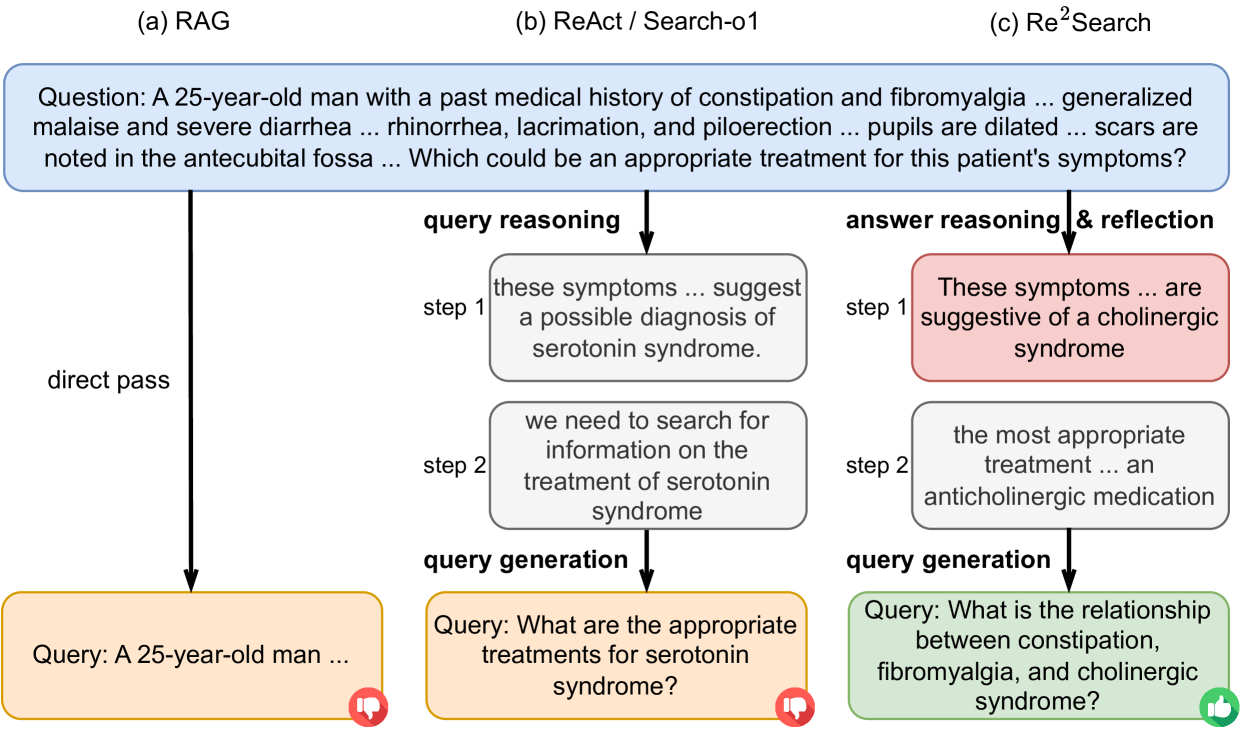
This diagram illustrates and compares three different approaches to answering a complex medical question: RAG (Retrieval-Augmented Generation), ReAct/Search-o1, and Re²Search. The diagram depicts the flow of information and reasoning steps within each approach, highlighting the differences in how they process the initial question and generate a final answer.
### Components/Axes
The diagram is divided into three main columns, labeled (a) RAG, (b) ReAct / Search-o1, and (c) Re²Search. Each column represents a different approach. Within each column, there are boxes representing steps in the process: "query reasoning", "query generation", and in ReAct/Search-o1 and Re²Search, "answer reasoning & reflection". Arrows indicate the flow of information. The initial question is presented at the top of the diagram. Each approach culminates in a generated query.
### Detailed Analysis or Content Details
**(a) RAG:**
* **Question:** "A 25-year-old man with a past medical history of constipation and fibromyalgia … generalized malaise and severe diarrhea … rhinorrhea, lacrimation, and piloerection … pupils are dilated … scars are noted in the antecubital fossa … Which could be an appropriate treatment for this patient’s symptoms?"
* **Process:** A "direct pass" from the question to the "Query: A 25-year-old man …" indicating a direct retrieval without intermediate reasoning.
**(b) ReAct / Search-o1:**
* **Question:** Same as RAG.
* **Step 1 (Query Reasoning):** "these symptoms … suggest a possible diagnosis of serotonin syndrome." (Box color: light blue)
* **Step 2 (Query Reasoning):** "we need to search for information on the treatment of serotonin syndrome" (Box color: light blue)
* **Query Generation:** "Query: What are the appropriate treatments for serotonin syndrome?" (Box color: green, with a thumbs-up icon)
**(c) Re²Search:**
* **Question:** Same as RAG.
* **Step 1 (Answer Reasoning & Reflection):** "These symptoms … are suggestive of a cholinergic syndrome" (Box color: light blue)
* **Step 2 (Answer Reasoning & Reflection):** "the most appropriate treatment … an anticholinergic medication" (Box color: light blue)
* **Query Generation:** "Query: What is the relationship between constipation, fibromyalgia, and cholinergic syndrome?" (Box color: green, with a thumbs-up icon)
### Key Observations
* RAG relies on direct retrieval, bypassing explicit reasoning steps.
* ReAct/Search-o1 involves reasoning to identify a potential diagnosis (serotonin syndrome) before formulating a query about treatment.
* Re²Search reasons towards a different potential diagnosis (cholinergic syndrome) and then formulates a query to explore the relationship between the patient's symptoms and this alternative diagnosis.
* The color coding (light blue for reasoning, green for query generation) is consistent across ReAct/Search-o1 and Re²Search.
* The thumbs-up icon on the query generation boxes suggests a successful query formulation.
### Interpretation
The diagram demonstrates a progression in complexity and reasoning ability among the three approaches. RAG is the simplest, relying on direct information retrieval. ReAct/Search-o1 adds a layer of reasoning to refine the search query. Re²Search takes this further by incorporating answer reasoning and reflection, leading to a potentially more nuanced and contextually relevant query. The difference in the queries generated by ReAct/Search-o1 and Re²Search highlights how different reasoning paths can lead to different information needs. Re²Search's query suggests a deeper investigation into the underlying relationships between symptoms, potentially leading to a more accurate diagnosis and treatment plan. The diagram effectively illustrates the benefits of incorporating reasoning and reflection into information retrieval systems for complex problem-solving tasks.