## Flowchart: Comparative Analysis of Information Retrieval Methods
### Overview
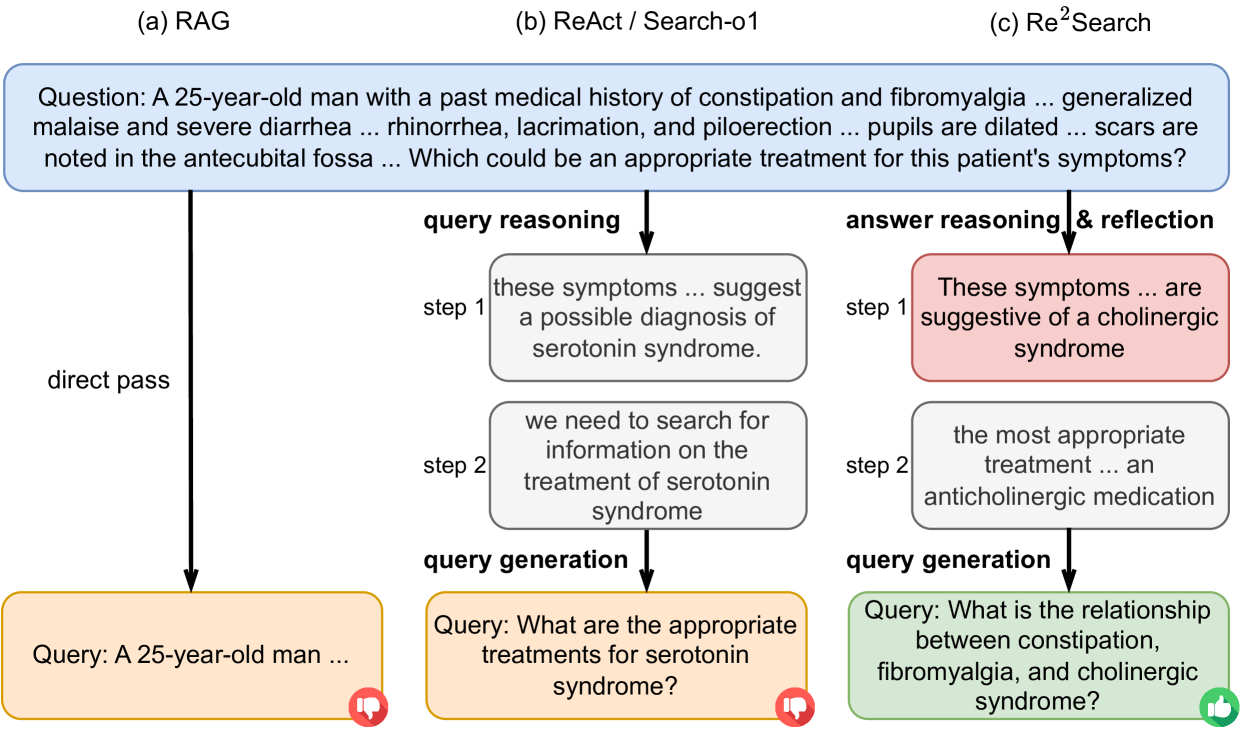
The image presents a comparative flowchart of three information retrieval methods: RAG (Retrieval-Augmented Generation), ReAct/Search-o1, and Re²Search. Each method is visualized through a sequence of steps demonstrating how they process a medical query about a 25-year-old patient with complex symptoms. The flowchart uses color-coded boxes (blue, gray, red, green) to distinguish between query reasoning, answer reasoning, reflection, and final query generation.
### Components/Axes
1. **Methods**:
- (a) RAG (left)
- (b) ReAct / Search-o1 (center)
- (c) Re²Search (right)
2. **Steps**:
- Direct pass (black arrow)
- Query reasoning (gray box)
- Answer reasoning & reflection (red box)
- Query generation (orange/green box)
3. **Color Coding**:
- Blue: Initial question
- Gray: Query reasoning
- Red: Answer reasoning & reflection
- Green: Final query generation
### Detailed Analysis
#### (a) RAG
- **Initial Question**: "A 25-year-old man with a past medical history of constipation and fibromyalgia ... generalized malaise and severe diarrhea ... rhinorrhea, lacrimation, and piloerection ... pupils are dilated ... scars are noted in the antecubital fossa ... Which could be an appropriate treatment for this patient's symptoms?"
- **Flow**: Direct pass to final query without intermediate reasoning steps.
- **Final Query**: "Query: A 25-year-old man ..." (truncated)
#### (b) ReAct / Search-o1
1. **Step 1 (Query Reasoning)**:
- Text: "these symptoms ... suggest a possible diagnosis of serotonin syndrome."
- Color: Gray
2. **Step 2 (Query Generation)**:
- Text: "we need to search for information on the treatment of serotonin syndrome."
- Color: Gray
3. **Final Query**: "Query: What are the appropriate treatments for serotonin syndrome?" (orange box)
#### (c) Re²Search
1. **Step 1 (Answer Reasoning & Reflection)**:
- Text: "These symptoms ... are suggestive of a cholineergic syndrome."
- Color: Red
2. **Step 2 (Query Generation)**:
- Text: "the most appropriate treatment ... an anticholinergic medication."
- Color: Red
3. **Final Query**: "Query: What is the relationship between constipation, fibromyalgia, and cholineergic syndrome?" (green box)
### Key Observations
1. **Method Complexity**:
- RAG uses a direct retrieval approach without intermediate reasoning.
- ReAct/Search-o1 introduces query reasoning to refine the search.
- Re²Search adds reflection to answer reasoning, leading to more nuanced queries.
2. **Color Progression**:
- RAG: Single blue box → direct pass.
- ReAct/Search-o1: Gray boxes → sequential reasoning → orange query.
- Re²Search: Red boxes → reflective reasoning → green query.
3. **Query Evolution**:
- RAG: Symptom description → direct treatment query.
- ReAct/Search-o1: Symptom → diagnosis → treatment query.
- Re²Search: Symptom → diagnosis → treatment → etiological relationship query.
### Interpretation
The flowchart illustrates a progression from basic retrieval (RAG) to increasingly sophisticated reasoning (ReAct/Search-o1) and reflective analysis (Re²Search). The Re²Search method demonstrates the most advanced approach by:
1. Correctly identifying cholineergic syndrome (vs. serotonin syndrome in ReAct)
2. Generating a query that explores etiological relationships between symptoms
3. Suggesting anticholinergic medication as treatment
This progression highlights how adding reflection to answer reasoning can lead to more accurate diagnoses and deeper exploration of symptom relationships. The color coding effectively visualizes the cognitive load and complexity of each method, with Re²Search requiring the most processing steps but potentially yielding the most clinically relevant queries.