\n
## Text Block: Cow and Human Tongue Interaction
### Overview
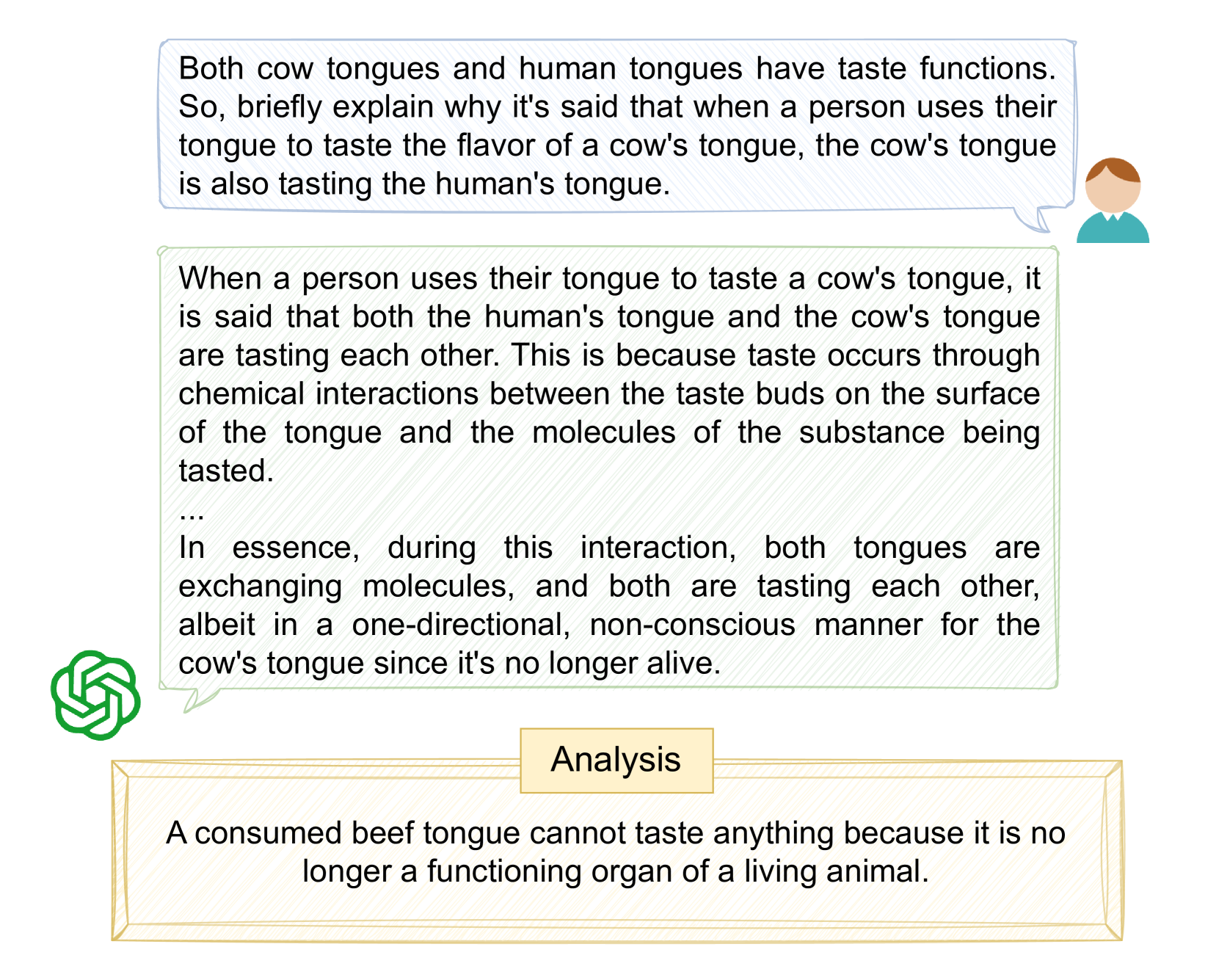
The image presents a block of text discussing the reciprocal tasting interaction between cow and human tongues, and a concluding statement about the inability of a consumed beef tongue to taste. The text is visually segmented with colored backgrounds and includes illustrative icons.
### Components/Axes
The image is structured into three main sections:
1. **Initial Explanation:** A block of text explaining the initial premise of reciprocal tasting. Background color: White.
2. **Detailed Explanation:** A longer block of text elaborating on the chemical interactions involved in tasting. Background color: White.
3. **Analysis:** A concluding statement in a yellow rectangle with the word "Analysis" prominently displayed. Background color: Yellow.
Additionally, there are two icons:
* Top-right: A grey icon depicting a human head and shoulders.
* Bottom-left: A green swirl-like icon.
### Detailed Analysis or Content Details
Here's a transcription of the text content:
**Section 1:**
"Both cow tongues and human tongues have taste functions. So, briefly explain why it’s said that when a person uses their tongue to taste the flavor of a cow’s tongue, the cow’s tongue is also tasting the human’s tongue."
**Section 2:**
"When a person uses their tongue to taste a cow’s tongue, it is said that both the human’s tongue and the cow’s tongue are tasting each other. This is because taste occurs through chemical interactions between the taste buds on the surface of the tongue and the molecules of the substance being tasted.
…
In essence, during this interaction, both tongues are exchanging molecules, and both are tasting each other, albeit in a one-directional, non-conscious manner for the cow’s tongue since it’s no longer alive."
**Section 3:**
"A consumed beef tongue cannot taste anything because it is no longer a functioning organ of a living animal."
### Key Observations
The text presents a somewhat counterintuitive idea – that a cow's tongue can "taste" a human's tongue during consumption. The text clarifies this is due to molecular exchange and chemical interactions. The final statement provides a logical conclusion, stating that a consumed tongue lacks the biological capacity to taste. The use of "…" suggests omitted text in the second section.
### Interpretation
The text explores the biological process of taste in an unusual context. It highlights the reciprocal nature of chemical interactions, even in a scenario involving a non-living organ. The text is attempting to explain a common, but often unconsidered, phenomenon. The inclusion of the "Analysis" section suggests a deliberate attempt to provide a definitive answer to the initial question. The text is not presenting data in a quantitative sense, but rather a conceptual explanation. The icons appear to be purely decorative and do not contribute to the informational content. The overall message is that taste is a chemical process involving molecular exchange, and that a dead organ cannot experience sensation.