## Code Snippet: Subset Transitivity Theorem
### Overview
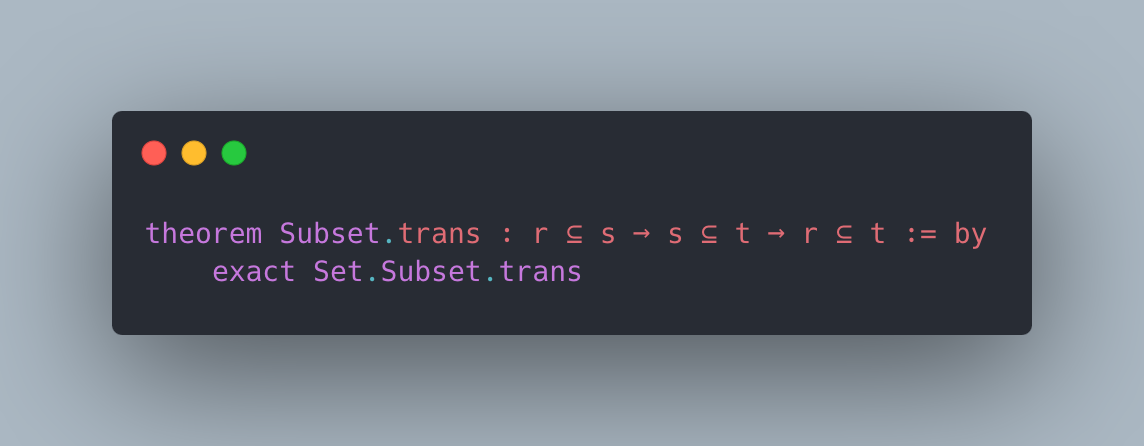
The image is a screenshot of a code snippet defining and proving the transitivity of the subset relation. It shows the theorem statement and the proof using the `exact` tactic. The code appears to be written in a proof assistant language, likely Coq or Lean.
### Components/Axes
* **Window Controls**: The top-left corner of the window displays three colored circles: red, yellow, and green, representing close, minimize, and maximize/fullscreen, respectively.
* **Code Text**: The main content is the code snippet, which includes the theorem definition and its proof.
### Detailed Analysis or ### Content Details
The code snippet consists of the following lines:
* `theorem Subset.trans : r ⊆ s → s ⊆ t → r ⊆ t := by`
* `exact Set.Subset.trans`
**Line 1 Breakdown:**
* `theorem Subset.trans`: Declares a theorem named `Subset.trans`.
* `: r ⊆ s → s ⊆ t → r ⊆ t`: Defines the theorem's statement. It asserts that if `r` is a subset of `s` and `s` is a subset of `t`, then `r` is a subset of `t`. The symbol `⊆` represents the subset relation, and `→` represents implication.
* `:= by`: Introduces the proof of the theorem.
**Line 2 Breakdown:**
* `exact Set.Subset.trans`: Provides the proof of the theorem using the `exact` tactic. It directly applies the existing theorem `Set.Subset.trans` to prove the current theorem.
### Key Observations
* The code defines a theorem about the transitivity of the subset relation.
* The proof is concise and relies on an existing theorem.
* The notation `r ⊆ s` indicates that `r` is a subset of `s`.
### Interpretation
The code snippet demonstrates how to define and prove a theorem about the transitivity of the subset relation in a proof assistant. The theorem states a fundamental property of sets, and the proof shows how to leverage existing knowledge to establish new results. The use of `exact` suggests that the proof assistant can automatically verify the correctness of the proof.