\n
## Line Chart: Test Accuracy vs. Communication Round
### Overview
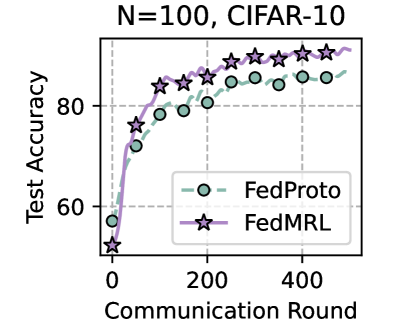
This line chart depicts the test accuracy of two federated learning methods, FedProto and FedMRL, over a series of communication rounds. The chart is titled "N=100, CIFAR-10", indicating the dataset and potentially the number of clients involved.
### Components/Axes
* **X-axis:** Communication Round (ranging from 0 to approximately 450, with tick marks at 0, 200, and 400).
* **Y-axis:** Test Accuracy (ranging from approximately 50 to 95, with tick marks at 60, 80, and 90).
* **Data Series 1:** FedProto (represented by a dashed light blue line with circular markers).
* **Data Series 2:** FedMRL (represented by a dashed purple line with star-shaped markers).
* **Legend:** Located in the bottom-right corner, labeling the two data series with their corresponding colors and markers.
* **Title:** "N=100, CIFAR-10" positioned at the top-center of the chart.
### Detailed Analysis
**FedProto (Light Blue, Circles):**
The line representing FedProto shows an initial steep increase in test accuracy from 0 to approximately 100 communication rounds, reaching around 75% accuracy. The slope then gradually decreases, continuing to rise but at a slower rate.
* At Communication Round 0: Approximately 55% accuracy.
* At Communication Round 100: Approximately 75% accuracy.
* At Communication Round 200: Approximately 83% accuracy.
* At Communication Round 300: Approximately 87% accuracy.
* At Communication Round 400: Approximately 90% accuracy.
* At Communication Round 450: Approximately 91% accuracy.
**FedMRL (Purple, Stars):**
The line representing FedMRL also exhibits a rapid initial increase in test accuracy, but it appears to be slightly faster than FedProto. It reaches a higher peak accuracy than FedProto.
* At Communication Round 0: Approximately 50% accuracy.
* At Communication Round 100: Approximately 80% accuracy.
* At Communication Round 200: Approximately 88% accuracy.
* At Communication Round 300: Approximately 92% accuracy.
* At Communication Round 400: Approximately 93% accuracy.
* At Communication Round 450: Approximately 94% accuracy.
### Key Observations
* FedMRL consistently outperforms FedProto in terms of test accuracy across all communication rounds.
* Both methods demonstrate diminishing returns in accuracy as the number of communication rounds increases. The rate of improvement slows down significantly after 200 rounds.
* Both methods start with low accuracy (around 50-55%) and converge towards a high accuracy (around 90-95%).
### Interpretation
The chart suggests that FedMRL is a more effective federated learning method than FedProto for the CIFAR-10 dataset with N=100 clients. The faster initial convergence and higher peak accuracy of FedMRL indicate that it can learn more efficiently from the distributed data. The diminishing returns observed in both methods suggest that there is a limit to the benefits of continued communication after a certain point. This could be due to factors such as data redundancy or the saturation of model capacity. The initial low accuracy suggests that the models start with limited knowledge and require a significant number of communication rounds to learn meaningful patterns from the data. The difference in performance between the two methods could be attributed to differences in their algorithms, such as the way they aggregate local model updates or handle data heterogeneity.